

Traditional Crafts:
In spite of the development and progress achieved by Omani society in all aspects of life, the preservation of the Omani heritage is a fundamental pillar of the modern state and a distinctive feature of the Omani society. Heritage is an essential element in the formation of national identity. Despite the tremendous development of tools and means of production.
Omani crafts include:
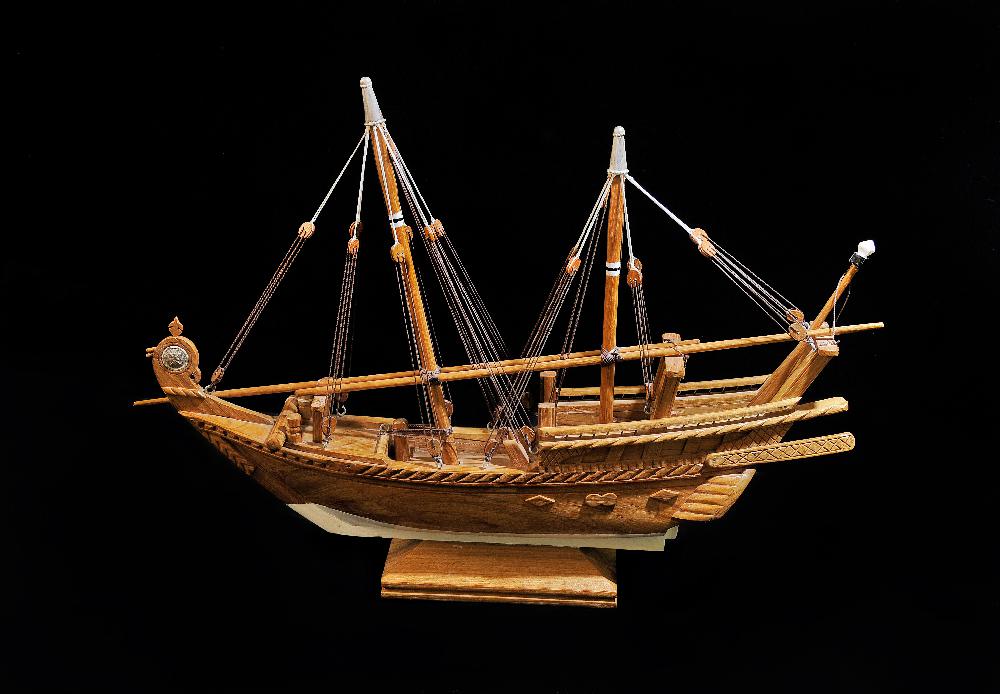
Ship (Dhow) Building
Oman's connection with the sea stretches back many centuries when Omani sailors using mast and sail, pioneered sea routes to the cities of the ancient world. Favorable factors were Oman's position at the crossroads of shipping routes which linked the Arabian Gulf to India, the Red Sea and East Africa and her knowledge of shipbuilding.
Oman became the first non-European country to extend its influence to Africa where it remained for hundreds of years, due mainly to her ships/dhows. Oman was an important maritime and political power who established relations with China, Great Britain, France, the Netherlands and the United States of America. Throughout its long history, Oman's navy has played a key role in the country's economic success, both in providing the instrument for internal and external trade and in underpinning fishing and pearling activities. The Omani warship "The Sultana" which anchored in New York harbour in 1840, bearing gifts from Sultan Said bin Sultan to the American President, was a symbol of the greatness of the Omani fleet at that time.
In Oman two techniques are used in shipbuilding. In the first, timbers are laid side-by-side and pierced at intervals with a fine hand drill. The timbers are then bound together through these holes by means of rope made of coconut fibre and the holes covered with a mixture of fibre or raw cotton soaked in fish, coconut or sesame oil. Arab geographers such as Al Idrissi and Ibn Jubair believed that boats bound with fibres and with flat hulls were safer than those fitted together with rigid iron nails because if they ran onto rocks or came into contact with another hull, they were more flexible. In the second method, nails are used and in essence this is the same technique as used in other countries of the Arabian Gulf and Red Sea.
The main type of wood used for the hull and keel is teak which is imported from India. The ribs are made from locally available woods such as qart, sidr and sarar. The tools used in a ship's construction are simple and basic such as the hammer, saw, awl, bow drill, chisel, plane and calking iron. The principal shipbuilding yards in Oman were Sur, Mutrah and Shinas.
Omani ships, which can last for 60-100 years, are distinguished by their variety of types although some are no longer made. The largest type was the ocean-going cargo vessel, the baghlah with a length of 135 feet and a load capacity of 150-400 tonnes which could be distinguished by its high poop deck and quarter galleries, its transom stern being pierced by five window apertures and often elaborately carved. The ghanjail was very similar to the baghlah, and is considered by many Omanis to be the most beautiful of the large dhows.
The sambuuq used to be one of the most commonly seen Arab vessels: its distinguishing features are the low, curved, scimitar-shaped stem piece and high square stern which lacks a quarter gallery.
The word sambuaq used to denote the sewn boats of the Dhofari coast, and may therefore be a term of great antiquity.
The government is keen to encourage the maritime tourist industry, in restoring old ships, increasing the use of large vessels/dhows for sea fishing, and also the building of small models of Omani ships for decorative purposes and for i participating in exhibitions.
HALWA
Omani halwa (sweet) is famous at home and abroad as a symbol of traditional Omani hospitality. It is usually served in Omani homes before drinking Arabic coffee.
The main ingredients which go into the making of halwa are: starch, eggs, sugar, water, ghee, saffron, cardamom, nuts and rose water from the Jebel al Akdhar. The ingredients are mixed, in proportions and quantities known only to the skilled halwamaker, and cooked in a mirjnl (large cooking pot used especially for halwa) for a time of not less than 2 hours.
The cooking can be done over a gas or electric stove, but the preferred method is over a wood fire made up of snmr wood, known for its durability, smoke and odourfree properties.
After cooking, the halwa can be preserved for more than four months without losing its quality, and without the need for refrigeration or preserving agents.
Halwa is usually served in a dist, a large earthenware bowl, which can vary in size and composition according to demand or type of occasion. The list can also be made of metal or plastic. Halwa is invariably served at times of joy or sorrow and, on religious occasions and festivals. It graces the tables of every Omani home.
Bee keeping
Beekeeping has been practised since ancient times in Oman. The subject of honey is mentioned in the Holy Koran sura 'The Bee' in ayyats 68 and 69: And the Lord taught the Bee to build its cells in hills, in trees, and in men's habitats; then to eat of all the produce and find with the skill the precious paths of its Lord: there issues from within their bodies a drink of varying colours, wherein is healing for men; verily this is a sign for those who give thought.
Oman has a varied landscape represented in its dried-up river beds, hills, plains and deserts in which flourish the plants and trees which provide the honey bee with the nutrients it requires: palm trees, coconut palms, cereals, limes, vegetables, sugar cane, frankincense and gum trees.
In particular the samr, sidr, and ghaaf trees, coconut palm, prickly pear and papaya trees provide the principal ingredients which give Omani honey its distinctive flavour.
Two types of bees are known in Oman: Apis millifera and Apis florea.
The specialist bee keepers of northern Oman have developed great skill in obtaining honey and propagating bee colonies in a sustainable manner.
In Northern Oman the larger honey bee was traditionally kept in hollowed out trunks of date palms, locally known as tubl. When bee keepers require honey they cut from the back of the tubl. Modern methods of bee-keeping have now been introduced into Oman and honey production efficiency has been greatly improved.
The Ministry of Agriculture and Fisheries has imposed a strict ban on mixing Omani and imported strains of bees.
His Majesty's government provides veterinary services, advice, and material support to all Omani beekeepers.
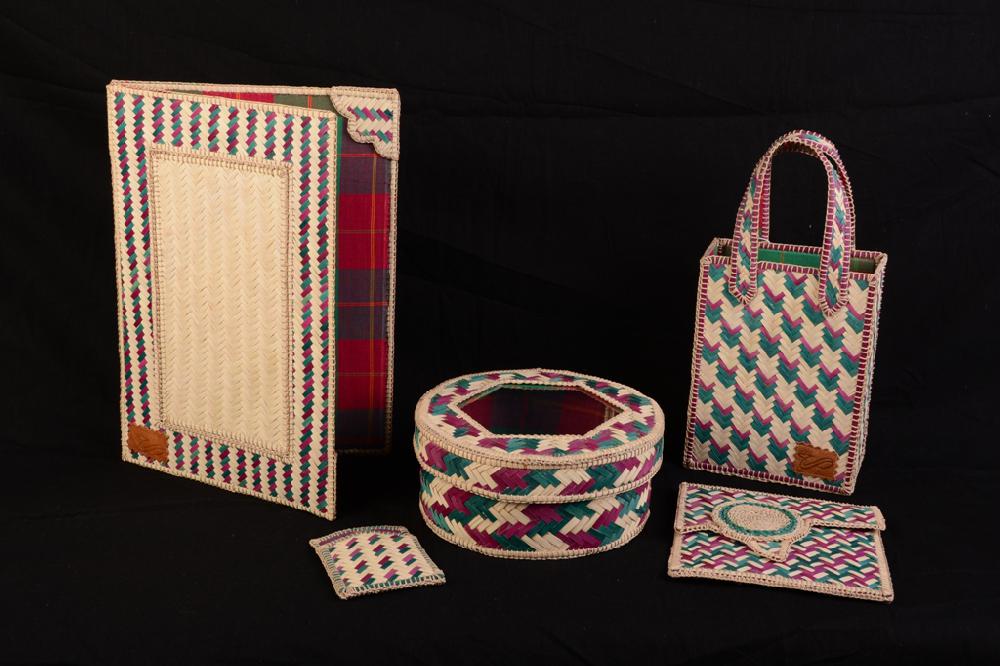
Palm leave products
The Palm leave products depends on palm trees. There are Al Khaws (palm leaves), the Zawr (palm branches stripped of their leaves), the palm trunk and the fibre. For example, mats(rugs) are made of the two plants called Al Ghadf and Al Rusul which grow on the valley banks where there is an abundance of water.
Governorate of Musandamis renowned for its palm leaf industries, such as utensils (Al Surood and Al Makba) which are made from palm leaves. Al Surood is a mat-shaped tray known as Sama, used with food to protect it from insects, while Al Makba fulfils the same purpose.
The Pottery
The art of pottery-making is an inherent and distinct testimony to the world’s civilisations as it reflects the extent of their development and advancement.
Though pottery-making is one of the simplest forms of art because of its primitive nature, it is in fact, one of the most difficult trades because it involves a form of art.
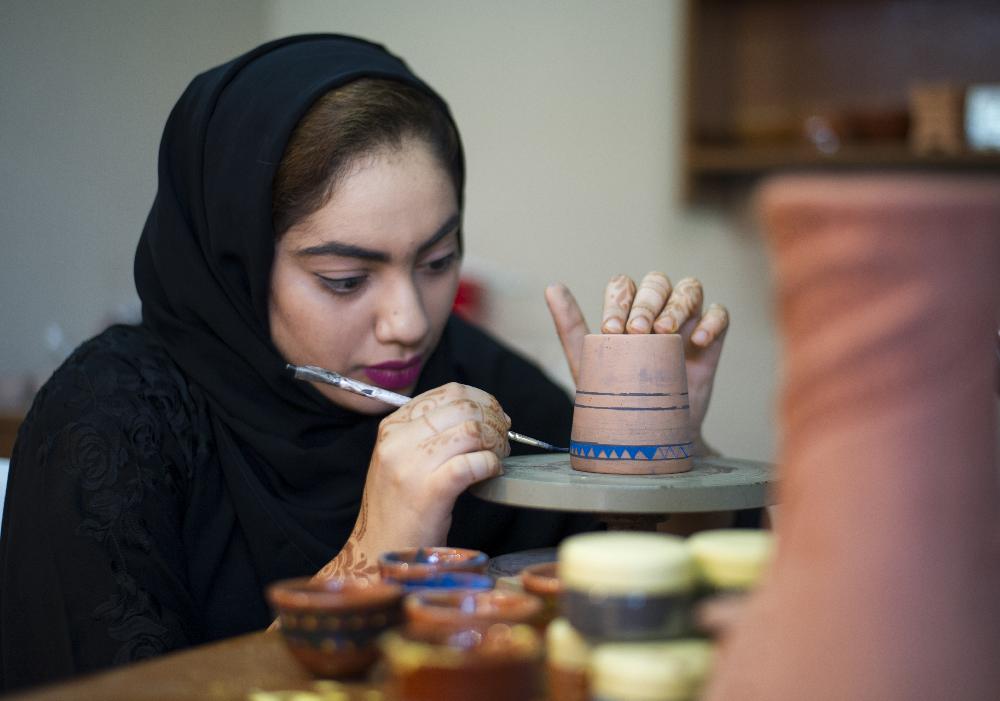
Pottery-making in Oman is considered an ancient industry. The reason it has attracted much interest can be attributed to the multitude of its uses in Omanis’ daily lives. Bahla in A'Dhahirah Governorate is the most famous town for pottery-making in Oman.
Pottery is of many kinds and shapes, and its uses and manufacturing materials vary. The pots known as jihal are used for keeping water, the red pots with a thick layer known as khuroos are used for keeping water and dates, the small ones are for keeping honey and grease and the pots known as brams are used as cooking utensils. Pottery is also made as coffee pots and thermoses.
Clay is the main component of Pottery and is widely available in Bahla in A'Dhahirah Governorate, where the soil is rich in clay.
DISTILLATION OF AROMATIC PLANTS INDUSTRY:
Aromatic Plants contain oils most of their . Such oils are found in flowers like roses and jasmine, and in leaves such as date palm spadix, and in seeds such as alshua and alqafs, and roots such licorice root, and in stems such as alalalan wood. There are many ways of extracting aromatic/ volatile oils, including distillation, squeezing and pressing and melting. The method of extracting aromatic oils in Oman is based on evaporation of such oils with the as their boiling temperature decreases when they are mixed with with water.
Extraction of some aromatic plants oils and water is an old and important activity for the inhabitants of Aljabal Akakhdar.It has been practiced there as a leading craft for a very long time due to the favorable climatic conditions (moderate in summer and cold in winter), as the area is about 4500-5500ft above sea level . The region is covered by green farms and orchards throughout the year.
Roses constitue an importing product of Aljabal Alakhder and contribute considerably to the farmers income due to their medical value, Roses are grown on the mountain terraces and irrigated by alaflaj water. they are widespread particularly in saiq, Alshiraiha and alhuema, as well as in Nizwa and some other parts in Aldakhliya.
Distillation of rose water
PERFUMES AND COSMETICS INDUSTRY:
There are many perfumed that are blended and mixed secretly .The scent is the essential component of the perfume and the incense is the nice smell of the perfume .It an important part of life of both Arab men and women .It is generally known that perfume making craft is limited to certain families, generation .
Incense is one of the essentials of the Omani house , as it is considered the perfume of clothes and the house , as well .Here in the Sultanate of Oman . we find many kind of incense , some of which are used without additives , although the majority is mixed with other perfumes , in which case it is called almasluha . Incense craft is largely associated with women.
Frankincense has been a principal component of incense over centuries . Frankincense is produced by a tree called boswellia , and the best
frankincense quality is found in Dhofar where the relative humidity is ideal for this kind of trees . The boswellia tree has thick branches and
green dark leaves .It about 3-5m .tall .The tree has milk glands the rating substance . The tree begins to produce such substance after 8-10years of growth. The frankincense has been used in religious rituals and as medical treatment , and is an integral part of the Omani social
life
COTTON TEXTILE INDUSTRY:
Textile industry is the art of making fabric by weaving threads on the loom. The fabric consists of long thread known as 'alsadi or alsada' (warp), with other threads, known as alluhma' (weft) are passed over and under. Fabrics vary in appearance and texture. During the weaving process, a group of alsada (warp) threads disappear under one of the luhmat (weft) and vice versa. Therefore, the warp threads are divided into two groups in accordance with the disappearance and appearance process:
The first: the single threads, and The second: the double threads.
The threads of each group appear and disappear together, and when the single threads appear, I.e.come up and are separated from the double threads, a space is formed to allow the weft threads pass into them, alternately to weave the simplest and most commonly used kind of fabrics, called the plain fabric. The craft instructor is considered the top of the textile craft hierarchy, followed by his deputy, who is called 'almuaawin' (assistant) and 'alshaghird', who moistens the weaving threads with water and takes part in the weaving process.
The person wishing to learn textile craft may need a training period of six months or even a whole year to master the craft. The weaver must be patient, diligent and sharp-eyed. When a trainee completes the training period successfully, a celebration, attended by the relevant craftsmen in the town, is made in honor of such trainee.
BONE CARVING INDUSTRY:
The bone cutting and shaping process is the most critical stage as the accuracy and quality of the product depend on it .Craftsmanship requires the display of detailed inscriptions on the long , circular and rectangular beads , together with the creation of some other designs according to the customers wish. Also , the bone piercing process must be gone through very carefully to make the channel through which the thread is passed to lace the necklace1 . Artisans involved in this craft various women accessories , including kohl containers , trinkets , etc ,and designed many ornamental items used by women in the past , such as aldor , alshibas , pins and necklaces .
Many archaeological sites witness that the inhabitants of the Arab peninsula made use of bones in their ancient arts . Antiquities including articles made of bones and ivory , including bracelets , rings , earrings , hangers , etc were found on these sites . Bones were also used for writing on . This is evidenced by bones written on in black ink , discovered in many locations in the Arabian peninsula
COPPER AND METALS INDUSTRIES:
Copper industries are the crafts of fabricating copper in the service of man in all walks of life. The person practicing such industries is known in some Arab countries as coppersmith and in others as bras smith. He carries out the making, repair and polishing of all brass products. In Oman such person is known as bras smith. Brass products are too many and variable ,in teems of form and functions. Most of these products constituted for centuries the main household ware and vessels, as ornaments and weapons. Hence, copper has so far been of both utility and aesthetic value.
Metal smelting techniques were known in the ancient Near East. Archaeological discoveries have revealed that copper ores have been known since the Fourth Century B.C. Man might have discovered copper by chance in pottery ovens. Copper is mostly found as natural raw material in blue rocks. The use of copper was anciently very limited before it became widespread round about 2900 B.C. when it began to be used in making vessels, mirrors , women ornament boxes, fishing hooks, chisels, khanjars and axes. Later on, craftsmen in ancient world began making their tools and other articles , such as swords, axes etc .. From bronze.
There are many convincing indications that copper mining in Oman has been practiced since very early times. Some copper articles were found in Arja. The antiquities discovered in ancient Oman sites in Wadi Aljizi, Massira Island and other locations witness that the Omanis were acquainted with mining , especially copper mining , and they were skilled in making weapons and other different articles they needed in their everyday life. More than sixty copper mines and smelting ovens have also been found in different places in the mountains of Oman.
It has learnt that copper ore was first smashed near the mine, then ground with millstones and burned under a very high
temperature to purify it from impurities. The smelted metal was then collected in basins facing the ovens, and then transported to manufacturing places. The fuel used by ancient people in their smelters was wood and bellows to initiate to blow fire .The produced copper needed special treatment in special ovens order to be suitable for the production of bronze. Some of that copper was exported to Mesopotamia via Dalmon, as Majan was the main source of such metal.
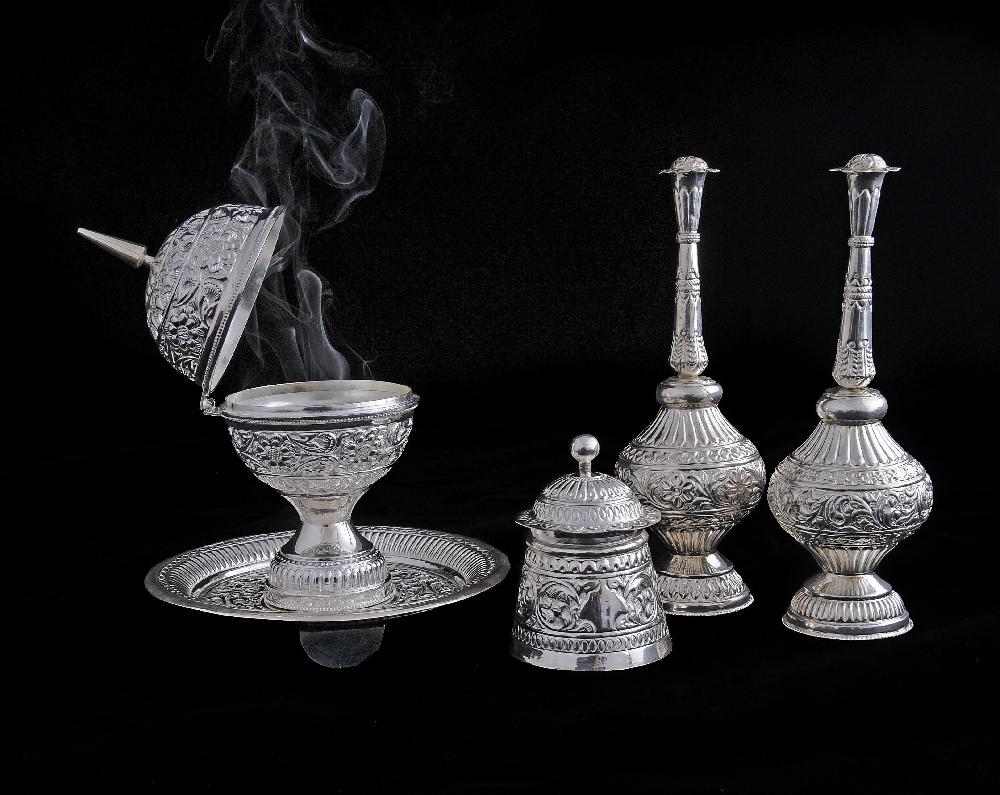
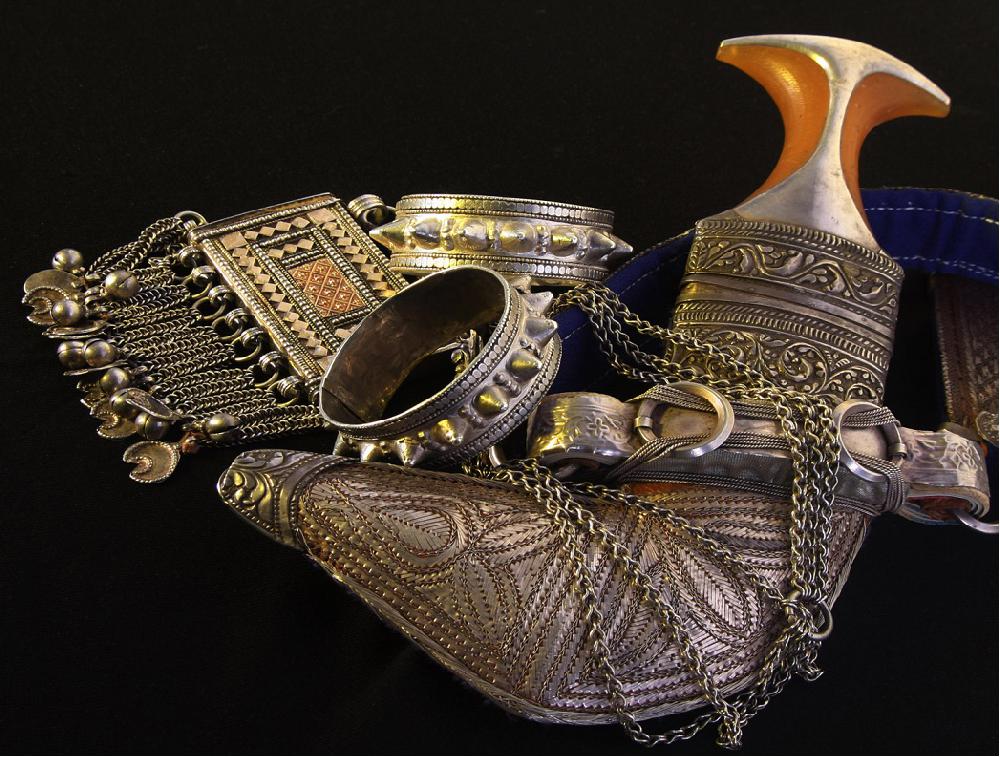
SILVERWARE INDUSTRY:
Silverware industries are the most important and widespread metal industries in Oman. These industries are mastered by the Omanis who have inherited them generation after generation.
The oldest trinkets in Oman were discovered by archaeologists in Ras Allhamra where they discovered female skeletons adorned with trinkets consisting of rings, bracelets and necklaces made of shells with eardrops in the form of plant leaves hanging down from them. They go back to the 4.Century B.C. Also many silver pieces were found in other places. The white bright color of silver, its being easy to shape and resistance to oxidization have enabled it to become an essential element Silver had had prominent position in ancient in ancient times as evidensed by the archaeological discoveries related to what is known as the Ancient Near East Civilizations.
CARPENTERY AND WOODWORK INDUSTRY:
Oman has been practicing shipbuilding industry for decades. The history of the ancient Near East had established Oman's precedence in connection with maritime activities when it confirmed the frequent arrival of the Majan (Oman) ships in Mesopotamia in the Third Century B.C., in more than one text. Majan was a maritime country, with a long coastal line, highly skilled in navigation and shipbuilding. Its ships sailed as far as Akkad, according to the texts of the Akkadian King, who ascended the throne under the name of Shrukeen or, in other words, the ships built of the wood of Majan and with the hands of its men sailed up the Euphrates to beyond Akkad, the capital. In the long reign of King Nram Sin, which extended for 36 years, it was said that the sovereignty of his kingdom greatly extended and he benefited from the diorite quarries of Majan. And during the reign of Gudia, the King of Laqash, in the beginning of the 21st.Century B.C., inscriptions belonging to that reign referred to commercial relation between his kingdom and each of Syria, Ailam, Bahrain and Oman. Such inscriptions also stated that the king of Laqash imported coloured stones, minerals of different values and wood by road, river and sea from the lands of Majan and Malokha for Laqash Temple in particular.
This confirms the fact that there existed a considerable maritime Omanitrade in copper, shells, shark skin, wood, azurite and diorite stones which were loaded from the Omani ports to Sumer. However, Majan trade relations were not confined only to Mesopotamia, it had contacts also with the sind valley. In the light of Oman subsequent history in connection with its interaction with the sea, it is established that the people of Majan were famous seafarers, and Majan was more famous than Dulmon and its ships, and Majan ships might be similar to the Chinese ships that participated in the trade of the Far East at the time, as Oman had made a certain type of boats known as the (sewn boat) i.e. its planks were sewn together without using nails. It is still widely used in the Omani water.
The Omani maritime activities in the periods of strength and boom were not confined only to the economic field, but such activates covered also the maritime role and status of the second half of the 19th Century. The Arabs mentioned in their poetry and books many types of ships and relevant terms and expression, such as alkhaliya, alghurab, alsndal, albarha, alhoori, alfaluka, alkhashab, alustool, altarasana, aljuajua, alkawthal, alsakkan, alshiraa, aldugul, algalfata, alungur, alganook, alkumkum, alnoti, alrubban, alnalhtha, ameer albahr, alkhun, etc..
Robinson, said, commenting on Muslims: 'wherever they landed, they paved roads, built ports, maintained hotels and organized caravan routes. The Islamic cities and towns were major trade centres, and they interested themselves very much in shipbuilding. When they came, they used to dominate and control the coastal towns between Antakya in the north and the coast of Barqa in the west----- the towns frequently attacked by Byzantine ships---- and as those towns were short of ships, the Khalifa Omaer Bin Al-Khattab adopted a defensive maritime strategy based on repairing the forts and castles extending parallel to the coast, and protected it for the safety and security of traders. As the northern parts of the Gulf were shallow, the Abbasid State erected wooden lighthouses to guide ships away from the shallow places.
The Arabs adhered to such policy until they established themselves in Syria and Egypt, when they aspired to match the Byzantines in their offensive maritime strategy and, consequently, established the ships of the Arabian Gulf were distinct in terms of their types and shapes. Their bodies end with a sharp front and end, such as albadn, abloom, albateel and albaqara. The sailors there used ropes instead of nails in building their ships. When Marc Polo saw the Arabian Gulf ships in Hormuz in the 13th. Century A.D., he said, they have no iron nails; their planks are joined with ropes made of palm fiber.
The ships themselves are strong and cannot be affected by sea water; however they cannot resist storms for long. The ships are not painted with tar; they are painted with fish oil. They have one mast, one sail and one rudder. They have neither deck nor cover to stretch over the ship. They have no iron for making nails; therefore they use wooden nails in building their ships.
Shipbuilding in the Sultanate of Oman is one of the oldest, most important and most widespread crafts ever known by the Omanis. This, in fact, is attributable to the location of Oman in each of the Indian Ocean, the Arabian Sea and the Arabian Gulf, with a coast line extending to over 1700km. The People of Oman, therefore, had no alternative but to coexist with the sea since very early in history. They became, through time, daring seafarers who sailed far away to distant lands and ports and, hence, the maritime activities have become the most important activities the Omanis have ever practiced.
The Omani maritime activity, especially in the periods of prosperity and strength, was not limited to trade and economy, but it was linked to the Omani State and its maritime role and status. Therefore, the Omani fleet in the first half of the 19th century was one of the most important and powerful fleets in the Indian Ocean. Moreover, Oman has contributed much to the development of navigation laws and the improvement of navigation instruments and equipment through many of its renowned scientists, such as Ahmed Bin Majid.No wonder then that Omani ships and sailors reached African and Asian ports, as well as the ports of the Mediterranean sea, centuries ago, and Washington in North America more than 150 years ago.
The Omanis also sailed as far east as china and other ports in South East Asia. Still the Omani sails and masts challenge sea waves to all parts of the world, especially after the revival of the Omani seafaring activities in 1970. In 1996, the Omani ship 'sohar' memorial was inaugurated in the Chinese port of its arrival to that port.
POTTERY INDUSTRY:
Pottery is any object, such as pots, dishes ,cups, ets. Made with clay, which is composed of very tiny alluvial particles of less than, 002. In size, that is baked in the oven to become solid, especially when they are made with hand. Such particles result from the disintegration of the earth rocky crust and stick together when they lose water, though they remain. The potter produces from both clay and porcelain different vessels, such as dishes, pots, cups, ets either with his hand or on the rotary wheel. Then the products are left to dry under the sun and thereafter baked in the oven. As for porcelain, is product made of the dame clay added to it sand and white alumin as supplementary materials.
Pottery craft industry is one of the prominent illustrations of the ancient world civilizations as it indicates clearly their cultural developments. Pottery industry was very common in the ancient world civilizations since pre-historic epochs. In Egypt, for instance, such industry was known since the existence of the ancient Egyptians in the Nile Delta and Nile Valley. Therefore, archaeologists could trace back the chronological order of civilization through pottery, by studying the modes of its making and the decoration it carried before inscription became common. The most ancient pottery objects were made by hand and left to dry under the sun. however, after the discovery of fire, they were burnt to become more solid and durable. Later, after the invention of the rotary wheel by ancient Egyptians, pottery objects came out decorated with coloured animal and plant pictures, as well as geometric shapes.
Pottery industry is one of the traditional inherited crafts in the Sultanate of Oman since very early times. The Omani craftsmen took interest in pottery due to the multitude of it uses. They were encouraged to carry out such industry by the availability of the suitable loam. The archaeological excavations in each of Bat village, near Ibri town, and Alarjaa in wadi Aljizi, near Sohar, and Alakhdar village in Wadi Samad have proved that pottery industry was widespread in these areas even in the fourth century B.C. Such excavations have indicated that pottery vessels were made there in a very developed style similar to what was found in the region by that time. Moreover, the excavations indicated that the pottery industry in these areas was contemporary to the ancient Sumerian Civilization in Mesopotamia, such as Ur and Jamdat Nasr regions. It was influenced by the pottery industry techniques existing then in Southern Persia, which evidences the existence of old trade relations between Oman these regions.
There were found in a hill near Bisya, to the south of Bahla, pieces of pottery vessels. Some of them were thick similar to those discovered in the excavations at Ras Alhad Port, which similar in turn to those found Gidi and Lamu Islands in East Africa, or Siraf overlooking the Persian Sea. The vessels discovered in Bahla indicate the interlacement of relations between Oman and the regions of international trade, via whose ports used to pass the goods of Eastern trade, and the interlacement of relations and mutual interests between the interior of the country and its coasts. Pieces of pottery found at the mouth of Wadi Bani Kharrous (on the coast of Albatinah between the two cities of Almusanaa and Barka), were found to be similar to those found in Samarra in Iraq, Siraf in Persia and Yemen. This is good evidence that Oman was a meeting point of different civilizations where they were fused in its melting pot. For instance , in Bahla factory the rotary wheel and the mould were similar to the ancient Sumerian technique, Soor Alsawadi factory in Saham was influenced by the Persian style in terms of the mould and the oven where pottery was burnt while Musallamat (a village in Wadi Almaawil) factory combined both the Sumerian and Persian styles. Also pieces of pottery vessels in green colour mixed with greenish colour and other glazed ones on this site
LEAVES INDUSTRIES:
The industry of many useful traditional products depends on date palms. This has been the case for centuries. people use all kinds of palm in making baskets and other leaves products all over Oman.
The people in both rural and urban regions care very much for palm trees and benefit by their products. Bedouins , living outside villages , live in houses made of palm leaves during summer season and date harvest.
The Omanis make use of all parts of the date palm in a useful , productive craft. the ‘ zoor ‘ of the date palm is used in making different kinds of cages and in strengthening certain items such as the frames of food covers and in many other things . on the hand , the trunk of the date palm is used for building purposes , particularly as roof beams , and is also used in making char coal and making fire to prepare ‘ sarooj ‘ ( clay ) and the lime used in painting walls . The fiber obtained from the trunk is use for making roper, handles of baskets , cleaning vessels and lining of camel saddles.
Palm leaves industries are the most ancient craft industries that depend mainly on the products of the date palm.Besides , the Omanis depended largely on the date palm : It provide them with food ,shelter , furniture , vessels , boats , fuel , ropes and many other things.
ALSAROOJ ( THE OMANI CEMENT )INDUSTRY:
Alsarooj is a kind of clay burned at a a certain . Alsarooj (gypsum) is produced from almal or almuqata clay . It was used earlier in construction works . Alsarooj craftsman has to choose appropriate place from which he can obtain the good soil for making alsarooj , and which must be free of salinity and preferably mixed with gravels the help alsarooj be more consistent . Alsarooj is used for construction instead of cement . The Omanis also used alnora (lime) , made from white stones and sands in a similar way as alsarooj , in painting buildings.
Alsarooj industry has been known in Oman for a long time as there is evidence that it was used in pre-islam eras in the construction of certain forts . It has occupied a prominent position among the building materials of the Omani architecture as evidenced by old mosques, houses , forts and castles . The authorities responsible for the protection of such buildings preserve such old buildings by using alsarooj in maintaining and repairing them till now.
LEATHER INDUSTRY:
Means animal skin tanning by putting the skins in a pottery vessel, big enough to accommodate, at least, 25 skins. A quantity of dates and salt are added and left for a period of 5-10 days. The skins are then taken out in preparation for removing wool by stuffing the skins with the fruits of ‘alqart’ tree, salt and water. The skin is then blown and fixed on a wooden board for 5 minutes until it is free of wool and ready for use in different leather crafts.
Tanning craft, on which leather crafts depeds, has been practised for many defaces. Tanning is “the tanning of animal (catthe, sheep, etc.) skins by using certain materials.” Tanners have used different materials. Some of which are primitive, and treated skins before tanning through many processes to patch, clean and polish it. Such processes start immediately after the slaughter of the animal and stripping off its skin. Then the skin is taken by shoemakers and other craftsmen for tanning.