
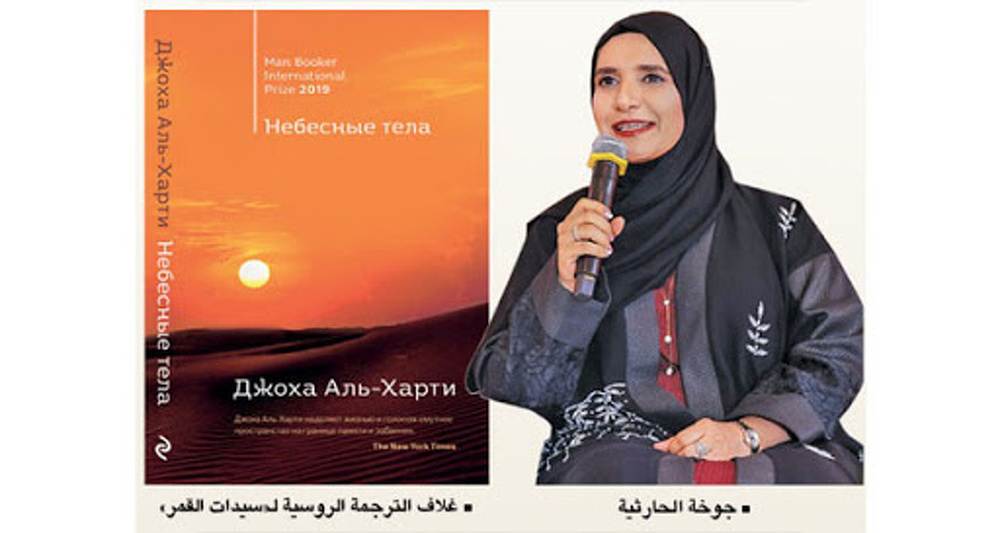
Moscow,ONA) - The Russian translator Victoria Zaritovskaya said that Omani writer Jokha Al-Harthi's novel, Celestial Bodies, is an “unusual” novel for foreign readers, because it talks about a country that is not known enough to them and delves deeply into the traditions, customs and beliefs of Omani society.
On the occasion of the release of the Russian version of the novel that won the Man Booker Prize for 2019, Zaritovskaya added that qualifying to compete for this award is extremely difficult, as it passes through a series of stages that start with obtaining literary work in presence and readability at the regional level, justifying its translation into English, and then the translator worked professionally to preserve the warmth of the original text, to avoid an ill-considered abbreviation, and to highlight the novel as a new work worthy of reading in the culture to which it is transmitted, and in the end, after the work completes its arduous journey to reach the short list, the confrontation with the other nominees begins.
Zaritovskaya revealed that the Polish writer Olga Tokarczuk, winner of the Nobel Prize for Literature 2018, was one of Al Harthi's competitors for the award.
The translator, who was a member of the jury for the International Prize for Arabic Fiction for 2020, added that Celestial Bodies’ award has prompted major international publishing houses to translate it, including the Eksmo Publishing House, which is the largest of its kind in Russia.
According to Zaritovskaya, who works as a professor of Arabic at the Russian University in Moscow, “the text of the novel, in which the author used a technique that belongs to the stream of modern consciousness, is mosaic, full of secrets, as it awaits you on every page a turn you did not expect.”
She added, “On the other hand, this novel does not close to its world, as we see in it the influence of globalization and modernity that overwhelms contemporary life, and this is a common issue that contemporary man lives everywhere. Jokha Al-Harithi put the aspects of globalization at the test of her novel, and among these manifestations is the so-called generational struggle, which we see in the vibration of the common language between one generation and another in light of the successive economic changes. The author also poses the question of society’s adherence to the human essence in the face of the phenomenon of globalization.”
Zaritovskaya expresses great hope that the translation of the novel Celestial Bodies will open a new door for Arabic literature in Russia, and that a quantum leap will be made in this field. Literature translated into Russian since the time of the Soviet Union, such as Naguib Mahfouz's novels and Taha Hussein's books, has not spread among readers for reasons that can be attributed to “poor distribution”, the cultural gap between the style of the Arab pioneers and the Russian reader, and the level of translation.”
She points out that reading the current Russian cultural scene allows one to notice a remarkable openness towards the cultures and literatures of the Middle East, and to sense the curiosity that will prompt the reader to acquire a novel that takes him to a new country, not to mention that Celestial Bodies won an international award and its Russian version was issued by a prestigious publishing house.
Zaritovskaya, who translated a number of works by Naguib Mahfouz and Alaa Al Aswany, said that her stay in the Sultanate for nearly five years, and her acquaintance with Omani folk culture from the inside, made it easy for her to translate Celestial Bodies, which is full of references from history, folklore and popular culture.
She explains that the period spent in the Sultanate enabled her to perceive the amazing harmony in the novel, and her closeness to the writer's language and style, with which she brought together divergent themes. She added, “A spectrum of the Omani popular scene, and an arc of societal climate with all its colours and sounds, were present before me as I translated the novel.”
She asserts that during her work on translation, she went through “a new knowledge experience” that is no less important than her knowledge gained from her residence in the Sultanate, in addition to that translation opened new knowledge doors for her, as she prepared a study on the Omani poet Abu Muslim Al-Bahlani, in which she dealt with his life and creativity. The prestigious Asia and Africa magazine published by the Russian Academy of Sciences welcomed the publication of this study in its next issue.
Regarding her current projects, Zaritovskaya says that she is preparing a study on the Ibadhi sect, adding, “I do not think I will get rid of the magic of Oman that Jokha Al-Harithi led me to. Her novel represents my second discovery of Oman, which astonished and fascinated me and linked me to this country, which is great with its history, rich in its heritage and traditions, and firm in its love of life and deep belief in diversity, and this is exactly what makes the future of the Sultanate open to hope.
(ONA)