
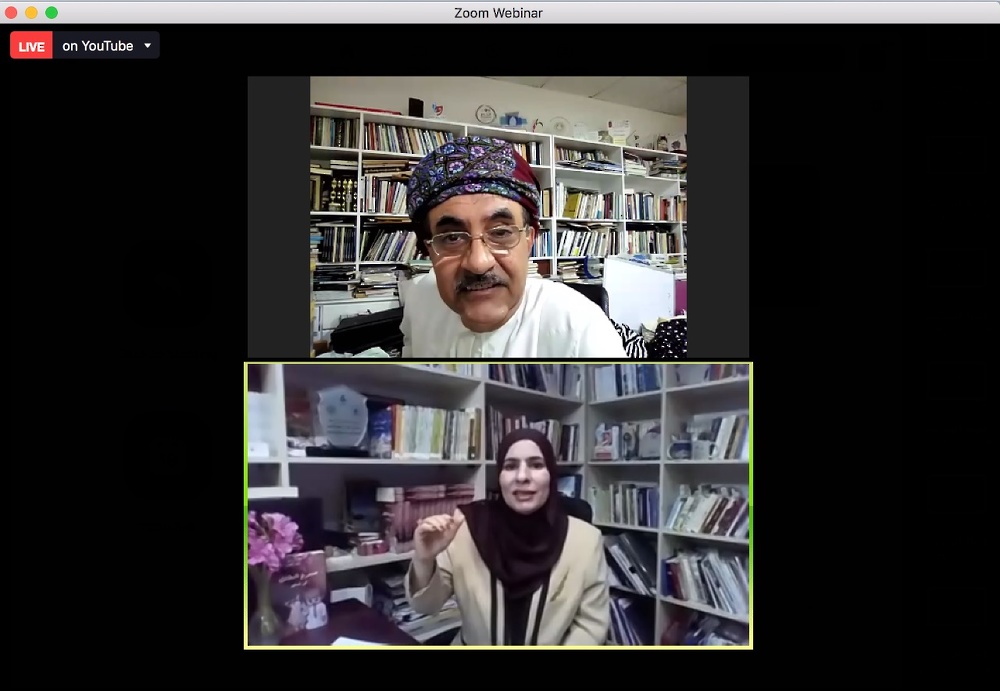
Muscat, November 17 (ONA) Within the cultural season program of the College of Arts and Social Sciences at Sultan Qaboos University, a dialogue session was organized on Child Theatre in Oman, moderated by the poet and playwright Abdul Razzaq Al-Rubaie. The session was devoted to reading in the book "Children's Theatre in Oman" issued by the Luban Publishing House, which is considered the first in this field in the Sultanate, through the Zoom application. The session hosted Dr. Kamilah Al Hinai, assistant professor in the Department of Theatre Arts in the college, who has several books, most notably "The Other in the Omani Theatre" in addition to scientific researches, and has participated in local and Arab festivals, seminars, and jury committees in numerous competitions.
The doctor began her speech by clarifying the important role the Sultanate has made in the field of child care, through the great official interest in the social, health, educational and legal fields.
Dr. Al-Hanaia also talked about the controls, including “selecting what is compatible with the child's personality and mental abilities and consistent with Islamic law, higher human values, developing and enhancing the cultural aspect, the values of creativity in childhood, and the child's pride in his Omani cultural identity, and strengthening his affiliation with it.” The regulations stipulate the obligation of libraries, clubs, and cultural centres, when displaying or selling books or publications to children, with the controls that revolve around preserving the child's ethics and his relationship with others, his adherence to his belief and the teachings of his religion, and his removal from all intolerance and any violence.
On the child's relationship with theatre, she indicated that children, since their early ages, play games of a dramatic and theatrical nature, games that include simulation, imitation, dialogues, movement, sounds and emotions. These games may be one-on-one, or joint or group games with another child or group of children. It is through these games that the child expresses himself, explores the world around him, and develops his social relationships. This may confirm what the researchers say that “theatre is in us,” even from childhood. Then she touched upon child theatre and the problem of the term, which has not been decided even in the West. There is confusion between the concept of child theatre and other forms of theatre presented to the child. The art of Bakit, which combines traditional and performing arts, which forms a theatrical phenomenon that existed before the emergence of the Children's Theatre in Oman, and before the play (Brave Knight), which was performed on the national stage in 1972, which is the first play presented to children in the Sultanate. She praised the efforts of theatre groups in the Sultanate, especially the Hiwat Al Khashabah group, which presented many theatre performances for children, which exceeded nine performances, including children’s theatre and puppets.
In the conclusion of her speech, Dr. Kamilah Al-Hinaia discussed the role of the Ministry of Education in supporting theatrical activities and the School Theatre Festival. She said, "The cultural situation of children in general requires more efforts by the official institutions concerned with children in the Sultanate, in addition to the role of civil society institutions and individuals. There is still a great shortage of cultural activities and events provided to children, including theatrical events, especially activities provided to children in the early stages of life and preschool."
(ONA)