
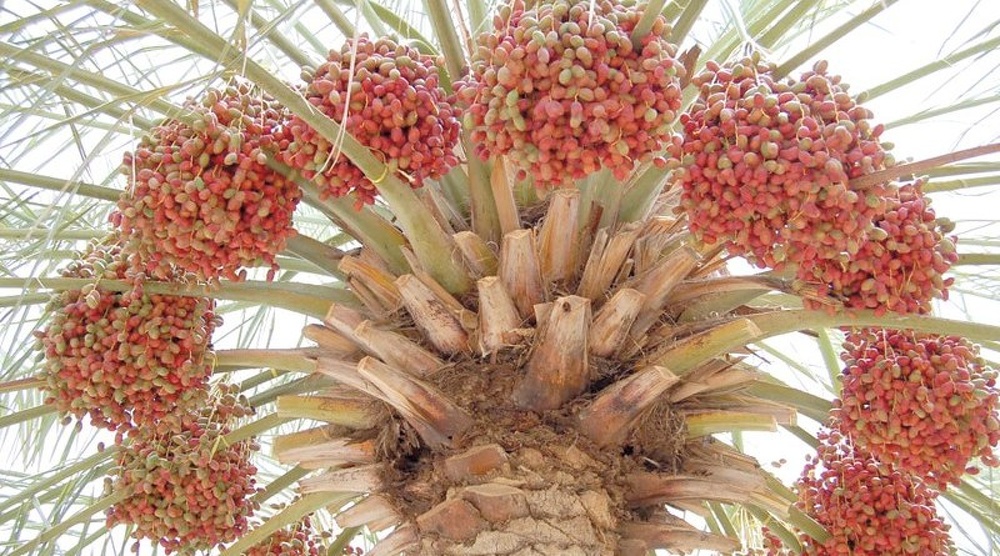
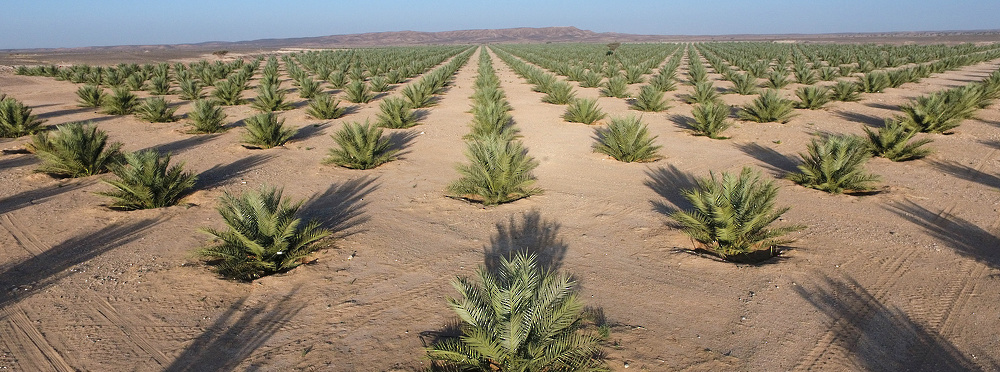
The Date palm is the first crop in the Sultanate, in terms of number, the areas where it is grown, or the integrated agricultural and environmental system.
It is a national wealth that touches and affects directly and indirectly lives of citizens. Therefore, maximizing its economic, social and environmental returns is extremely important as it is the most important food-producing tree, and represents the basis for sustainable agriculture in all governorates of the Sultanate.
The Ministry of Agriculture and Fisheries prepared the national strategy for the development of date palms and its implementation plan, which sets out the limit of its plan to reach, represented in the maximization of the economic, water, social and environmental returns of date palm cultivation in the Sultanate at the individual and national level.
As part of the process to promote the date palm industry in the Sultanate, a company named Nakheel Oman Development Company was established in 2018, as a closed Omani joint stock holding company owned by the Diwan of Royal Court, represented by the Directorate General of One Million Date Palm Trees Project, and the Oman National Investments Development Company (Tanmia). The holding company will purchase the dates and thereby- products from the Directorate General of One Million Date Palm Trees Project. It also provides material resources such as land, energy, water, and environmental permits, as well as expertise needed. The City of Nizwa was chosen to be the location for the company’s main manufacturing complex for date palm products.
The volume of investments that include the central unit for processing dates and date-based industries, as well as industries based on by-products are estimated at about RO92 million.
The company announced last January that it had issued four tenders for the construction of the manufacturing complex. Tenders for the first phase of the project include civil works for the construction of the manufacturing complex and the work supplying and installing the steel structures of the complex, as well as the work of supplying and installing the cooling station for the cold stores, and electrical and mechanical works manufactured for the complex.
In 2018 also, Oman Dates Production and Packing Company was also established. It is one of the companies affiliated to Oman Foods Investment Holding Company, by investing in a project to establish an integrated factory in the Wilayat of Barka and six collection centres in the governorates. The company will purchase dates products from farmers, then process, package and sell them in local markets and export them. The cost of the project is RO28 million in the first stage and will reach RO75 million in the last stage. Eng. Adnan bin Mohammed al-Alawi, CEO of Oman Dates Production and Packing Company, said to Oman News Agency, “The project comes within the framework of developing the dates sector in the Sultanate, creating an incubating and marketing environment for Omani dates as part of the food security and import substitution system, in addition to developing governorates and providing high-quality products in line with international quality standards, providing job opportunities for citizens and localization of the food security industry. The project will benefit from this abundant production of Omani dates in the Sultanate, and support farmers to purchase their products through collection centres.’
On distribution centres,, Eng. Adnan al-Alawi explained to Oman News Agency that "its construction will be completed within a year and a half and before the completion of the factory, so that the company can receive and store the dates crop. The plan includes building (6) collection centres in (6) governorates, in the Wilayats of Saham, A’Rustaq, Nizwa, Ibri, Ibra and Jaan Bani Bu Hassan.”
Al-Alawi stressed that the factory’s initial production in the first stage will reach 30,000 tons annually and will reach 80,000 tons annually in the final stages. The factory will distribute 20 percent of its production in the local market and 80 percent for export. It is expected that the factory will start production within two years according to set plans.
He pointed out that "the factory was designed for the production and packaging of dates at the highest international standards on an area of one hundred thousand square meters in the Al Rumais area in the Wilayat of Barka, and will follow the best methods taken in terms of cooling, drying, cleaning, fumigation and the technical aspects that the dates need.”
The number of palm trees in the Sultanate, according to the latest statistic published by the Ministry of Agriculture and Fisheries, reached 7.6 million palm trees in agricultural areas, in addition to 800,000 palm trees in home gardens, about 200,000 in streets and public parks, and 600,000 palm trees within the project of one million palm trees. The Sultanate's production of dates reached (369,000) tons in 2018. The human consumption in 2017 of dates reached (53%) of local production, as 6% of the produced dates were processed and exported. ONA