
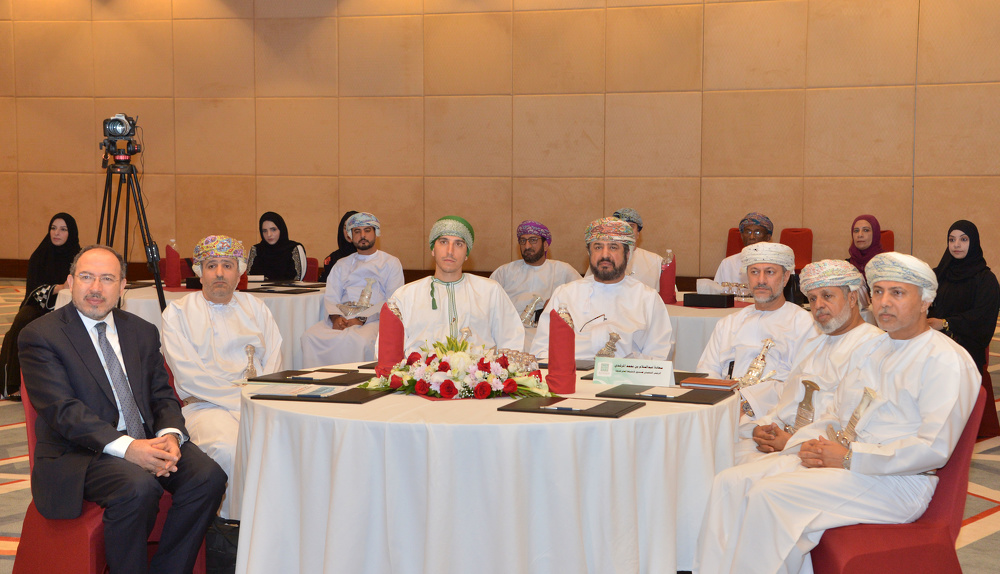
The Institute of Public Administration (IPA) today organized at Sheraton Hotel- Oman , the Second Annual Undersecretaries Meeting and their equivalent under the title "Digital Transformation in the Public Sector and the Management of Institutional Change" under the patronage of Sheikh Khalid bin Omar al- Marhoon, Minister of Civil Service.
Sheikh Khalid bin Omar al- Marhoon, Minister of Civil Service, said in a statement that organizing the annual undersecretaries meeting of the undersecretaries under the title "Digital Transformation in the Public Sector and the Management of Institutional Change" in order to ensure the study of changes and developments in the science of public administration.
For his part, Abdul Salam bin Mohammed al-Murshidi, CEO of the State General Reserve Fund, said in a statement that digital transformation is an indispensable option, whether it is an offensive or defensive strategy, and we are trying to catch up in the digital transformation if we are to be on the offensive strategy and be at the forefront.
Eng.Ahmed bin Hassan al-Theeb, Undersecretary of the Ministry of Commerce and Industry said that the digital or electronic transformation in the public sector is important and that keeping pace with these new changes and keeping pace with new technology and developments from the public sector is very necessary
Abdul Wahab bin Nasser al- Mantheri, Deputy Chairman of the Public Authority for Craft Industries, spoke about the importance of utilizing digital capabilities and business models to innovate and drive competitive change with unprecedented scale and speed and focus on providing value to customers. He also touched on the digital transformation of the public sector, how to create a suitable competitive environment for startups to thrive, create the environment to become more competitive by drawing a line for talent, and investing the ideas of innovators and using public fundamentals to push forward and enhance innovation.
The lecture dealt with several important themes , the most important of which is the global acceleration with its comprehensive changes in various fields of life, in addition to the emergence of the Fourth Industrial Revolution with its advanced technologies and tools that have brought about pivotal changes in work environments, production, consumption patterns, government work management, artificial intelligence, blockchain technology and the Internet of Things, as well as nanotechnology, 3D printing, biotechnology and other emerging technologies.