
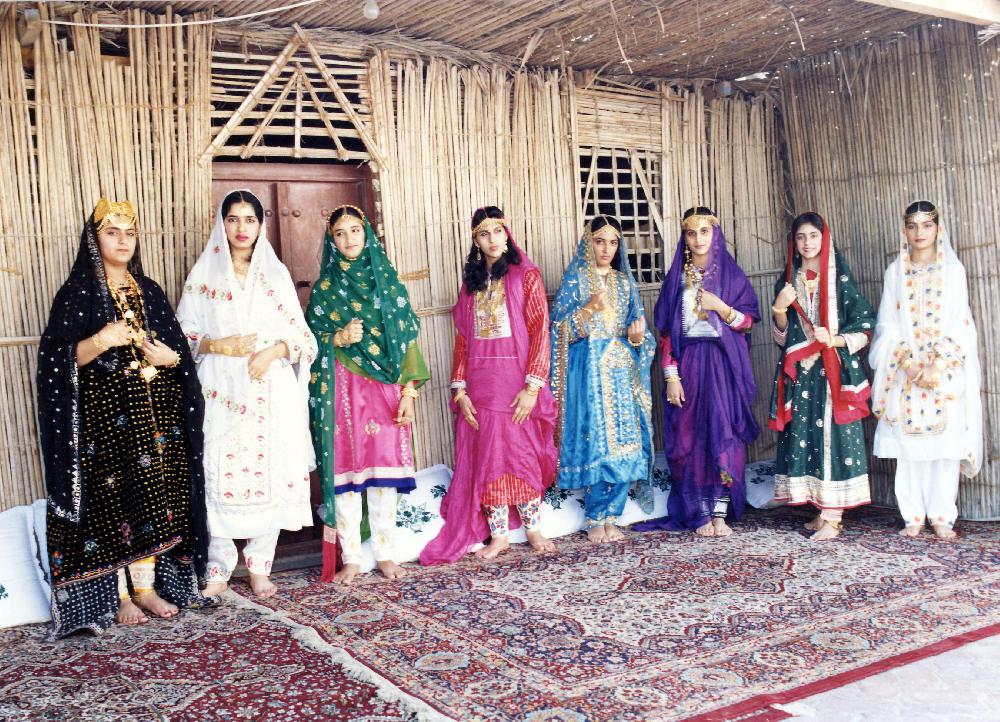
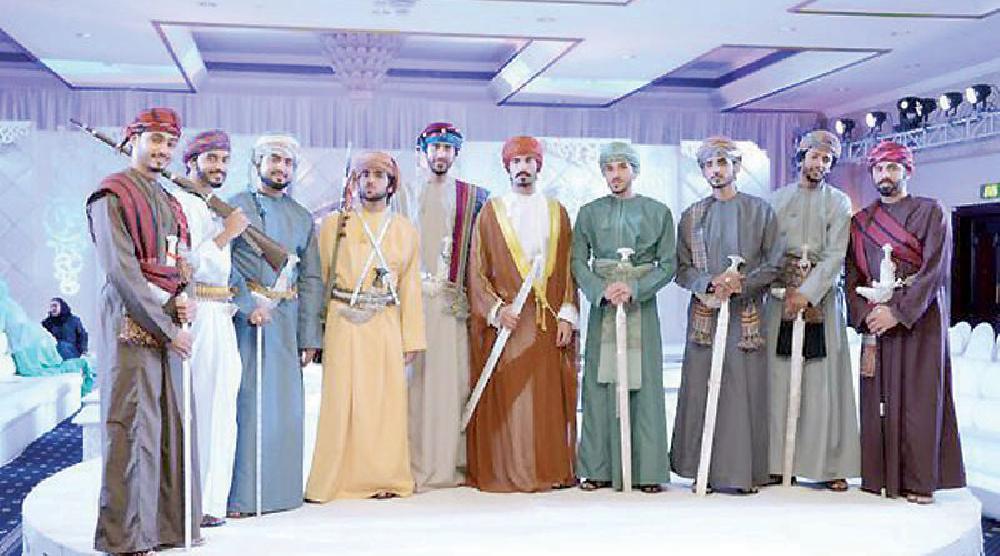
The national dress for Omani men is a simple, ankle-length, collarless gown with long sleeves called the dishdasha. The colour most frequently worn is white, although a variety of other colours such as black, blue, brown and lilac can also be seen. Its main adornment is a tassel (furakha) sewn into the neckline, which can be impregnated with perfume. Underneath the dishdasha, a plain piece of cloth covering the body is worn from the waist down. Omani men may wear a variety of head dresses.
The shape of the khanjar is always the same and is characterised by the curve of the blade and by the near right- angle bend of the sheath. Sheaths may vary from simple covers to ornate silver or gold-decorated pieces of great beauty and delicacy. In the
past the silver khanjars were made by melting down Marie Theresa silver coins.
Different types of khan jars are named after the regions in which they are made and vary according to size, shape, type of metal and the overlay. The top of the handle of the most usual khanjar is flat but the "Saidi" type, which takes its name from the Ruling Family, has an ornate cross-shaped top.
However, all possess certain common features and have the same components:
• The hilt may be made of costly rhinocerous horn or substitutes such as
sandalwood and marble.
• The blade determines the value of the khanjar according to its strength and
quality.
• The sadr, or upper part of the sheath, is decorated with silver engraving,
• The sheath , the most striking part of the khanjar, is worked with silver threads.
Khanjars are supported on belts of locallymade webbing, sometimes interwoven with silver thread or belts of leather covered by finely woven silver wire with handsome silver buckles, and a knife with an ornate handle of silver thread is often stuck into a simple leather pouch behind the sheath.
Khanjars are worn on formal occasions and at feasts and holidays, and almost all Omani men boast one.
Once worn in self-defence, the khanjar is today both a fashion accessory and a prestige item much in demand.
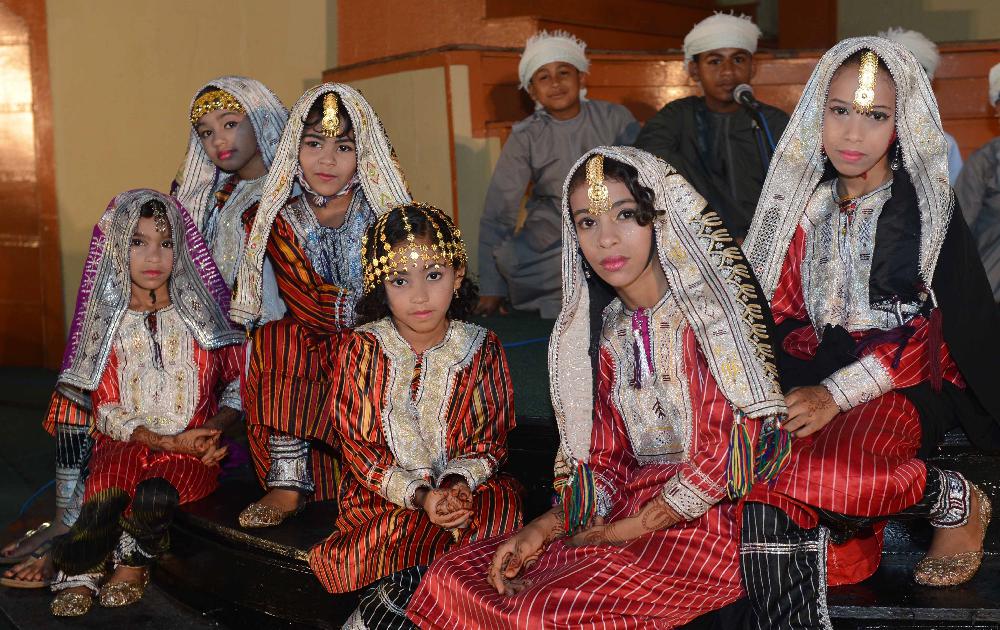
There are numerous traditional styles of Omani costume seen in Muscat. However, there are three main types which show vibrant colours, embroidery and decorations. One style of costume is rather flowing and resembles that worn by the women of the Interior, while another is decorated with distinctive silver bands. The embroidery on these dresses can take around two months to complete.
The jewellery worn by Omani women is fashioned mainly from gold, although the traditional metal was silver. Work is very intricate and elaborate patterns and symbols, even Quranic calligraphy, is engraved into the metal.
Traditional footwear was a type of platform shoe made from wood called the qurhaf. However, most women now wear sandals or Western-style fashion shoes.
Omani women have used natural cosmetics and beauty preparations for centuries and despite the supply of brand name cosmetics sold in department stores and supermarkets, the traditional products are still available at souqs all over the Sultanate.
Kohl, a dark powder used as an eyeliner made mainly from frankincense or the roots of the arvea jevanica, is still used to enhance the eyes and is applied with a small stick made from silver (marwat) or wood. As a 'moisturiser' women grind the seeds of the prunus mahled together with the yellow pigment of the carthamus tincturius flower.
Indigo is also used as a 'skin wash'. The indigo is pounded into a powder and rubbed into the skin, to then be rinsed off with the crushed leaves of the becium dhofarense. This beauty treatment leaves the skin smooth and faintly tinged with blue which enhances the natural skin tone and is complemented by the colours contained within the vibrant dresses and scarves. Indigo is also applied to the face in decorative patterns for festivals and celebrations, such as weddings.
Hair is conditioned with oil extracted from the shoo seeds which is said to make the hair shine and delay the signs of greying. A popular shampoo is made from sidr and ipomoea nil leaves.
Many women in Oman paint their hands and feet with henna, particularly before special occasions such as Eid holidays or weddings. Henna comes from the plant of the same name and is extracted by pounding the leaves into a powder which is then mixed with water to form a thick paste. The paste is applied in patterns on the hands and feet, which, when dried, leaves a temporary orange/brown design which fades after around three weeks.