

Archeological Sites:
Since the establishment of the Ministry in the mid-seventies, programs and plans were made to initiate a wide operation in the field of excavations and archaeological survey. The efforts were fruitful and an archaeological map was prepared showing the different archaeological sites throughout the Sultanate of Oman dated to different ages. Care for archaeology goes back to the beginning of the fifties and sixties of this century. The major excavation sites were conentrated in several areas but mainly in Khor Rori, Al Balid, Al Mughsayl, Sohar and other locations. The most important Archaelogical sites in the Sultanate of Oman are:
The Rās al-Jinz
Archaeological excavations began on the Rās al-Jinz site in the Wilayat of Sur in 1981 when the Joint Italian-French Expedition found a piece of ancient Harappan pottery bearing inscriptions and decorations dating back to the 4th millennium BC. Its historical significance became apparent after preliminary surveys of the site were conducted and the Ministry undertook work to discover its cultural monuments.The site was thoroughly explored in 1985 and excavations continued to reveal a rich depository of highly valuable cultural and archaeological discoveries. The archaeological survey indicated that the site was not restricted to one particular area but spread over a wide geographical area representing a number of ancient civilisations.
The significance of such sites is that they show the course of interaction between Omanis and their surrounding environment throughout history. The discoveries established that Omanis were skilful fishermen and producers of important and outstanding industrial products given the circumstances at that time. They have also shown that Omanis were sociable and enjoyed life and demonstrated that they established contacts with the outside world through their seafaring activities throughout the Arabian Sea and Indian Ocean.
Their ships reached India’s coasts to discover another world that was very different to theirs in terms of style, behaviour and beliefs, and to trade the goods they produced with others needed in their everyday lives. The copper, stone, jewellery and accessories found at Rās al-Jinz reveal the skill of ancient man in a wide variety of arts. The importance of this site is also attributed to the fact that it was an important ancient port in which traditional boats docked during the Bronze Age.
Al Baleed
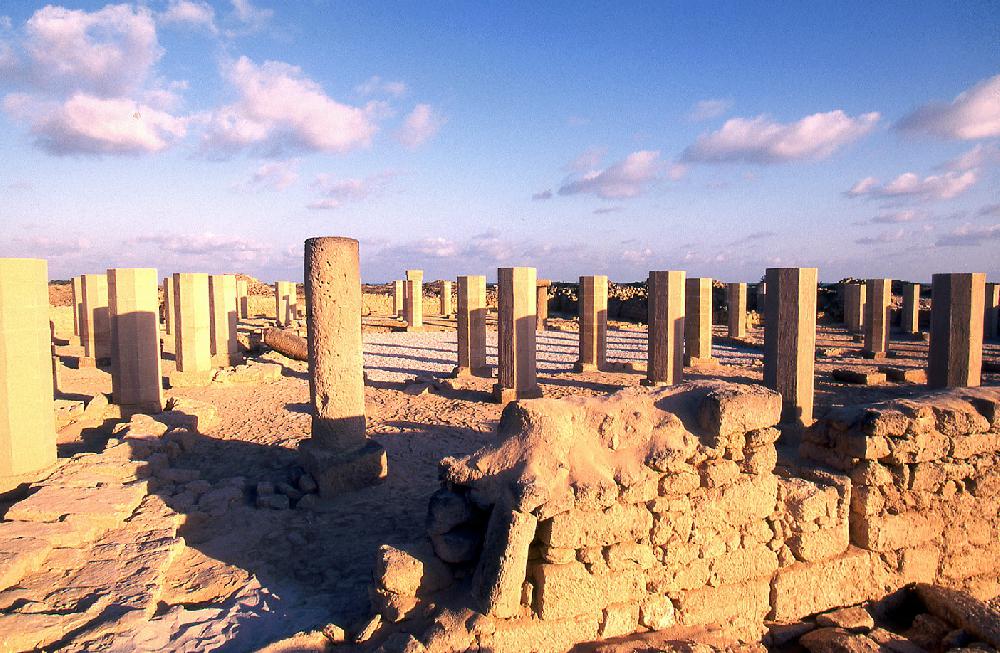
The city of Al Baleed lies on Salalah’s coastal strip and covers an area of 640,000 square metres. During the Middle Ages the town played an important role in world trade through its harbour and links with the ports of China, India, Sind, Yemen and East Africa, as well as with Iraq and Europe. A German university and Omani team date the site from the Islamic period, though the area was inhabited from the end of the 5th and beginning of the 4th millennia BC. The city was re-established in the 4th century AH/10th century AD at the time of the Mujais dynasty and was rebuilt during the Habudhi period.The main archaeological discoveries in al Baleed include the great mosque which has around 144 pillars and is nearly square in shape. It has outbuildings, a minaret and is believed to have been built during the7th century AH/13th century AD and remained in use until the llthAt Al Suwaih evidence of successive round huts directly onto the rocks, and finds have included copper fishhooks, small implements, spear-heads, and potsherds originating in Mesopotamia.
Excavations continue in the Ja’alan (eastern) region on the sites at Ras al Hadd and Ras al Jinz where it is believed there has been human development from the Holocene period in the 7th millennium BC to the arrival of Islam. Italian, French, British and Omani teams are focusing on maritime trade in this area during the 2nd half of the 3rd millennium BC. Pits in the area suggest that 4th millennium BC fishing communities built In the Wusta (central) region stone implements have been excavated from the Asholite civilisation. An American and Omani team are working on the migration of early man from Africa to Asia via Oman across a land bridge that existed before the Red Sea trench was formed.century AH/17th century AD. The city is surrounded by a moat.fishing settle-ments from 6,000-4,000 BC have been uncovered.Excavations at Ras al Kabbah have revealed that this is a 5th-4th millennium site which was located on a rocky promontory between the sea and a dried up creek. Marine resources from the creek were used in abundance. Findings at Wadi Shab (near Sur) have included 24 rings (or fragments of rings) made of smooth soapstone.
Wubar
Wubar lies in Shisr district, south of the Rub al Khali (Empty Quarter) desert some 170 kms north of Salalah. Islamic sources refer to Wubar as the home of the Azd people and record that the overland frankincense and incense trade route passed through the Empty Quarter. The National Committee for the Supervision of Archaeological Surveys in Oman, in cooperation with an American university, carried out surveys and exploratory work on the site and found pottery, glass, incense containers and fragments of chess set which dates it from the lst century BC up to the early and middle Islamic period. It would appear that the site flourished as a trade centre up to the beginning of the 16th century AD when it ceased to be of commercial importance following the collapse of the frankincense trade.
Khor Rori - Sumharam
The Khor Rori sites are adjacent to the lagoon on the coastal strip in the Taqa region, 40 kms east of Salalah. Historical sources and archaeological exploration by an Italian university indicate that the history of this city spans several eras – some dating back as far as the lst century BC to the 3rd century AD and others date from the 4th century BC. Inscriptions in the South Arabian alphabet give clues which indicate the city was built to reinforce its people’s control over the frankincense trade. Coins also found indicate it was the site referred to as Sumharam and the port of Moscha in two Greek texts dating from the period between the lstThe great gate of the town indicates that the citadel had an outer wall with towers and 2nd centuries AD. threegates, and that its main entrance was protected by square towers. It contained an inner structure which may have been a temple or castle consisting of large frankincense stores. Other finds include coins, earthenware pots, bronze objects, and a 2l cm high incense burner.
Wadi Dawkah
Wadi Dawkah is part of a chain of sites that have been historically linked to the Dhofar region’s frankincense and incense trade. It lies beyond the northern slopes of the Dhofar mountain range some 35 kms north of Salalah and here frankincense trees (Boswelia sacra) grow in abundance.
The Rās al-Ḥamra
The Rās al-Ḥamra site, which was discovered in the 1970s, dates back to the 4th millennium BC. Actual excavations on this site, which comprises a group of nacreous and calcareous hummocks, started in 1980. Artefacts included fishing hooks, stone net weights, hammers, chisels, stone axes and women’s shell jewellery. Skeletons on the site were buried in a squatting position facing the sea with some holding pearl beads, and two of them were conjoined.
This site is a geographical extension of the al-Qurum Nature Reserve, which also contains a group of archaeological sites. Human activity in Rās al-Ḥamra depended on fishing and green turtles. People also worked as collectors of seashells and, to a lesser extent, as pastoralists growing oats, corn and cranberries. Domesticated wild animals, including sheep and deer, were also found on this site. Excavations continued in different areas of the site and tombs belonging to the prehistoric period and remains of cottages dating back to the 4th millennium BC were discovered. The site will be rehabilitated, the fishing village rebuilt and an archaeological park established within the al-Qurum Nature Reserve in order to transform the site into a village that embodies activities practiced by 5th-century BC inhabitants in their daily life.
Bat Tombs
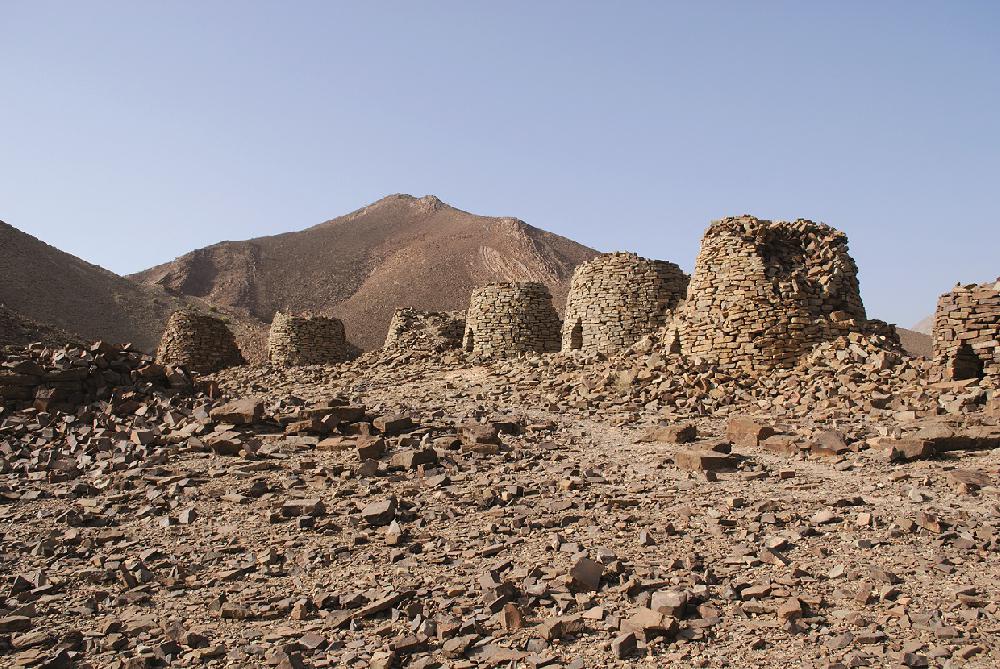
Bat is no longer a suburb of Ibri, after the significant discovery of Hafit and Umm al-Nar Periods, but an international ancient city known by all who study archaeology. Its historical significance was boosted after the UNESCO added Bat tombs, along with al-Khaṭm and al-‘Ain, to the World Heritage List in recognition of their cultural value and historical significance. The tombs discovered in Bat belong to an ancient civilisation that dates to the 3rd millennium BC. In 1973, the Ministry commissioned an archaeological expedition to carry out excavations in the cemetery, which are still ongoing, in order to find significant archaeological remains of ancient civilisations. The cemetery is situated in the city of Bat thirty kilometres from Ibri's city centre. Several rock tombs were found as well as other tombs in the southern part of the cemetery.
The Bat tombs are circular in shape with a diameter of between 5 and 10 m, and were built from solid square blocks of rock. They comprised two external and one internal wall and featured flat roofing slabs. During excavations, fragments of red pottery resembling production from the potteries of the Jemdet Nasr civilisation in Iraq were found. In addition, another fragment of red pottery decorated with light black lines was found, as well as other fragments of pottery with handles. The site features circular defensive towers in various areas of al-Dhahirah.
Samad al-Shān
The archaeological excavations that took place in the early 1980s in Samad al-Shān in the Wilayat of al-Muḍaibi were focused on studying the contents of the tombs that had been discovered. In terms of shape, the tombs are rectangular holes demarcated with stones on the outside.Pottery jars of different sizes, in addition to stone seals, metal vessels, arrowheads, bronze spears, a bronze horse’s head and different types of shell beads, garnets and remains of human bones were discovered on the site.
After studying all the archaeological artefacts, it became apparent that there were three types of tombs. Those for men and women contained bronze weapons, pottery jars and bottles, in addition to bronze beads and jewellery, and those for children contained pottery jars. In 1989 a tomb was discovered that contained a skeleton of a small camel with a necklace around its neck. After studying the beads of the necklace it was evident that the camel belonged to the Late Iron Age (200 – 629 BC). It is considered the first recorded on the Arabian Peninsula.
The al-Khaṭm (al-Wahrah) Tower
This tower is 3 kilometres away from the al-Rujūm tower and is similar in shape to the al-Sulimi tower. It is also similar to the towers of al-Khafāji and al-Muṭairiya in terms of the size of its calcareous mass and its construction techniques. Excavations conducted on this site in 2009 showed the foundations of rooms that were added at different stages. A study of nearby sites showed cemeteries dating back to the Hafit Period (3000 – 2600 BC) with some going back to the Umm al-Nar Period (2600 – 2000 BC). There was also evidence of stone and copper tools in addition to limestone products dating back to the Middle Ages.
There is a large area of deserted farms between Bat and the al-Khaṭm tower in which some pottery vessels that had obviously been brought from nearby tombs and that dated to the Bronze Age were found. The Ministry has signed an agreement with the Mining Museum in Bochum to repair the cemeteries and prepare the entire site for tourism. A number of cemeteries belonging to the 3rd millennium were re-excavated and an ancient tomb dating to the Umm al-Nar Period was restored. This tomb was originally built on top of a hill using white stone moulds, and some of the rooms of the main tower were also restored. Two cemeteries dating to the 3rd millennium and four other cemeteries on flat land that date to the Hafit Period were also restored. There are plans to rehabilitate the site and make it a tourist archaeological park.