
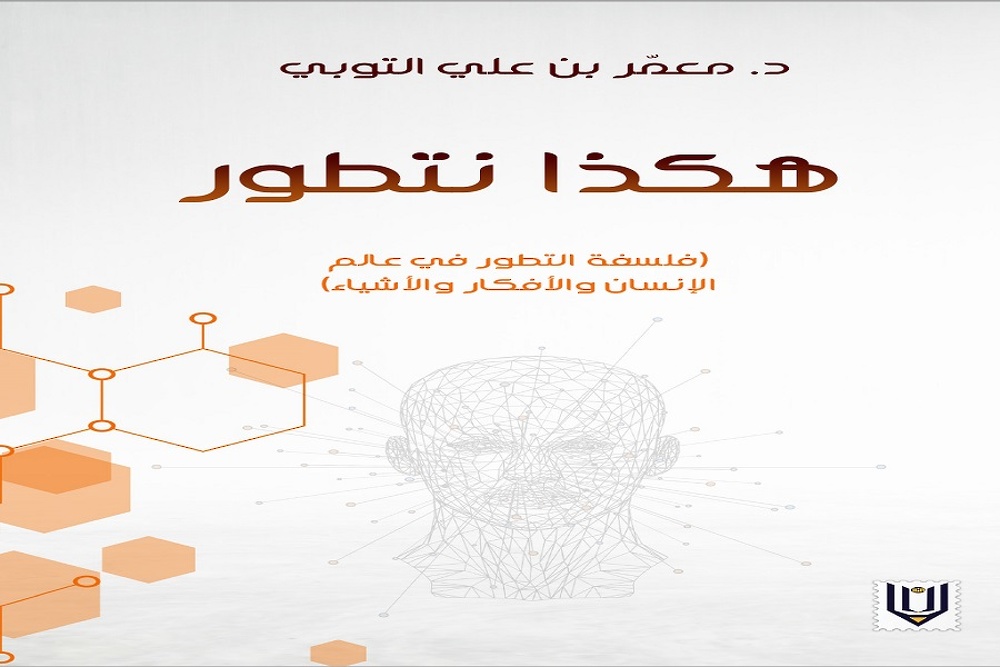
Muscat, November 2 (ONA) - Dr. Muammar bin Ali Al-Tobi chose the title “This is How We Develop” to approach what he defined as “The Philosophy of Evolution in the World of Humans, Ideas and Things” as it is the subtitle in the book issued by the Luban Publishing Establishment, which is the second publication of Al Tobi after his first book entitled “Science and Faith” previously issued by Al Ghasham Publishing House.
In the introduction to the book, Dr. Muammar said, “This is how we think when we are faced with an enormous amount of ideas and things. We see things according to what they are. It may be safer to say according to our own rules and values, to judge them and the mechanism of their existence and development through our outcome and our knowledge acquisitions. The questions about existence between philosophy and science at times and between religion and science at other times - according to the geography of space and time and their culture - are multiplied and mixed according to the degree of its ambiguity, all of which feed into the following question: How did the universe begins - with everything in it and in what it contains - and how did it develop? And most importantly why? Such questions have existed - in reality - in the mind of man since his first existence, noting that “this is what prompts us to think about the philosophy of evolution itself.”
The author points out that “it is very easy to trace the development in history in most ideas and things. Some philosophical principles and ideas were developing over time and someone would add to them or understand them.” He explained that “Evolution as a philosophy is represented in the sequence and development of ideas from previous ideas. Evolution, as a biological principle, is another story that has long roots throughout history.”
The first chapter comes under the title “This is how we think about how creation began”, introducing a prelude to the idea and then a subsection on the biological idea (the idea of the emergence and creation of man), with a summary of the idea. The author noted that the idea of creation since ancient times has been mixed with human perceptions and imaginations, some of which have been attributed to religious sources, indicating that the contradictions that were in the Bible with the Church is the spark of the clash between science represented by the theory of evolution and religion.
The second chapter entitled “Origins and Development in the World of Ideas” deals with concepts such as morality, communication and language, religion, God, religious beliefs and rituals, and the idea of existence, survival and conflict.” The author believes that “the development of an idea is inevitable and necessary, and in its reality, it is natural as a result of the circumstantial need that suits the time according to the multiple variables, and the old idea, although it is a reason for the advanced and new idea, may no longer have a place and influence in a new and advanced era.
The third chapter discusses the emergence and development in the world of things, such as the emergence and development of civilization, industrial and scientific development and its impact on the world of ideas, and the world of things to where? In the preface to this chapter, Dr. Muammar Al-Toubi confirms that the world of things is a vast world, whose development is constantly accelerating. We can measure this acceleration and growth in the world of technologies and matter, which we have gathered with the world of things, starting with the agricultural stage or revolution that contributed to the development of things in terms of technologies and tools. Their beginnings were in fields and farms and set out to include homes and societies, stressing that this came “as a result of the development factor that begins with one thing and then various things that serve many areas branches out of it, all of which serve the human being to facilitate his life.”
The topic of the book revolves around a basic idea that Dr. Muammar Al-Tobi paved for, when he pointed out that “our acceptance of the truth is not by compulsion and coercion as much as it is through research, evidence, proof and conviction. Otherwise, we will find ourselves in a society of the human herd that moves, speaks and believes according to the approach of the collective mind in which the human mind has no value, and in which the human subject, which is full of love of inquiry and question and the attainment of certainty by crossing the bridge of doubt, is marginalized.”
(ONA)