
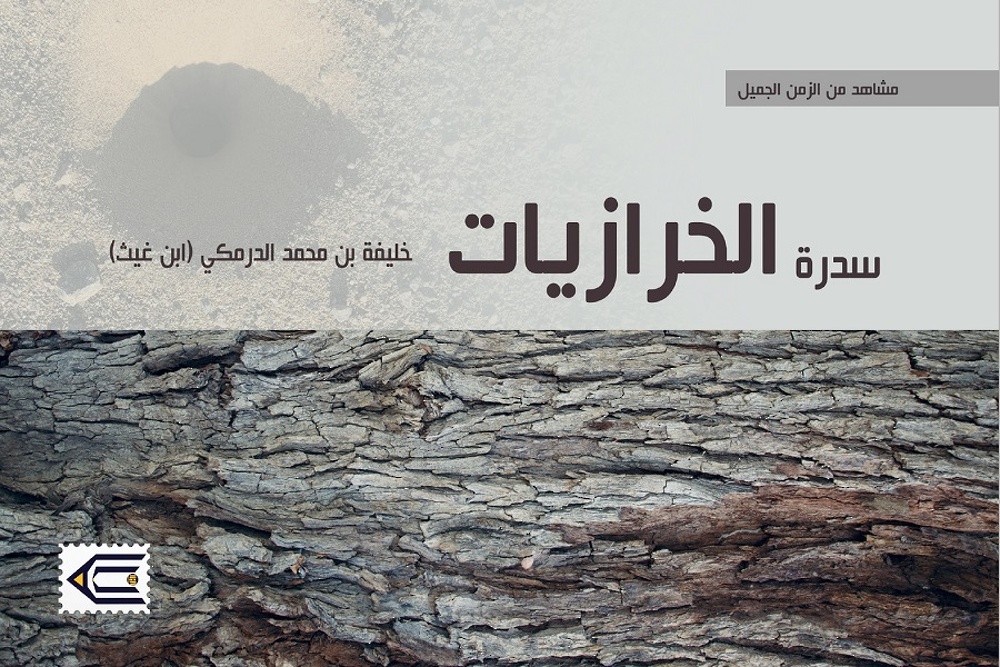
Muscat, November 2 (ONA) - The writer Khalifa Al Darmaki presents his new project in documenting places in his book “Sidrat Al Kharaziyat”, published by Luban, which comes with a cover that represents a threshold for the content, where the trunk of the sidra (Christ's thorn jujube) of Al-Jalaba Mosque appears as “the distant, close neighbour” of that located in Allayat Baldat Al-Yaman, Ain Saana, in the Wilayat of Izki, presenting the book to those who witnessed this tree. “Its dreams filled with their shadows, and its hopes increased in their spaces, so for them it was a story of an authentic time and a memory of a beautiful place.”
Al-Darmaki considered that this book is “an attempt to bring together scattered ancient scenes and memories, and rosy dreams that occurred between 1985 and 1995, and their fragrance is still stuck in my memory which summarizes them with love and remembers them with longing.” He added that it is also an “attempt”, which he considers “deficient” to document “some of the landmarks and names of places in my town and my first passion, before they are forgotten, and their images fade away, and their features are erased from the memory, the succession of days and the passage of years.”
In the first opening, the author refers to his choice of this sidra, explaining that it is the perpetuation of its position that has been on the throne of hearts for many years, and its name remained a tale of endless chapters of beauty. It is a beautiful response to it after time has passed since it has been managed by humans. It also represented passage stations for scenes from the beautiful time that were reduced by memory, thus forming the largest share of the scenes of this book.
The pages of the book go on a beautiful circumnavigation of quick scenes, which Al-Darmaki picks up smoothly and skilfully, without lengthening the idea, but wrapping it as a picture, or proceeding in the form of a short story. The event seems based on the past and its memories and fertility of its legacies.
The author does not present his ideas in report articles, but rather with a narrative mastery that adheres to the art of the story, where Sidrat al-Kharaziyat can be read as a group that converges between the story and open texts. Among the texts we read is “The witness sees ... what the absent does not see.”
The number of arrivals increased on the outskirts and surroundings of the town after the opening of the first cement brick factory in the town, whose land was divided into two parts, a section for the manufacture of bricks, and the other part, like a soil football field called the factory football field, in which the dusty boys’ feet found their way in those days to the bricks lined up on its edges, so some of them were broken with shots of the one who missed the ball, and some of them tore shoes and chipped fingers. The faces and lips were also affected by its soil and sand and got stubbornly cold, which could not be softened with anything but the original Indian Vaseline.
(ONA)