
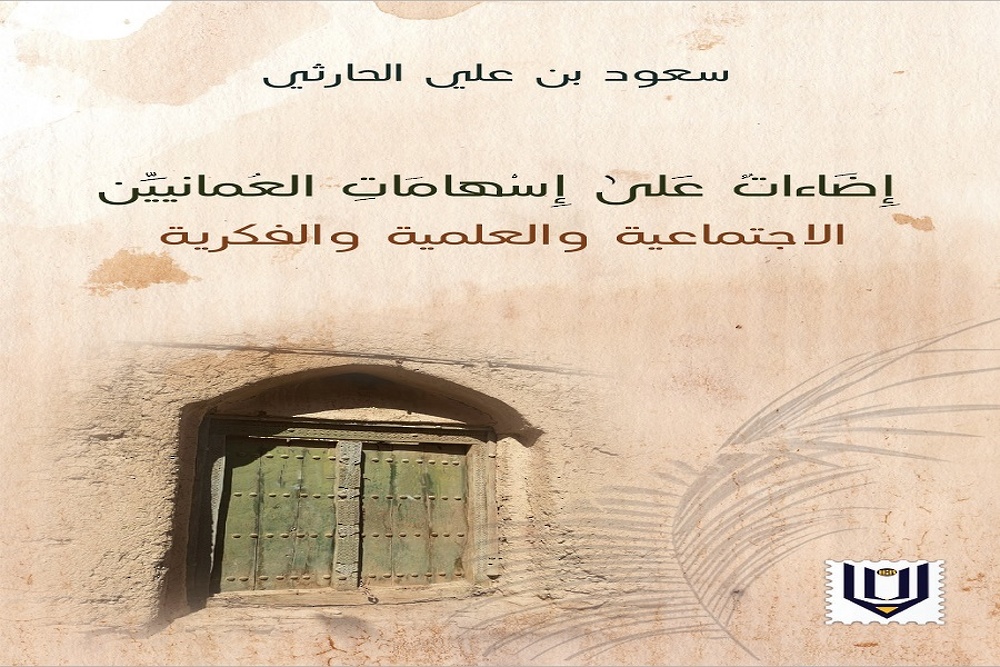
Muscat,ONA) - Writer Saud bin Ali Al-Harithi documents an important aspect of Omani life through his new publication, “Highlights on the Social, Scientific and Intellectual Contributions of Omanis”, approaching the features of this life through a group of articles included in this book issued by Dar Al Luban Publishing.
Hammoud bin Salem Al-Siyabi introduced the book by saying that the author was keen “not to be a reportable book in order to spare the reader from the crowd of numbers, but rather to make it a humanist full of emotion, as the camera rotates to evade impressions that the author experienced throughout his life,” considering that this book is one of the most important publications of Al-Harithi, “as he collected everything in it and covered everything about Oman, its history, geography, topography, places and important aspects, so all the aflaj flowed into the pages and all the valleys were poured.”
The book deals with a group of titles starting with the Omani personality, passing through public life and village life, then architecture such as antiquities and discoveries, crossing over to the concept of heritage, and an article on literature, arts and traditional industries. He also talked about manuscripts (letters as a model), valleys and aflaj, the relationship of the palm tree to the Omani, and other related fields, right up to al-sablah as the bright past, recounting what the pen wrote about it. Then he referred to events and mosques as places of worship and study circles. He also referred to the importance of values and responsibilities, noting the concept of values between two times, religious tolerance, women, and history, recounting scenes from Omanis being the masters of the sea, just as the values of freedom strengthened historical strength.
Saud Al-Harthi referred to examples from Omani history, through attitudes and personalities, and up to the Omani renaissance as a victory over challenges, and a question about the past and the present, are they in a relationship of conflict or complementarity?
At the end of the book, the author presents summaries and outcomes, which can be said to be the essence of the vision he wishes for his country. After talking about all these topics, he provides a summary of what he sees as a work map that can be read and benefit from seeing its status following local affairs for many years. In its opening, he believes that “the parents’ account in their solid will, dedication, eagerness, and supervision in raising their children to ensure their distinguished performance, and their sitting in the Omani sablah, in their travel, daily activities, various aspects of their dealings and the benefit from their experiences over the past centuries, is what led to this cultural diversity and multifaceted experiences, and to the stamina and toughness of personality and adherence to values. These are features that we lack, and features of a high culture, which, unfortunately, are greatly diminished by the younger generations.”
Al-Harthi believes that it is not wise for a person to deny, resent or cancel his past, from the dictionary of life and from his living memory, with its vast inventory and accurate details of events, pictures and milestones before the moment in which he lived. Whatever the image of this past, and no matter how difficult and miserable it is, and whatever the situation of the deniers of his past and his condition in the midst of that past and the oppression and persecution suffered by him or his predecessors symbolize a period of time that has its conditions, nature, and general features. The present is nothing but an extension of the past with its good and bad.
(ONA)