
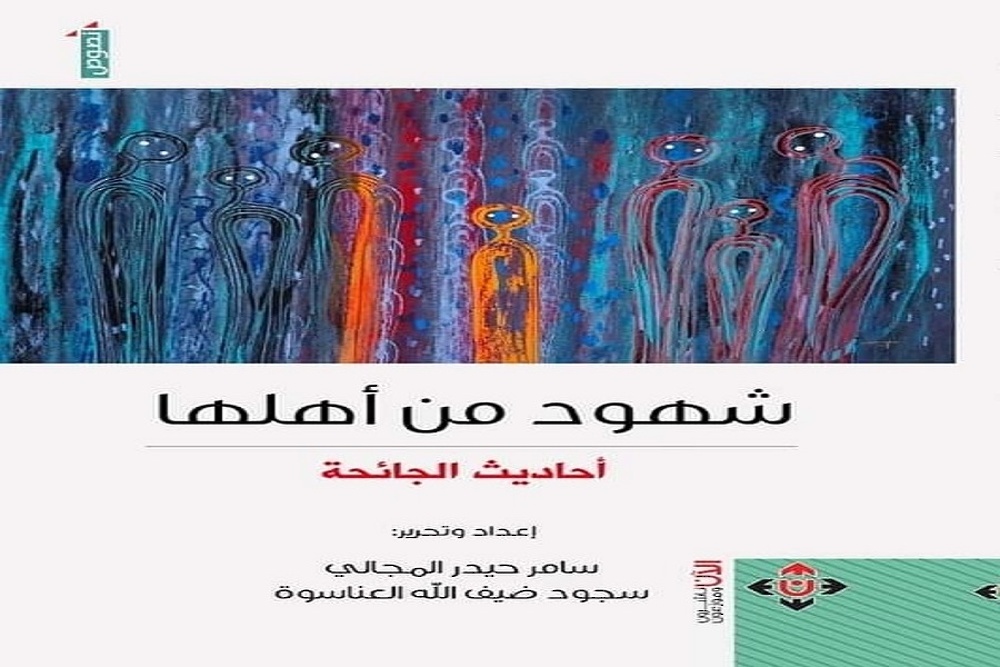
Amman, (ONA) The book entitled “Witnesses from its People” includes texts in which their writers embodied their own visions during the first months of the spread of the Coronavirus pandemic, and they transmitted its daily scenes in their countries, and expressed their aspirations through the article, the story, the poem and the contemplative thought.
Four female writers from the Sultanate participated in the book, which was published by Now Publishers and Distributors. They are Dr. Aziza Al-Taia, Sherifa Al-Toubia, Ishraq Al-Nahadiya, and Rafif Al-Taia. Dr. Aziza Al-Taia's participation in the book represented a contemplative text on solitude as “shelter and life”, in which she says
Covid-19
What have you done to us?
Everything stopped
Cancelled, prohibited
Our details are in
Isolation trench
Our dreams are in
Isolation haven
Covid 19,
Windows are closed
Doors are locked
Walls are high
Fear gripped us
Do not stop life
Covid 19,
The night steals the fun
The road is lonely
The moon is dark
The morning kills mercy
The street is silent
The palm trees are tearful
We wait for the spring
Covid 19,
We are still between love and loss
Stop, don't procreate
Do not kill life
We still carry our implants
May the earth rise
The human is blessed
We are still dreaming about the next
May the earth bloom
Aroma and Jasmine
Sherifa Al- Toubia’s participation came under the title “Not a joke”, from which we quote,
“My phone scares me as soon as I open it to know the latest developments in this world. These messages terrify me, whose source and truth I do not know. I throw away my phone amalgamated with warning and alarm messages, treatments, and global and home research. It is Corona. It is the most intense war on the world and mankind, worse than the First and Second World Wars, the bomb which is more destructive than Hiroshima and Nagasaki. I seek refuge in my home, my library, and my silence, and because I am a (home) woman who relies on her phone to find out what is happening in this world of events.”
She adds,
“Perhaps it was the isolation that I hoped and waited for, the isolation that keeps me away from all the evils of the world and brings me closer to those souls that inhabit my books, which I have been waiting for me to devote themselves to even after a while. The daily and when the children grow up, and here I am today as (Corona) sits me in my house, besieging myself in it a national and health commitment, and a duty to do, but I am dispersed by that diaspora that others live in the time of (Corona).”
The participation of Ishraq Al-Nahadiya took the form of a story entitled “Wishes in the Time of Corona”, in which she said,
“Shihab drives his car to the utmost happiness, looking for gloves, as the markets are empty of them and the rest of the sterilizers. But after careful search, and for hours on end, he returns home with a solution (Dettol) and white vinegar, as well as (Clorox), and other detergents. On the way to his room, he looks at his son Jamal, who was sitting on the floor in the hall of the house spread out with his toys and books, and as soon as he noticed him, he jumped to him, encircling his legs with his two small arms. His son is both his weakness and his strength, his heaven on earth; By him he lives and from him he derives his survival, and by him his defences are removed from him. He is his light hanging in the sky.”
The article “Stay home for them they deserve by Rafif Al- Taia include:
“This phrase has been repeated a lot in recent times, as if it were a terrifying obsession, and we neglected that (Stay Home) is a daily routine that we used to live, get bored of it and we ask for a change in travel or going to spend a certain time drinking coffee. Also, we were looking for the opportunity to sit at home to rest after the hard work and pressures of life. Why is this fearful obsession in which our psyche was disturbed? Dear reader, a pause and reflection is needed here. (Stay Home) not for us, but for them, because of that cadre who risked his life and the life of his family. For whom? For the sake of us. So, stay home for their sake. We must not forget that Oman is one body, one pulse, and a common spirit for an entire people.”
The house general manager and the storyteller house Jaafar Al-Aqili launched the idea of the project in April 2020. The idea met with great demand and interaction on the Arab level, then the texts were examined after technical evaluation, and in the end, 59 texts were chosen that formed the final body of the book prepared and edited by Samer Al-Majali and Sujood Al-Anaswa. According to Al-Aqili, the book is an added value for those of our current generation who witnessed the pandemic, and it is a testimony from those who have witnessed it for future generations, who can learn about our grievances, our thoughts, and our conversations that accompanied this exceptional historical circumstance.”
In addition to the four Omani women writers, other Arab writers took part in this book including: Dr. Nidal Al-Saleh, Fadwa Al-Aboud, Nour Nasrat, Raafat Hekmat, Nawzad Jadaan, Muhammad Sheikh Hassan (Syria), Istabraq Ahmed, Afrah Al-Hindal (Kuwait), Asma Jazairi, Abdul Razzaq Al-Saghir (Algeria) ), Dalanda Al-Zughaidi, Najeeba Al-Hamami, Hoda Al-Harami, Mohamed Bouhouch, Najwa Al-Rouh Al-Hamami, Zahra Dhaheri (Tunisia), Maryam Al-Jenioui (Morocco), Dr. Samih Masoud, Hassan Abadi, Samah Al-Khuffash, Tahseen Yakin (Palestine), Baraa Al-Ayoubi, Fatima Mansour (Lebanon), Sheikh Noah (Mauritania), Rabaa Al-Khatam, Ghada Farouk, Azza Diab, Hiba Allah Ahmed (Egypt), Musa Abu Riach, Mahmoud Jaber, Dr. Inas Khadrawi, Magdy Daibes, Sona Bedir, Ramzi Al-Ghazwi, Victoria Yaqoub, Jamil Qamma, Ola Al-Omari, Amal Badir, Hanadi Saada, Amal Al-Sheikhs, Zuhair Al-Balawneh, Tariq Banat, Faten Anwar Mansour, Muhammad Khudair, Dr. Wafa Al-Khatib, Dr. Hoda Fakhoury, Mahmoud Al-Mahadin, Ali Al-Kharsha, Tariq Qaddis, Hussein Daasa, Muhammad Aref Masha, Dr. Harbi Al-Masry, Rajaa Al-Zahir, Mona Hamzah (Jordan), in addition to the book editors Samer Al-Majali and Sujood Al-Anaswa.
(ONA)