
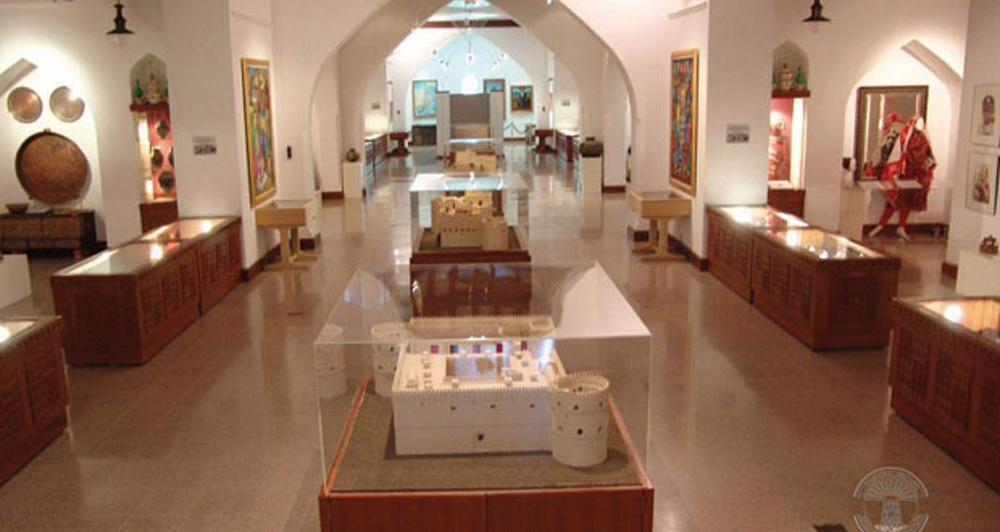
Muscat,/ ONA / FANA / The Sultanate is rich in many museums distributed in different regions of the Governorate of Muscat and the rest of the governorates. The sizes and collections of these museums and the dates of their establishment vary. In contrast to the National Museum, which is the most prominent and modern, there are small and specialized museums, such as the Omani-French Museum, which is located in the city of Muscat, close to the Al Alam Palace, and includes a collection of archaeological artefacts, traditional crafts and cultural materials related to the historical links between the Sultanate and the Republic of France.
In the past, the museum was known as the House of France, and the name of this building comes with that name since it was the headquarters of the French Consulate between 1896 and 1920. It remained the seat of the consulate and the residence of the French consuls until the year 1920. The establishment of this museum came to revive the Omani-French relations, which are more than a century and a half old, and it is a microcosm of the historical relations between Oman and France.
The Omani-French Museum is a traditional square-shaped house built with stones and stucco tiles, with a small square courtyard surrounded by a teak-wood portico in the middle, open to all high-ceiling rooms which are spread over two floors. The ground floor contains four halls, and the first floor contains five halls, standing in one of the ancient houses, which is about 170 years old. It was built by Sayyidah Ghalia bint Salem Al Busaidi, the sister of Sultan Said bin Sultan. It is of a medium height.
Its halls include a diverse richness stemming from the exhibited holdings, enabling the visitor to wander selectively among the museums. The museum building with its doors, galleries and halls provides many options, as the visitor can enter the museum through a small side door, until he reaches the reception desk. The museum contains halls connected to each other.
Among the museums is the Children's Museum, which is a cultural institution concerned with the simplification of science and technology, as it contains scientific exhibits in various fields such as chemistry, physics, biology, engineering, astronomy, the universe and other fields. Through these exhibits, the visitor can learn a lot of scientific information and theories in an atmosphere of entertainment where he can touch and operate these devices.
The museum aims to develop the love of exploration and knowledge among children and push them to try to understand what surrounds them, to make them understand the scientific material in a different way that helps them brighten their perceptions. The museum also seeks, in its annual plan, to attract many different events and activities aimed at visitors to the museum to achieve the museum’s lofty mission as it is one of the means concerned with culture and science.
The museum is currently in the process of formulating a development plan, due to the development of means of interpretation and education in addition to technology. The advisory study for the development and rehabilitation of the Children's Museum was recently approved with the aim of disseminating knowledge in science and technology, displaying modern inventions, and communicating scientific information in a simple and easy way for the children, allowing them to comprehend, in addition to simulating and enhancing their creative spirit.
In addition, there is the Natural History Museum, which was inaugurated on December 30, 1985, and it is located in the Ministry of Heritage and Culture in the Ministries Neighborhood in Al Khuwair area. The museum is concerned with the contrast in the features of the Omani environment through displays of terrain, geology, plants, insects, and land and marine animals. Despite the small area of the museum, but it abounds with a large amount of facts that are difficult for books to contain.
The museum includes mummified animals that are scarcely found in the wilds of species and types that live in the land of Oman, and the skeletons of marine creatures, birds and reptiles that lived in the Omani environment and died naturally.
The museum attracts a number of visitors of various ages and nationalities, public and private school students, and university and college students.
The Ministry of Heritage and Culture has prepared the general plan for the current natural history museum development project through the creation of the new version of the museum, which among its main objectives is to be a main destination for exploration, education and knowledge of the heritage and natural history, in addition to highlighting the Omani experience in dealing with nature gained during thousands of years.
In addition, it aims to strengthen the citizen's connection to this heritage through a set of programs in the field of collections management and the establishment of regular programs and events, and to contribute to the promotion and opening of new areas in the field of scientific research, education, communication and awareness with various segments of society, and for the museum to be a tourist attraction that strengthens the internal and external tourism system.
The Natural History Museum also includes five basic scientific collections for preservation, archiving and scientific studies, including the National Preservation of Omani Herbs and Plants, the National Insect Collection, the National Collection of Shells, the National Skeleton Collection and the National Collection of Fossils
The National Preservation of Omani Herbs and Plants contains more than 13.813 thousand samples that are preserved by drying method or with alcohol for the purposes of study and archiving. The National Insect Collection includes more than 202.13 thousand samples, which are preserved by drying method or with alcohol. The National Collection of Shells includes more than 7044 thousand samples of spiral mollusks with shells, preserved by drying method. The National Skeleton Collection includes more than 3001 specimens of vertebrate bones such as land mammals, birds, marine mammals (whales and dolphins), and amphibians (turtles) and a group of other invertebrate specimens, which are preserved by drying, alcohol or refrigeration method. The National Collection of Fossils includes approximately 851 fossils that date back to different geological eras, which were collected from different regions of the Sultanate, as well as a number of fossil formations such as geode stone, flint and desert rose.
As for museums and private heritage houses, they are individual experiences through which their owners try to display many of the collections, monuments and treasures of the folk and national heritage. It is also a system that seeks to preserve this heritage, so that future generations can know the manifestations of civilization and the national heritage identity of the state. There are approximately (20) museums in the Sultanate. A final license has been granted to (9) museums, located in various governorates.
Among the most important museums and private heritage houses is Bait Al Zubair Museum, which is located in the Wilayat of Muscat - Governorate of Muscat. It displays Omani collectibles, a collection of traditional weapons, jewelry, clothes, and old household items, and some examples that represent the rural and urban Omani environment.
The museum opened its ornate wooden gate to welcome its visitors in 1998. It is considered one of the architectural icons as it was honored in 1999 to receive the Sultan Qaboos Award for Architectural Excellence, and that was the first time that this award was granted. Bait Al-Zubair includes five independent buildings, namely: Bait Al Bagh, Bait Al Dalalil, Bait Al Oud, Bait Al Nahdhah, and Sarah Gallery, in addition to the garden that contains a number of Omani traditional features, as well as a café and gift shop.
The Adam House Museum, located in the city of Sultan Qaboos in the Governorate of Muscat, displays a group of coins as well as a distinctive collection of pieces, antiques, jewelry, ancient weapons, original documents and manuscripts. It has officially opened its doors in 2013 and since then it has been attracting a crowd of visitors and tourists due to its attractions.
The museum consists of several halls, the most important of which is the main hall, which was designed in an attractive and interesting way, and there is another hall that includes a group of daggers, and another that contains a library with many books and documents, and there is a corner in which a group of pictures and paintings is displayed in addition to coins and stamps.
As for the Bidiyah Museum, it is located near Al-Muntarib fort in the Wilayat of Bidiyah in Al Sharqiyah Governorate. The museum building was designed to simulate the ancient Omani architectural character, as it was built with stones.
The museum includes a collection of archaeological and heritage holdings, including weapons, currencies, crafts, costumes, and others, which narrate the history of Bidiyah in particular and the Sultanate in general. The most important thing that distinguishes it is a display of several types of Omani daggers, with their different shapes and different features, and what is unique to each region of the Sultanate from the other.
The Place and People Museum is located in Muttrah, in the Governorate of Muscat, and it is a group of old houses that embody the features of ancient Omani architecture. This museum also represents the lifestyle of the Omani person in the period from 1950-1975, in his endeavor to acquire knowledge, arts and industries while trying to live and adapt to them.
The museum was opened in 2013. Among its most important collections are household furniture, tables and chairs, some of them dating back a century, as well as rare collections of rugs, beds, and a collection of rare photographs, as well as jewelry, silverware, Omani and non-Omani fashion collection, copper tools and much more.
The museum not only talks about the heritage and culture left by the Omani person through the ages, but also deals with the story of the Omani person himself, how he adapted and coexisted with the modern world and its developments while adhering to the balance of his cultural heritage.
The old fort museum is located in the Wilayat of Al-Kamil and Al-Wafi in the South Sharqiyah Governorate, in which it displays a collection of archaeological and heritage collections, including weapons, currencies, paintings, crafts, ceramics, old stamps, and others.
What distinguishes the Old Fort Museum is the passage of Falaj Al Kamil between its sides, and this is an addition to another beauty and an element of attraction. The old fort is of historical status, as it was the seat of the governors between 1364 AH, corresponding to 1944 AD, until the dawn of the blessed Renaissance. In 2000, Sultan Qaboos gave his orders to restore it, and the ministry restored it and handed it over to Sheikh Khamis bin Halis Al-Hashemi in its original condition.
The Abnaa Majan Museum, located in the Wilayat of Suhar in the North Al Batinah Governorate, displays a variety of heritage holdings, such as weapons, currencies, navigation tools, agricultural tools, handicrafts traded and inherited over the generations.
The museum was inaugurated in 2014, and it consists of a large exhibition hall with a ceiling decorated with fronds. Among the most prominent collections is an old fishing boat of the Hori type called “Al-Eheimer” after Al-Eheimer star and Al-Eheimer wind that blows from the north.
Al-Ghashham House Museum, located in the Wilayat of Al-Ma'awal in the Governorate of South Al-Batinah, displays a group of holdings of a heritage character, including copper and pottery vessels, palm artifacts and coins, in addition to a group of jewelry, knives, weapons, and other holdings.
The period of building the house dates back to the reign of Sayyid Saeed bin Sultan Al Busaidi, meaning that it was more than two centuries old and was designed in the style of Omani architecture. It consists of two floors and includes 15 different rooms, such as Al Sabah, Al Sablah, the fortified rooms, the watchtowers, a well, places for storing dates and other foodstuffs, and a large courtyard after at its eastern entrance that gives it lasting joy and beauty.
In its beginning, the house was the house of Sayyid Muhammad bin Ahmed bin Nasser Al-Ghashham Al-Busaidi, hence it is called Bait Al-Ghasham. Then it became for Sayyid Ahmed bin Hilal bin Ali Al Busaidi, then it was bought by Sayyid Ali bin Hamoud Al Busaidi, who restored it properly according to the architectural style it was in, with the aim of making it a museum that plays cultural, social and tourism roles.
Bait Al-Ghasham Museum represents the style of Omani mud architecture that has been revived and reused. Today, it is considered an important tourist attraction due to its elements of cultural tourism, with the availability of important facilities such as a restaurant and shops selling antiques and gifts to serve visitors. It provides a wonderful model for the museum's tourism activities in an integrated manner through the establishment of many events, cultural programs and various activities with a theater in it.
Madha Museum, located in the Wilayat of Madha in the Musandam Governorate, displays a collection of archaeological and heritage collections, including rock inscriptions, fossils, weapons, coins, gem stones, rings, manuscripts and documents, and more. The museum is considered rich in the diversity of its valuable collections, such as artifacts dating back to the periods of BC, such as drawings, rock writings and manuscripts in various sciences and other holdings of the nation's cultural heritage, including what is about different civilizations and cultures, so that all of them are under one roof and safe from loss and extinction and remain a mirror for the visitor and a reference for the researcher. The establishment of the museum came with the orders of Sultan Qaboos and was officially inaugurated in 2018.
The Afiya Heritage Museum is located in the Wilayat of Sur in the Governorate of Sharqiyah South and displays a group of heritage collections, including coins, weapons, books, documents, musical instruments, electronic devices, pottery and copper vessels, fronds, wooden doors and others. What adds beauty to the museum is the presence of a model of the Bilad Sur fort which is displayed in front of the museum entrance.
ONA / FANA