
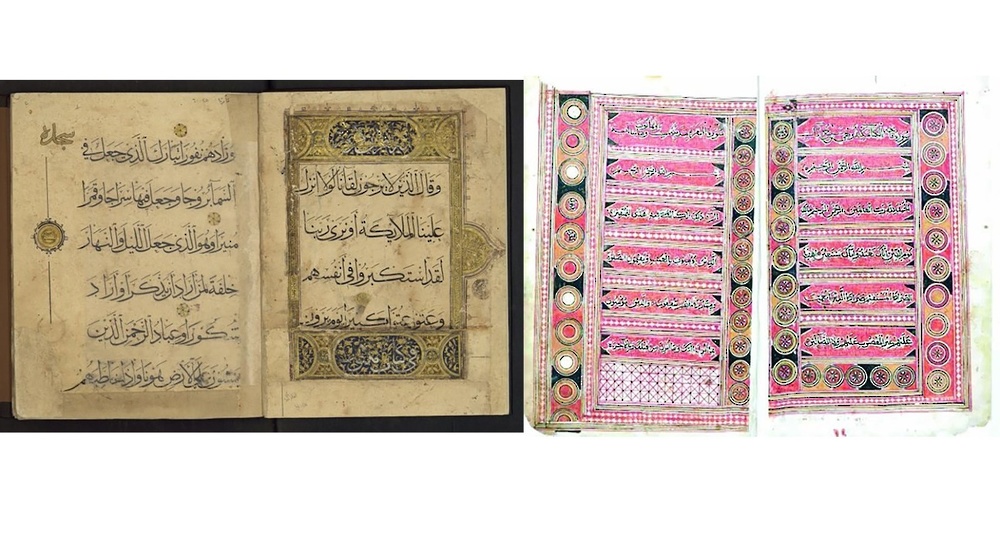
Muscat, (ONA) -The Greatness of Islam Hall in the National Museum in Muscat is rich in many treasures that enrich the visitor to the museum and introduce him to the Omani contributions in many fields of science, as the hall includes among the exhibits many Omani Qur’an manuscripts that Omani scribes and calligraphers gave great importance and competed in its mastery and creativity, which are distinguished by the beauty of calligraphy, good binding, decoration and gilding.
In the Manuscripts House at the Ministry of Heritage and Culture, there are a large number of Quran manuscripts, exceeding 200 copies. Muhammad bin Fayel Al-Tarshi, Head of the Manuscript Registration Department at the ministry, says that among these manuscripts there are “Qur’an manuscripts distinguished by their ornamental character and their geometric and botanical shapes that are realistic, modest and brightly colored, as Omani calligraphers and scribes tried to do their utmost in copying this type of manuscript in the distinctive Omani script, which combines the naskh and thuluth font and uses intertwining lines at the beginning and end of the manuscript.”
Al-Tarshi, who prepared a research in this regard, added that “Omani calligraphers and copyists used many tools in copying Qur’ans to draw geometric shapes, including circular, oval, rectangular and square. These decorative elements were dominated by the colours and inks prevalent at the time, such as red, black, blue and brown, and the use of gold decoration within the narrowest limit. This decoration is evident in the wonderful paintings at the beginning and at the end of the Qur’an, which we call the introductory page or the opening page, and also at the beginning of the surahs and page frames and in the margins that include signs of verse headers, parts, and special places. This is followed by many margins such as endowment, ownership, purchase and loan, in addition to many written phenomena at the beginning and end of the Qur’an, which constitute wonderful paintings. For example, poetic verses were written at the end of the manuscript, especially when the closing entries in the manuscripts are separate from the text, which makes some scribes add some verses at the end of the Qur’an expressing their suffering and the effort they made.
He explained that “one of the written phenomena that are considered decorative elements with which Qur’ans are adorned is that words are divided at the end of the line and completed in the next line or in the margin to preserve equality between these lines.”
He pointed out that “there are many examples of these Qur’ans in the library of the Ministry of Heritage and Culture and also in the Omani Qur’ans in public lockers. Also among the writing phenomena are Qur’anic verses. One of the well-known Qur’ans, the “Al-Mushaf Al-Sindi” manuscript, scribed by the calligrapher Muhammad bin Fadhil Al-Sindi, in 1179 AH in Bandar Muscat and preserved in the Ministry’s library with No. 2863, the end of which was sealed with a Qur’an verse from Surat al-An'am “Your Lord's word has been fulfilled in Truth and justice. There is no power that could change His words. He is the All-Hearing, the All-Knowing.” This verse is written in a circular frame with a blue background and decorated in red, yellow and black colours.
Muhammad bin Fayel Al-Tarshi said that “one of the written phenomena is “taqeebah” which is the word that is often at the bottom of the right-hand page to indicate the beginning of the next page. It is also known with the term “inter-page succession”. It is a type of numbering that scholars used to arrange their writings, which is for the copyist to write at the end of the Qur’an under the last word of the last line, the first one or two words from the next page to indicate the sequence of the text. They would do that to help them in the arrangement of the papers when this arrangement was disturbed due to the disintegration of the manuscript papers and so on.
Al-Tarshi stated that “the decoration was also not limited to the written phenomena, the beginning and the end of the manuscript, but also the decoration extended to the two covers of the manuscript. I looked at Omani Qur’ans preserved in the library of the Ministry of Heritage and Culture, with preservation number 4891, lined with a silk cloth. Lining is a type of decoration in Ebru colours, which is an ornament inspired by Persian Qur’ans that appeared in the tenth century. There are Omani Qur’ans lined with this type of intertwining colours.
He pointed out that “some of the Qur’ans preserved in the library of the Ministry of Heritage and Culture, some of which were returned to the Ministry, including Omani Qur’ans that were written by Omani copyists, and some of them are non-Omani Qur’ans, which are Maghreb, Persian and Turkish Qur’ans, with records indicating deaths of the owners and Omani endowers.” The number of Qur’ans which have been counted, described and indexed is estimated at more than 300 Qur’an manuscripts. It is clear through the recording of dates of deaths on khatmah manuscripts that these manuscripts are read on the soul of the dead.
He added, “I studied Qur’ans that spanned from the eleventh to the fourteenth century AH. The oldest copy of the Qur’an that I have found in the library of the Ministry of Heritage and Culture is the one written in 1054 AH by Salem bin Rabi’i bin Rashid Al-Bahlawi, which holds the preservation number 15. However, the oldest copy in Oman is preserved in the treasury of Abu Al-Hakam Ahmed bin Abdullah Al-Harithi which was written in 1028 AH by the calligrapher Ahmed bin Abdullah Al-Khalili. The most recent of these Qur’ans was the manuscript written in 1332 AH by Zahran bin Khalfan bin Surur Al-Yarubi and it is preserved in the library of the Ministry of Heritage and Culture under the preservation number 4393.
He said that his study “divided the Qur’ans that are the subject of the research into complete Qur’ans whose copyist is known with the statement or clues, and their number is estimated at more than 50 Qur’ans and incomplete Qur’ans whose copyist and dates are unknown, which forms the majority and their number is estimated at more than 250 copies. As for the incomplete Qur’ans, the first and the last parts are missing and their original covers are lost. This loss was due to the frequent use of these Qur’ans, aging, erosion, and dampness or by robbery of some of those papers, especially those containing copy data. So we find many of these copies of the Qur’an were mutilated, as well as some scribes deliberately not writing their name and copying information.”
Muhammad bin Fayel Al-Tarshi, head of the Manuscript Registration Department at the Ministry of Heritage and Culture, explained that those Qur’ans that follow its study took two vascular forms, namely the Qur’ans and quarters, as the number of Qur’ans reached 260 in addition to 40 Qur’anic quarters and khatmahs. Most of these copies of the Qur’an are vertical, so that the height of the Qur’an is greater than its width. There are other forms of the Qur’ans, in which the width is greater than the length. They are not available here and appeared in the first Hijri centuries.”
Regarding the size of vertical Qur’ans in the library of the Ministry of Heritage and Culture, Al-Tarshi said, “The largest size is 36 cm by 25 cm, and the smallest is 16 by 10 cm, which is a quarter of the Qur’an, and between these two sizes came the rest of the Qur’an copies.” He pointed out that the rarest manuscript copies kept in the Ministry's library are the Qur’an of the Seven Qur’an in the handwriting of the calligrapher Sheikh Abdullah bin Bashir bin Masoud Al-Hadhrami Al-Suhari in the twelfth century AH. He is classified as a skilled copyist for the splendor of his handwriting. He is also a scholar and author and has jurisprudential classifications, and among his scholarly monuments are “Al-Kawkab Al-Duri”, “Al-Noor Al-Mustabeen” and “The Compendium of Kitab al-Musannaf,”. Al-Hadhrami completed writing the Noble Qur’an on the sixth of Muharram in 1253 AH, which is one of many Qur’ans he wrote in beautiful naskh script. He made the color black the basis, and colored red the first line from the beginning of each part, the names of the surahs, the name of Allah, the basmalah, and the first letter of each line. Al-Hadhrami was skilled at coordinating pages and lines, as each page begins with the beginning of the verse and ends with the end of the verse, and the first letter that begins with the first line is the same letter that begins with the last line on the page, and the first letter of the second line from the top of the page is the first letter of the second line from the bottom, and so on, the rest of the lines. The layout continues with this symmetry in the rest of the pages. As for the eighth line in the center of the right-hand page, its first letter is the same letter at the beginning of the eighth line of the left page.
Among the Omani Qur’ans in the Manuscripts House is the Qur’an of (Al-Riyami), for which the readers do not find any inscription or decoration, and it is a Qur’an written by the writer Amer bin Suleiman Al-Riyami, one of the scholars of the thirteenth century AH and completed his writing in the middle of Dhu al-Hijjah 1240 AH. The reader finds the coloring and decoration on its first two pages only, but it is a simple decoration as if it is a piece of old Omani tapestry. As for the copyist’s font, it is not distinctive but clear and legible, the lines are spaced, and the reader does not find a trace of decorative motifs. Rather, the pages of the Qur’an are usually devoid of framing and the calligrapher color is red. The names of the surahs that are surrounded by a frame in some cases.
Among the Qur’an copies of the House is also Mushaf Al-Waili, which is among the examples in which the simplicity of manuscripts of Omani Qur’ans appears. It is scribed by Suleiman bin Matar al-Waili who completed it on Monday 2 Jumada al-Ula 1291 AH. The reader does not find any decoration in this Qur’an manuscript other than a frame made of two parallel lines in red sometimes. This type of Qur’an is very common among the people of Oman. It stems from a principle that considers the beauty of it not in the decorations, inscriptions and adornments, but in the simplicity that gives the reader comfort and serenity, in the clarity of the handwriting and the control of the form that helps him to a correct and accurate reading of the Holy Qur’an and there are many examples of this type in the Manuscript House.
ONA / FANA