
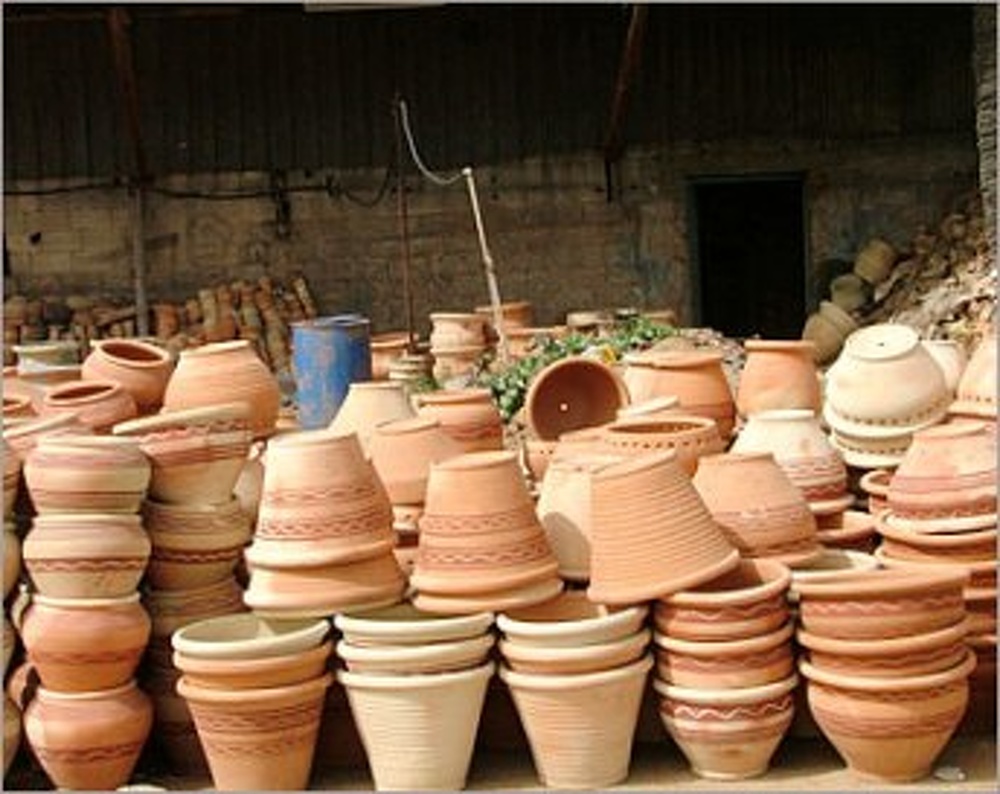
Muscat,/ ONA / FANA - The National Museum in Muscat displays in many of its halls a number of pottery and stone vessels or fragments of them of different shapes and decorative patterns, as the common vessels of stone vessels at the beginning of the Iron Age largely contained straight sides with prominent edges. These vases are similar in shape to pottery vessels from the same period, and the engraved circular shapes have been replaced by zigzag patterns, vertical lines, and triangles with thin lines. By the end of this period, those vessels demonstrate the predominance of zigzag lines, and sometimes include primitive shapes.
The archaeological findings in the village of Bat near the Wilayat of Ibri in the Al Dhahirah Governorate, and Al Arja in Wadi Al Jizi near the Wilayat of Suhar in the North Al Batinah Governorate, and the Al Akhdar village in Wadi Samad in the Wilayat of Al Mudhaibi in the North Sharqiyah Governorate, dating back to the fourth millennium AD, indicated that there is a widespread industry of pottery. It was described that it was a sophisticated and refined industry like its counterparts in the region at that period, and that it was contemporary to the ancient Sumerian civilization in Mesopotamia, such as the regions of Ur and Jemdet Nasr. It was influenced by the pottery-making methods that existed at that time in southern Persia, and this indicates that there were ancient trade links between Oman and these regions.
Pottery pots were found on a hill near Baysa, south of Bahla, in the Ad Dakhiliyah Governorate, including vessels with thick walls similar to those found in the excavations of Ras al-Hadd port, which in turn resembles what was found in Gedi and the Lamu Islands group in East Africa, or Seraph overlooking the Persian Sea. The vessels uncovered in Bahla indicate the intertwining of links and mutual interests between the country's interior and its coasts. A group of pottery pieces were also found at the mouth of Wadi Bani Kharous on the coast south of Al-Batinah between the cities of Al-Musanna and Barka, similar to the pottery found in Samarra in Iraq and Seraph in Persia, and Yemen. This indicates that Oman was a crossroads where the influence of different civilizations met, and melted them into its melting pot. For example, in the Bahla factory, we find that the pottery wheel and the mould in which it is poured is similar to the ancient Sumerian pattern, while the Sour al-Sawadi factory in the Wilayat of Saham in the North Al-Batinah Governorate was affected by the Persian style, in terms of the mould and the stove in which the pottery was burned. The Muslimat Factory (village of Wadi al-Ma'awal) combines the Sumerian and Persian styles. Blue-green pottery pieces were also found, and other glazed vessels.
The pottery artefacts displayed in the National Museum are distinguished by various motifs, which confirm the Omani artist's ability to innovate and the abundance of ideas and plastic solutions that he possesses to express the content of his culture, and the rich use of plastic components that occupied the various spaces with several decorative units, including the grooves on the wet surface which is wet, which may be filled with colours. Among the decorations that were also used were those that depended on geometric and plant units, calligraphy elements, or decorations derived from the Islamic heritage, such as hollow decorations and writing Qur’anic verses. Omani craftsmen have used clays since ancient times in pottery industries that are distinguished by traditional shapes, richness of decorative surfaces based on line and point, and visual features associated with simplicity of execution.
In this regard, Nasir bin Saif Al-Hatami, a fine artist and designer in traditional crafts, said, “The legacies of pottery since its first inception are distinguished by the grace and beauty that determine their original strength and absolute benefits, as these pottery legacies are distinguished by their traditional forms and the richness of their decorative surfaces based on calligraphy and point and visual features associated with the simplicity of execution, based on some simple skills and handprints and point prints, using simple tools such as ropes and pieces of wood that leave a mark on pottery and add the aesthetic touch that we see in ancient pottery.
Al-Hatami added, “Omani potters used two types of clay through the samples found in the National Museum, which indicates that he used Muddar clay, which is now easily and conveniently available in many governorates of the Sultanate. It is distinguished by its temperature tolerance, porosity and flexibility thanks to the particles that make up the properties of this type of clay. Its colour ranges from creamy white to pale pink and can be seen in many halls of the National Museum in incense burners, grinders, and utensils used to preserve water. Omani pottery makers also used Al Serboukh soil, which is a smooth, stony soil that is used after grinding and is characterized by its hardness and resistance to heat at very high temperatures. It was used in making utensils for cooking and preserving milk.
He explained, “The legacies of the pottery can be seen that they are distinguished by their similarity in terms of shape and nomenclature, with slight functional differences that distinguish each product from the other. An example of this is the jahla (water pot) which is a pottery vessel known for preserving and cooling water. The name is the same, but it differs in shape. In the wilayat of Bahla in Al Dakhiliyah governorate, Al Jahla has a spherical bulge in its belly, while the one made in the wilayat of Saham in the North Al Batinah Governorate is characterized by a greater breadth at the point of the abdomen so that it tends to be oval. Geometrically, this shape did not come randomly, as the craftsman intended the shape in terms of the positive flow of water while it was poured from it, as well as the cooling quality in terms of the pores in this vessel when hung.
He says that, “by viewing the holdings in the National Museum and related to pottery makers, we notice the use of Omani potteries for a set of very advanced skills at that time despite the simplicity of pottery forms, as wheel, rope, slice, and footprint shaping was used by cutting fabric or by using moulds made with tree leaves or pieces of cloth. This technique, despite the continuity of this craft, but in shaping and manufacturing, is inherited until now. As for the divisions related to the shape, some utensils such as braziers, jars and censers appeared through the shapes in the museum. Omanis used simple primitive methods of decoration based on engraving with simple tools, such as spiral winding using ropes or using a wheel, and the use of direct decoration by means of colouring with natural dyes that tended to reddish at the beginning of the making pottery and ceramics.
He added that in terms of techniques and methods of burning clay, and based on the collectibles, the Omanis used simple methods of burning. They used furnaces or direct clay burning and the techniques of making furnaces that contain the house of fire and ash and the house of artefacts and other burning as well as forming techniques. Through what was found from the pottery legacies, the human being was affected by the different environments in Oman. If we observe the forms of Omani pottery, we will find, for example, the Omani incense burner in Musandam was found in the form of layers. The shapes in Dhofar differed, taking the flexible circular shape and the square shape with sharp corners formed from the upper sides. The same decorative units were reflected on the same roofs of incense burners found in Dhofar and in Musandam Governorate, while we note the incense burners used in northern Oman are distinguished by their small size and simplicity of their inscriptions.
ONA / FANA