
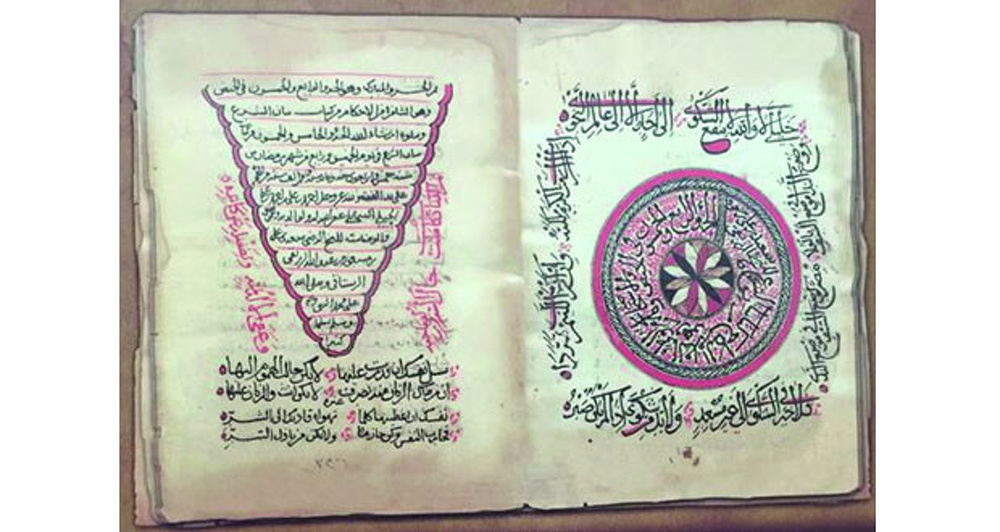
Muscat,(ONA) - The Greatness of Islam Hall in the National Museum in Muscat includes a large number of Omani manuscripts in the sciences of the Islamic faith and the natural sciences and its branches, including astronomy, biology, chemistry, physics, medicine, mathematics, sciences of Arabic language and literature. In addition, it displays a collection Omani Qur’an manuscripts that is distinguished by its writing style, binding, decoration and gilding.
Among the manuscripts presented in the hall to introduce the contributions of the Omani school to the sciences of the Islamic faith, Arjozat Al-Na’ma Al-Kafiyah by the scholar Sheikh Muhammad bin Ibrahim bin Suleiman Al-Kindi Al-Samadi Al-Nazwi, the manuscript of Al-Nur Al-Mustabeen by Sheikh Abdullah bin Bashir Al-Hadhrami and Manhaj Al-Talibin and Balagh Al-Raghebeen manuscript (Part Five). In addition, it displays the second part of the Manuscript of Bayan Al-Shara (The Clearness of Islamic Law), which is considered one of the oldest and most important legal references of the people of Oman, which was copied hundreds of years after the death of its author.
Fahd bin Ali Al-Saadi, a researcher in history, says that the author of the book Bayan Al-Shara is Abu Abdullah Muhammad bin Ibrahim bin Sulayman Al-Kindi, a scholar of the fifth century AH, who died in the year 508 AH. He is a judge, Jurisprudent, and poet, and he was one of the diligent people in seeking knowledge, and he was a student at the hands of the sheikhs of his time, such as Sheikh Abi Ali Al-Hassan bin Ahmed bin Muhammad bin Othman Al-Nizawi. Sheikh Al-Kindi left many Omani literature and brief letters in the fields of jurisprudence and faith, and he has separate answers. He also wrote the poem “Al-Abiriya”, composed of 83 verses, in which he describes heaven and what God has prepared for His people, and it is located in 83 houses.
He added, “Bayan Al-Shara is the most famous Omani book authored, and this book, if mentioned, then comes to mind the Omani encyclopaedias that consist of tens of parts. It comes in 72 parts, and its copies exceed more than 3 thousand manuscripts found in Oman and abroad, and it mainly deals with the fundamentals of Sharia and its branches and contains some history and other sciences that we may not find in many Omani books. A number of researchers turned around in the late period and wrote many scientific treatises on historical subjects that relied on this book as its first source, as it is an important reference for those who wanted to write about the biographies of Oman's scholars through its centuries to Sheikh Al-Kindi. I have written a book consisting of more than 600 biographies in which I relied on Bayan Al-Shara, including the biography of Abu al-Mu'thir al-Salt ibn Khamis, in twenty pages based on Bayan Al-Shara, and also the biography of Sheikh Musa bin Ali Al-Azkawi in more than 30 pages based on the same book. Also, the reader of this book can find issues related to geography within the borders of Omani countries and introduce them. We can make an Omani historical atlas by referring to the book Bayan Al-Shara A researcher in the field of economics can also look at this book, coins, existing currencies, buying and selling methods, and the organization of the jurisprudence of markets and others.
He explained that, “as it is mentioned that its author died before he arranged it, but the one who arranged and put its introduction was his cousin, Ahmed bin Abdullah al-Kindi, the author of Al-Musannaf book, which is also an encyclopaedia which comes in 41 parts.” He pointed out that “the author of the Bayan Al-Shara book tried in his book this to collect a lot of the writings and opinions of the scholars who lived before him. He was not a closed scholar. He included in his book works on fiqh (jurisprudence) by non-Omani scholars and other schools of thought. He arranged his book tightly according to the chapters of jurisprudence.
Researcher Fahd Al-Saadi admitted in his speech that “due to the importance of this book, scholars dealt with it by copying summarizing it. Among the Omani scholars who summarized it, Sheikh Saeed bin Abdullah bin Amer Al-Azkawi and he has a book called “Al-Ikhtisar min Ma’ani A-Aathar. Likewise, all the jurists who came after Sheikh Muhammad bin Ibrahim Al-Kindi took from this book. Rarely is there a book after the book of Sheikh Al-Kindi that did not rely on the book Bayan Al-Shara. For example, Sheikh Jamil bin Khamis Al-Saadi made it a source for his book The Dictionary of Sharia, which is a book that falls into 90 parts with its rearrangement, indicating that one of the characteristics of Omani literature is that it includes increments by scribes or scholars, and the most famous of these books and manuscripts is the Bayan Al-Shara book.
The parts of the Bayan Al-Shara book include chapters on science, the fundamentals of jurisprudence, rulings of the Qur’an and its sciences, the fundamentals of religion, guardianship, innocence, judgment, sermons, morals, intentions, purity, impurity, prayer, zakat, fasting, pilgrimage, vows, penances, faith, sacrifices, judiciary, good deeds, prohibition of evil, claims, testimonies, affirmation, exchange of contradictions, marriage, separation and waiting period, the rights of husbands and children, menstruation, provisions of slaves, lineage, orphans, wills, obligations, trusts, guarantees, penalties, retribution, blood money, imamate, jihad and war. It also included a multitude of cataclysms and scientific issues that reflect a vivid picture of Omani society at that time, in addition to a rich material on Islamic jurisprudence and political history in Oman.
It is also considered the largest book compiled after the (Dictionary of Sharia) by Sheikh Jamil bin Khamis Al-Saadi, who was born in the town of al-Qurt near al-Masna'a, who lived in the thirteenth century AH, and comes in 90 parts. It is also one of the largest Islamic books, and it contains all the chapters of Sharia including faith, jurisprudence, ethics, morals, and fundamentals of jurisprudence, and a very large collection of hadiths. It also contains the sayings of scholars from various Islamic schools from the first century AH to the thirteenth century AH.
ONA / FANA