
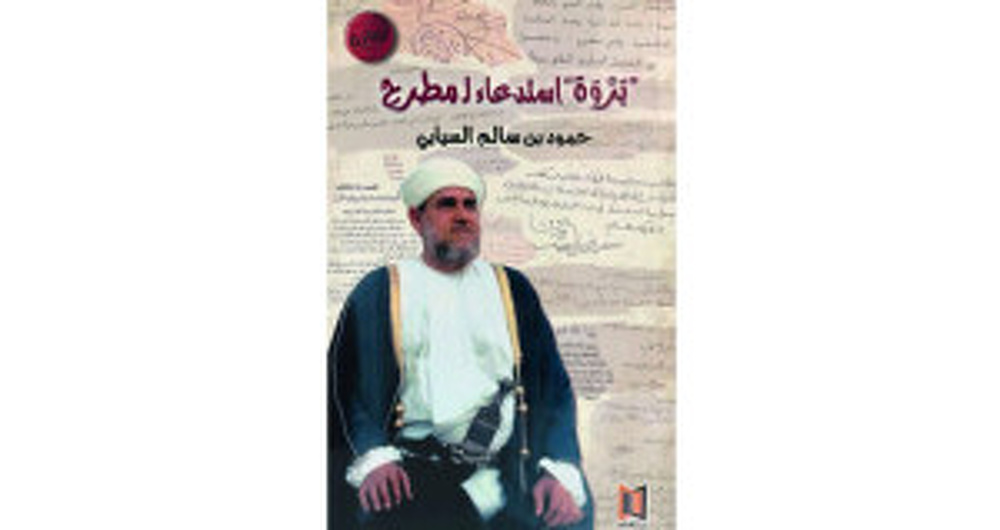
Muscat,(ONA) - In his latest publication, Hammoud bin Salem Al-Siyabi converges between history and fictional art through his new narrative work, “Summon Barwa (Document) to Muttrah”, which is a fictional approach to the history of this city through his summoning of the character of Wali Ismail Al Rassasi in the days of Sultan Said bin Taymour.
The 400-page novel is a dialogue of two times, the time of writing the novel, where Muttrah was closed with the emergence of the cholera epidemic and its hero Saeed, who tells the story of his father, and also the story of love that he lives with the girl from Sur, and another time with the trip to the city of Muttrah in modern history, and the events that occurred during the period of Sultan Said and its wali (ruler), Al Rassasi, passing through Muttrah’s famous figures and its lanes and paths.
In its last cover, the writer Muhammad bin Saif Al-Rahbi writes about the novel: “It is not a novel ... but more than that, as it can be described as an Omani historical manuscript wet with water from the Sea of Oman as it kisses the feet of the city of Muttrah, which almost reaches its fortified castle, evoking the Wali Al Rassasi, its lanes, and its homes, penetrating into its old story. It is a poetry collection written with the remainder of the ink of the poem of Imru’ Al Qais when he cries over the ruins. It is what Nizar Qabbani was unable to say to his beloved Belqis, so Hammoud Al-Siyabi spreads it in the form of roses and jasmine through the protagonist of his novel on his sweetheart from Sur.”
Novelist Muhammad Al-Rahbi describes it as “a bright and daring novel, documenting what happened decades ago, and preserving what is happening for the next decades.”
Al-Siyabi divides his novel into a group of titles for each chapter, in some of which he questions his father about the conditions of Muttrah.
This novel is the first publication of Al Siyabi, who wrote in the eighties several stories published by the Oman newspaper, in which he worked for many years. It is noteworthy that this novel is one of the publications of Dar Al-Ghasham as its latest issue. The publication is available in the publisher’s library, which is expected to turn into another name within a new project soon, succeeding Dar Al-Ghasham, which was established in October 2012. Over the course of nearly 8 years, it has issued more than 750 publications, most of them by Omani writers and it has participated in several activities inside and outside the Sultanate.
(ONA)