
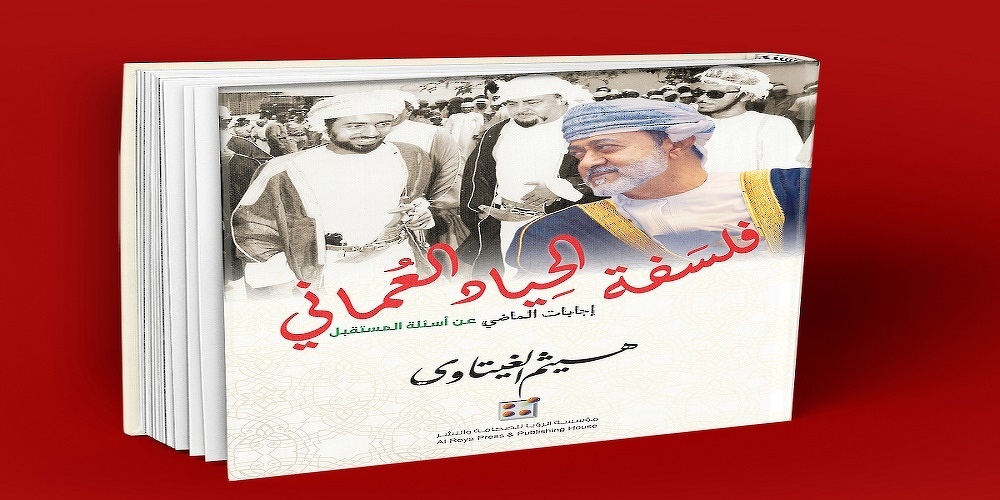
Muscat, August 10 (ONA) - Under the title “The Omani Philosophy of Neutrality ... Answers of the Past to Questions of the Future”, Al Roya Press and Publishing House has issued a new book that examines and documents historical facts that prove that the Sultanate’s commitment to its realistic diplomacy and positive neutrality has achieved many gains over the course of half a century.
In 6 chapters, the journalist, researcher and author Haitham Al-Gheitawi explains how this tolerant mental image of the Sultanate abroad was and still is an intuitive reflection of the spirit of understanding, coexistence and tolerance, which has become one of the most important components of the Omani identity at home.
State Council member and editor-in-chief of Al-Roya newspaper, Hatim bin Hamad Al-Taie, said in the introduction to the publisher, “Al-Roya Press and Publishing House is proud to crown its cultural and historical publications lists with a new book that contributes to perpetuating the achievements of the quiet Omani diplomacy that established its foundations over the past half-century of the late Sultan Qaboos bin Said bin Taimur and it was valued by His Majesty Sultan Haitham bin Tariq, in his first speech, describing it as a ‘great heritage’ on which the Sultanate will build - on its basis - the future of its relations with the countries of the whole world … This diplomacy, which was His Majesty Sultan Haitham bin Tariq himself one of its creators during the 20 years he spent in the Ministry of Foreign Affairs.”
Regarding his research journey to prepare the chapters of his book, researcher Haitham Al-Gheitawi says, “I started working on the book project in November 2018, and its core was a press report entitled “Whoever enters the Qaboos Oasis, he is safe.” It was published on the pages of “Al-Roya” newspaper, in which it reviewed quick stops in the Omani diplomatic journey since the beginning of the Renaissance era and highlighted challenges and decisive positions. The reality of the late Sultan Qaboos bin Said bin Taimur was a safe bridge to cross it and saw it form a general picture of what can be described as “deliberate patience diplomacy”, which made Oman a safe oasis in a world that is not.
“Thanks to the good judgment of the publisher, the intensive press report developed into an expanded research project, and with his constant encouragement, I was able to see dozens of references, research and sources to document and explain what was previously summarized in the report until the 1500 words that formed the body of the press report became more than 107 thousand words that are interpreted, analysed, documented and embedded in the roots of the tolerant mental image that characterized the Sultanate’s reputation in all international forums.
With the reading and analysis of about 98 official speeches of the late Sultan and 51 press interviews and the texts of the royal decrees related to foreign affairs specifically over the past fifty years, I felt that - on a personal level – I rediscover the personality of the late Sultan Qaboos bin Said bin Taimur not only as a wise ruler, but rather, on the level of his human makeup, open mind, and practical and objective philosophy that does not skip the facts of reality or quarrel with logic. Rather, I even felt that I was re-discovering Oman, in which it seemed to me that I had lived for about 6 years without getting close enough to its memory, mind and spirit, which was the main pillar of the Renaissance edifice in all fields.
Documenting and perpetuating the heritage of quiet Omani diplomacy, the author presents a lengthy documentary study in more than 430 pages to introduce the new generations to the challenges and achievements of Oman's diplomacy and its positive neutrality in the era of the blessed renaissance and to clarify what His Majesty Sultan Haitham bin Tariq intended in his first pledge. “We will remain as we used to be to the world ... and we will follow the steps of the late Sultan, stressing the principles that he set for our country's foreign policy.”
It explains the meanings of loyalty, good judgment and belief in the efficacy of the Omani approach in His Majesty’s speech that has been established over half a century, during the reign of the late Sultan until it became an icon of peace, tolerance, coexistence and neutrality, and an example to be emulated regionally and globally.
Al-Taie emphasized that the author was able to pass - with linguistic elegance between fields of thorns, in narrating and analysing the challenges that the Sultanate had overcome in order to reach fair border agreements with its five neighbours, as well as clarifying the historical factors - economically and politically - on which the Sultanate based its position on calling for a “GCC Union” and its commitment to work to achieve the goals of the Gulf Cooperation Council in its current form, on the ground.
The book includes a documentary appendix that includes several important documents, including the royal decrees issued during the reign of the late Sultan Qaboos bin Said bin Taimur, which charted the political path of His Majesty Sultan Haitham bin Tariq since the beginning of his work in the Omani Ministry of Foreign Affair. In addition, it contains the decrees related to border agreements with the neighbouring countries of the Sultanate during the era of the blessed Renaissance, as well as dozens of rare pictures of the late Sultan with leaders of various countries of the world. It also includes pictures of His Majesty Sultan Haitham bin Tariq during his tenure at the Omani Ministry of Foreign Affairs, as well as many rare pictures of His Excellency Yusuf bin Alawi bin Abdullah, the Minister Responsible for Foreign Affairs, which the author described as “the vigilant memory of the Omani diplomacy.”
Under 100 headings and sub-headings, the book does not overlook the factors that have shaped the internally tolerant Omani identity, including the axes of religious and sectarian tolerance, educating young people, diversifying sources of knowledge for young people, good understanding of residents of different nationalities, openness to the cultures and arts of different peoples of the world, as well as the axis of media discipline, which was often praised by the late Sultan, May Allah rest his soul in peace, including his saying, “We believe in the existence of a rational press. Our press is not a means of contention, but rather an ambassador that conveys the desire of one nation to another nation, a journalism that is free, constructive, committed and mature based on study and understanding.”ONA