
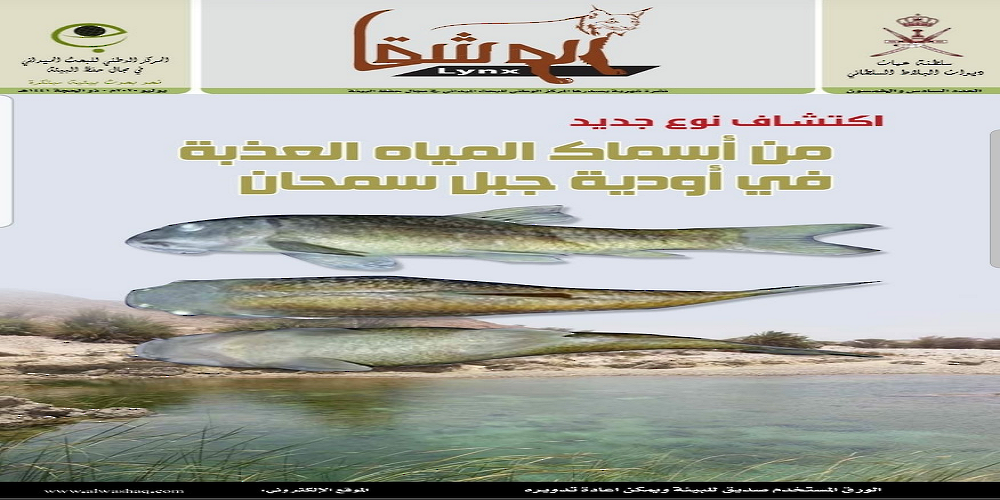
Muscat,- The National Field Research Centre for Environmental Conservation at the Diwan of the Royal Court has issued the new issue of Al Washaq bulletin, which bears the number 56. It was also issued in electronic format in Arabic and English, and it included several important topics dealing with some environmental phenomena.
The new issue dealt with the topic of launching the “Environmental Dictionary” hashtag to promote the culture of preserving the environment, which was launched by the Environmental Preservation Office at the Diwan of the Royal Court. This hashtag aims to spread a number of terms related to the environmental reality and to promote environmental culture among the community. This inauguration comes within the framework of the office's efforts to spread the culture of preserving the environment and involve the community to contribute to the rooting of this culture and to ensure its dissemination in community circles.
The main topic of the new publication of Al Washaq Bulletin, written by Gary Lyon, dealt with the discovery of a new species of freshwater fish in the valleys of Jebel Samhan. A team of researchers from the National Field Research Centre for Environmental Conservation at the Diwan of the Royal Court has discovered a new species of fish in freshwater ponds in the valleys of the Jabal Samhan Nature Reserve in the Dhofar Governorate that feed on rock plankton, and it was called Garra sindhi.
The details of this discovery go back to an expedition in late 2014 by a team from the centre where a small group of researchers, including Gary Lyon, Dr. Marina Tsaliki, Dr. Erica Cuellar, Muammar Al-Shanfari, and Khaled Al-Hakmani. They went to Najd through Thumrait, with the aim of conducting a short study of that area, hoping to record as much information as possible about the wildlife that can be found in the Jebel Samhan Nature Reserve.
In fact, the team has discovered a large part of the Jebel Samhan Nature Reserve, as it conducted an intensive year-long study of the biodiversity of many wadis (dry river valleys) in that area. The aim was to try to quickly scan what might be found in the area. The study has yielded a wealth of information about the life of birds, mammals, reptiles, amphibians, plants, aquatic life and invertebrates in the area, including potential new plant species and a new species of desert rat.
When the research team approached the freshwater pools on foot, they immediately noticed that there were some fish swimming in the shallow waters of these rock pools, and their number was rather large. When the fish were dashing from shallow water into the clear water, the team found that they were olive green in colour. It has also been found to be feeding on rock plankton using their lower, sucker-like mouths. The sizes of these fish vary, as the large ones range from approximately 80-85 mm, while the average size is about 45 mm. Among them were also smaller specimens, green in colour, with speckled gold spots that were very visible in the light and had a faint yellow or golden dorsal band running across their back. In addition, the team observed the presence of a waterfowl known as a monocle, a native waterfowl known to chase fish underwater.
Al Washaq Bulletin has also discussed the topic of “Sultanate and Immigration.” It also dealt with a number of dispersed news from the Sultanate and the Gulf countries, including the slogan “The difference is only two seconds”, the “Be’ah” campaign to limit the throwing of waste outside the containers. It discussed the signing of a memorandum of understanding for the protection and multiplication of Houbara birds from the UAE, the removal of the Ghweif trees on the Al Shamal Road from the State of Qatar, following up on the phenomena of fish deaths from the State of Kuwait, the camel numbering project to reduce traffic accidents due to loose camels from the Kingdom of Saudi Arabia, as well as signing the memorandum of understanding in the field of environmental and climate protection from the Kingdom of Bahrain.
(ONA)