
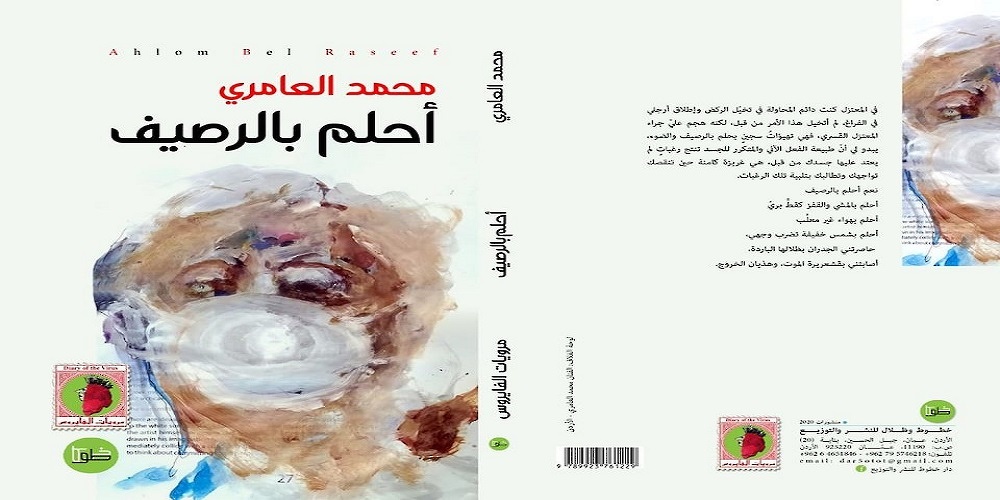
Amman, July 6 (ONA) - “I dream of the Pavement” book by writer and artist Muhammad Al-Amri provides daily narratives on the isolated person in the time of “Corona”, including a set of careful reflections on the nature of the movement of the human in quarantine and its daily suffering, as the window becomes the rectangular eye from which the author overlooks the world.
The book, published by Shadow Lines House for Publishing in Amman, is introduced by Anis Al-Rafii, saying: “I do not know the objective or intellectual justification, which prompted me to start reading the journal of Muhammad Al-Amri from the end. Is it a crazy desire to dig a disaster well from below? Or do you see it as a desperate attempt to rebuild the edifice of the bereavement, just as the archaeologist intends to resurrect the cities buried under the soil of the earth, starting from the fossils and remains of ruins?”
He added, “This epidemic is a severe vice that afflicted humanity in the endosperm and shook various known life systems. Perhaps its contemplation through the viewpoint of the narratives of the virus, whether literary or those that have been introduced by ordinary people, will contribute to dissecting this historical pandemic, which has become the bridge of time between the two eras: the world before the Corona and the post-Corona era.
Al-Rafei continues by saying, “Muhammad Al-Amri describe his brief notes written with the edge of a razor blade, within its sub-genre framework as lonely. It is an indicative and eloquent description with all the meanings of ruin. I mean, the total ruin of the outside, the ruin of life that fell vertically into the coma of clinical death.”
Al-Rafii believes that “I dream of the pavement” represents a diary for the inside par excellence. “The inside that has turned into an impenetrable fortress against the upcoming attacks of the pandemic. The outside is now a wasteland without a doubt, but the inside has quickly become all the necessities of survival and its vital causes.” Therefore, In the inside that Al-Amri has re-discovered, we find a man like Muhammad Al-Amri, the artist, poet, and narrator, who tries to mimic the precious details and elements of his previous roles and functions, which he performed in his previous life.”
While Al-Amri fails miserably in this matter, as Al-Rafii sees. “We see him resorting instead to lying on top of a long sofa with a soft feel, which he calls (the blue sarcophagus), then he begins to resist the outside with the inside furnishings and its elements. With his brushes, colours and pens, he drew sketches and layouts on paper. He looks carefully at boredom, emptiness, silence and isolation. He encompasses music, poetry, shadow and time. He thinks about the rose, the tree, the bird and the shoes. He explores the window, space, memory, and body. He tries his best to awaken life from the heart of the inside and to pull what was outside into the inside, into the deep inside, which has become the only safe shore, capable of saving being and existence from fatality.”
(ONA)