
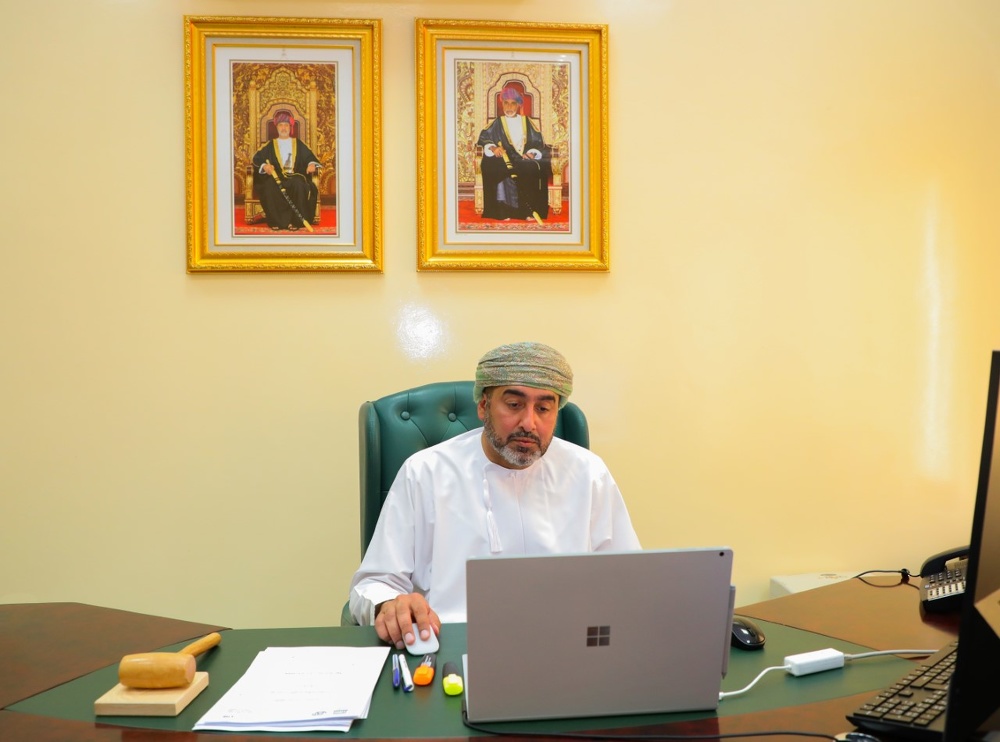
Muscat,(ONA) - The Sultanate represented by the Ministry of Arts Affairs presided over the meetings of evaluation files for the nomination to the lists of cultural heritage intangible held through video conferencing.
The Sultanate was represented at the meeting by His Excellency Mr. Saeed bin Sultan Al Busaidi, Undersecretary of the Ministry of Arts Affairs and Chairman of the UNESCO Evaluation Experts Committee.
In pursuit of the practice adopted by UNESCO, the Sultanate received the hammer of approving the decisions of the Committee of Experts of the Convention to adopt the decisions issued by the Committee.
During the meeting, members' opinions were discussed regarding the criteria through which the evaluation stipulated in the guidelines, each in its field. It included files submitted to the International List of Intangible Heritage, files provided for the urgent safeguarding of the intangible cultural heritage, and best practices related to the safeguarding of the intangible cultural heritage in accordance with the guidelines of the Convention.
Regarding the files submitted to the International List of Intangible Heritage, many criteria were discussed. The element should constitute an intangible cultural heritage as defined in Article 2 of the Convention. The element contribution should take part in securing the visibility of intangible cultural heritage, raising awareness of its importance, and encouraging dialogue, thereby expressing cultural diversity in the whole world and promoting evidence of human creativity. Measures for safeguarding should have been put in place that protect the element and ensure its promotion, and that the element has been nominated for safeguarding after the widest possible participation of the group, the group concerned, or the individuals concerned, according to the situation, and with their free, prior and informed consent. The element should be included in the list of intangible cultural heritage present in the territory of the State party (the States Parties) that submitted the nomination.
As for the files submitted for urgent preservation, the following criteria were discussed, namely: The element constitutes an intangible cultural heritage in accordance with its definition in Article 2 of the Agreement. The element is in urgent need of preservation because its survival is fraught with risks despite the efforts of the group or team or the efforts of the individuals and the State party (the States Parties) concerned, depending on the situation. The element is in urgent need of safeguarding because it faces grave threats that make its survival impossible without urgent preservation, and that safeguarding measures have been put in place that enable the group, group or individuals concerned, depending on the situation, to continue to preserve and transfer the element. The element has been nominated following the widest possible participation of the group, group or individuals concerned, as appropriate, and with their free, prior and informed consent. The element has to be included in the list of intangible cultural heritage present in the territory of the State party (the States Parties) that submitted the nomination, in accordance with articles 11 and 12 of the Convention. Consultations have taken place duly in cases of extreme urgency, with the State party (the States Parties) regarding the inclusion of the element in accordance with Article 17.3 of the Convention.
As for best practices related to safeguarding intangible cultural heritage, criteria have been discussed, including that the program, project or activity includes safeguarding, according to its definition, that the program, project or activity promotes coordination of efforts aimed at safeguarding the intangible cultural heritage at the regional, sub-regional or international levels, and that the program, project or activity express the principles and objectives of the Convention.
In addition to the fact that the program, project or activity has made an effective contribution to preserving the intangible cultural heritage and ensuring its survival, and that the program, project or activity is in the implementation stage or has been implemented with the participation of the groups and the groups concerned, or the individuals concerned, according to the case, and with their free, prior and informed consent. The program, project or activity shall provide a model at the sub-regional, regional or international level, as appropriate, for conservation activities, and that the proposed State party (parties), the implementing body (bodies), the groups and groups concerned, and the individuals concerned, as appropriate, willing to cooperate in spreading best practices, if their program, project or activity is chosen. The program, project or activity shall contain experiences whose results are evaluable, and that the program, project or activity applies to the special needs of developing countries.
The meetings between the Sultanate and UNESCO will continue until the third of July through video conferencing technology to produce the best recommendations and proposals for safeguarding the lists of intangible cultural heritage of the Sultanate and member states.
(ONA)