
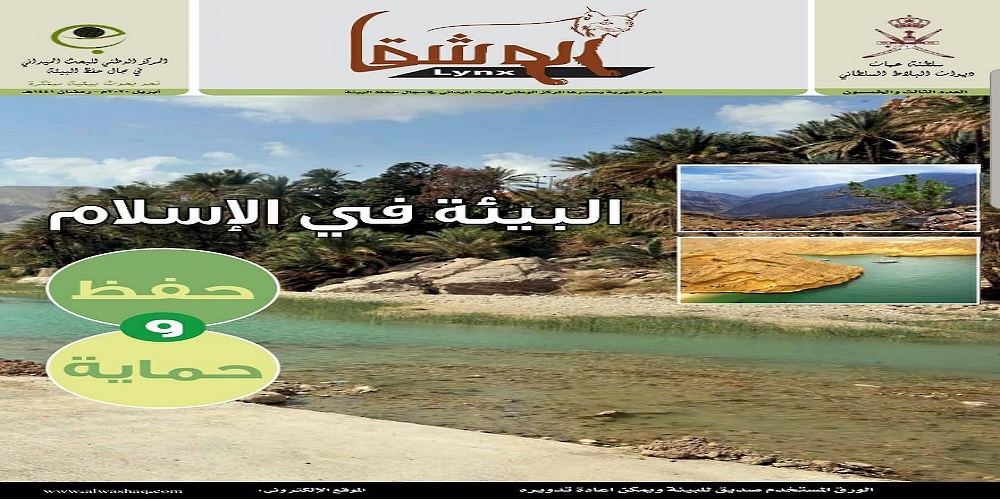
Muscat,(ONA) - The National Field Research Centre for Environmental Conservation at the Diwan of Royal Court has released the new issue of Al Washaq bulletin No. 55. The new electronic issue in both Arabic and English included several topics and discussed some environmental phenomena.
In the column of the point of view by Dr. Dawood bin Suleiman Al-Balushi, the chief editor, bore the title of “When is it the time?” in which he spoke about the slogan for celebrating World Environment Day. He said that the slogan for celebrating this year's World Environment Day, which falls on the fifth of June every year, has sparked widespread controversy in global environmental circles. The United Nations organization adopted this year’s slogan “It is Time for Nature” under the topic (Biodiversity), which confirms that it is time for all countries of the world to look positively and in depth on the importance of biological diversity, and that this diversity is the basis of life. Any damage to it leads to an imbalance in the global environment, which leads to environmental, natural and biological disasters at the global level.
Many environmentalists believe that this time has not come, but that it has already come in the past in their calls to preserve the environment, and that the current time is not the time to be aware of the importance of biological diversity in daily life, but rather the time to hold the human conscience accountable for its wrong behaviors in dealing with biodiversity. It is time to harvest the changes that human hands have gained from changes in the environmental, natural and biological systems. It is time to monitor the haunting global transgressions that claimed the lives of many people until now, and caused the loss of many natural habitats, the extinction of rare animals and plants, the degradation of forests, deserts and vegetation, the spread of pollutants of various forms on the parts of the world, the spread of diseases and serious epidemics as a result of research and biological factories and conducting genetic transformations in the composition of living organisms, viruses and bacteria. If biological diversity is of such critical importance in preserving the global system of life, is it time to be aware of its importance, or is it now time to address the damages that are caused by the lack of attention? The rings daily life and says when the time is.
The main topic of Al Washaq Bulletin in its fifty-fifth issue was entitled “Used vehicle oil ... from imminent danger to promising economic opportunities.” Al Washaq indicated that the number of vehicles traveling on the roads of the Sultanate is increasing regularly, as the number at the end of March 2020 reached one million and 555,514 vehicles, according to the statistics issued by the National Center for Statistics and Information (NCSI). These vehicles produce huge quantities of lubricating oil, currently 30,000 tonnes annually, which poses a risk to humans and the environment if they are disposed in improper ways.
The bulletin stated that the risks of used oils are numerous, direct and indirect, on human health and the integrity of agricultural lands and water. It takes years to decompose. One gallon of used oil can pollute a million gallons of water. It also kills the microorganisms present in the soil and covers the leaves of trees with an oil layer, which impedes the growth process and leads to the death of plants and the destruction of the soil. It may also reach wells and aflaj sources to cause the death of all forms of aquatic life, as these oils prevent oxygen from reaching these organisms, as well as they increase the activity of the anaerobic bacteria that cause water poisoning and make it not suitable for usage.
In the event that used vehicle oil reaches the marine environment, it causes the death of birds that live on the surface of the water and dive in order to obtain food and also lead to the death of fish and marine creatures. In addition, the impact extends to the beaches and thus affects the general view and marine tourism.
Al Washaq, through its follow-up on the issue of used oils and their impact on the environment in the current situation, stressed that there are determined efforts to get rid of these oils in a safe manner, and at the same time give added economic value. There are several local companies that buy these oils and recycle them to extract the essential oil that is reused in the manufacture of new oils. 60% of the burned oils are used while 40% of them go to the waste disposal facility in Suhar. This market witnesses strong competition between companies operating in this field because of the availability of technologies used in recycling and because of the fertile investment environment for that, which in turn saves the environment from the contamination of these oils and their derivatives.
We hope that the investment efforts will be doubled in order to maximize the benefit from recycling the used oil and reduce the waste percentage. In light of the existence of wrong individual practices to get rid of the burnt oils and the water used for washing the vehicles saturated with these oils, the current situation heralds a bright and prosperous future that protects the environment from its danger and doubles the economic return from its recycling.
The vehicle oil recycling process aims to reduce the waste rate and ensure that it does not reach agricultural lands, groundwater and surface water, and it is used to provide energy in several industries such as cement and iron factories. It is required that these factories have special purifiers to remove airborne toxic pollutants, as the process of burning oil to generate electric energy without the presence of purification devices leads to air pollution; The oils contain toxic substances and heavy metal compounds that affect human health and nature. The used vehicle oil can be used in heating and as fuel, and it can also be recycled as a vehicle oil again.
The benefits of oil recycling are not only about protecting the environment, it also brings economic returns to individuals and the country. The establishments that generate these oils in the Sultanate are currently collecting and selling them to the establishments that recycle them.
Al Washaq mentioned the efforts of Be'ah in this respect, as Oman Environment Holding Company Be'ah emphasized that lubricants have different uses in many industries. The company is currently focusing on the oils used to lubricate car engines, explaining that the quantities produced from vehicle lubricants are currently up to 30,000 tonnes annually.
Be'ah is currently developing an integrated system through which it aims to build the competencies of small and medium companies to provide best practices in the collection and disposal of lubricant oils. The company supports the principle of circular economy, which aims to bridge the gap between industrial production and the natural ecosystems that humans ultimately depend on.
In order to achieve the benefit, there should be a spread of awareness of the risks of used vehicle oil to humans and the environment in all sectors of society and preventing the consumption of used oils in agricultural lands, groundwater, dams, aflaj, beaches, and seas. There should also be awareness raising using purification devices in the event that used oils are used as a source of energy in factories, maximizing the role of investment in recycling used oils and following modern technologies for that, and activating the role of scientific research in reducing the cost of recycling and producing more effective and useful materials from used oils.
Al Washaq wrote about the United Nations launching a new climate initiative on World Environment Day as the United Nations Climate Change Secretariat launched a new initiative to combat climate change, in conjunction with World Environment Day, under slogan ‘Race to Zero’. The campaign aims to stop greenhouse gas emissions, such as carbon dioxide, by 2050 at the latest. According to the German News Agency and the United Nations, nearly 1,000 companies, 458 cities, 24 states and regions, 500 universities and 36 major investors have already committed to reduce emissions to zero by 2050. Among the companies that announced their commitment include Rolls-Royce, Nestle and international fashion stores Inditex. In addition, more than 120 countries announced their commitment to become climate-neutral by 2050.
In a title on human activity that causes the extinction of wild animals, Al Washaq said that a recent American study revealed that human activity on places that have a very rich life made hundreds of wild animals on the brink of extinction.
The study said that a group of human activities such as deforestation and overfishing pushed about 500 mammals, birds, reptiles and amphibians on the edge of extinction, confirming that there is evidence that the world is witnessing the sixth wave of mass extinction.
Al Washaq also addressed the issue of the world losing 10 million hectares of forest each year. A new UN report recorded an improvement in the world's loss of forest areas, where previously it lost about 16 million hectares (39.5 billion acres) each year, and since 2015 it has lost about 10 million hectares (24.7 billion acres) only. This situation, while improving, continues to call for more rapid action to protect forest biological diversity. The report issued by the Food and Agriculture Organization (FAO) on May 22 - on the occasion of the International Day for Biological Diversity - highlighted the importance of forest conservation. Although it occupies 31% of the land area, it is a host to most of the planet's biological diversity, as it contains 60 thousand tree species, 80% of amphibians, 75% of bird species and 68% of mammal species in the world.
Al Washaq Bulletin presented a topic entitled ‘Plant treatment removes pollutants in the soil and groundwater’ by Fatima Al Zadjali. She said, “The plant treatment is a biological process that uses many types of plants to exclude the pollutants present in the soil and groundwater or transfer these pollutants or reduce or eliminate them, and also the use of the plant to remove some pollutants, whether organic or inorganic from polluted places such as agricultural soil and water. It is an important method, simple and inexpensive, and does not lead to environmental damage. The plant is planted in contaminated places and absorbs large amounts of material within its biomass, such as roots, stem and leaves.”
These plants, as mentioned above, transport, downsize or destroy pollutants in the soil and in the water. It may also act as a filter for rainwater carrying harmful elements and returning to fresh water. They always grow near pollution sites to protect the environment. Al Zadjali addressed this issue from several sides, including the mechanisms of plant treatment and decontamination.
In the issue article, Eng. Khalifa Al-Hajji wrote an article entitled ‘Table of Medicine’, where he said that “the mountain environment embraces a lot of biological diversity because of its environmental specificity and the elements of wildlife in terms of food, drink, protection and distance from human gatherings. Its diversity is not limited to wild plants and animals, etc., but also to birds that have the freedom to move over vast distances to choose the appropriate environment for them and their preferred place. What makes some types of birds adore the mountains and settle them away from human populations? Doesn't that invite us to meditate and think?! In the article, the author discussed examples of these birds and a precise description of them.
In addition, Al Washaq addressed a number of news and events related to the environment in the Gulf, Arab countries and the world.
(ONA)