
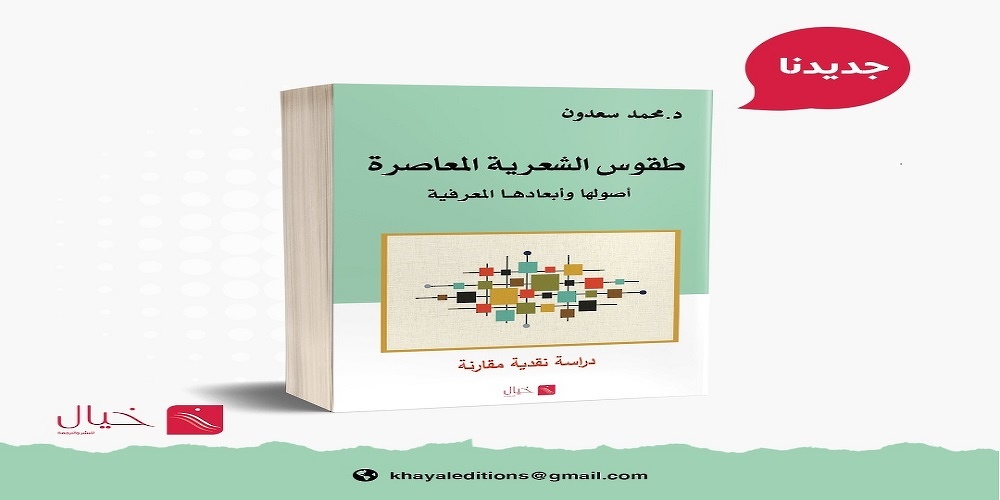
Algeria, (ONA) - Dr. Muhammad Saadoun discusses in his book “Contemporary Rituals of Poetic Poetry ... Its Origins and Cognitive Dimensions”, the topic of poetry by defining its general concept, as well as through Western critical schools.
The author affirms that poetry represents a contemporary critical approach that has not yet been completed, as studies are still in place to establish firm principles and laws in light of the domination of the authoritarian modern scientific wave. The efforts made by contemporary poetic scholars are essential starting points to reveal the essence of poeticism which escapes and refrains from strict scientific frameworks and laws, which constituted an intractable research for scholars and researchers, due to its nature that does not fit with scientific techniques to become a stand-alone theory or a critical approach similar to the rest of the curricula that are based on established principles and laws such as semiotics, structuralism and reception.
Engaging in the subject of poetry requires familiarity with the spaces of modern poetry to create laws and mechanisms that make it a contemporary critical approach. However, these laws and mechanisms should be compatible with the transparency of poetry, which identifies with the body of language. What makes it more difficult to deal with this issue scientifically, is the close relationship between poetry and beauty in its artistic sense.
The author begins the approach of the topic with a preamble in which he reviews the general concept of poetry, through four points: poeticism and romanticism, poeticism and aestheticism, and poeticism in Arab heritage, and the influence of Arab poetry in modern Western poetry.
In the first chapter entitled “Western modernist poetry and its spaces”, Saadoun discusses the views of Western schools, such as formal poetry, structural poetry, semiotic poetry, and the receptive or reading poetry. It also addresses the concept of poetry in a number of modern Western poets and critics, such as Roman Jacobson, Jean Cohen, Trivitan Todorov, Charles Baudelaire, Artur Rambo, Paul Verlaine, and T. s. Elliot.
In the second chapter, the author discusses the poetry of modern Arab critics and poets, including Ezzedine Ismail, Kamal Abu Deeb, Abdullah Muhammad Al-Ghazhami, Nazek Al-Malaika, Adonis, Saadi Youssef, Nizar Qabbani, and Amal Dangel.
Saadoun devotes the third chapter of his book, published by Dar Khayyal for Publication and Translation, to talk about the rituals of poetry in the Arabic poem and the French poem, through a number of points: poetry between reality and fiction, the realistic image and the emotional image, the poetic image between philosophy and art, intersection and problem between poetic images.
(ONA)