
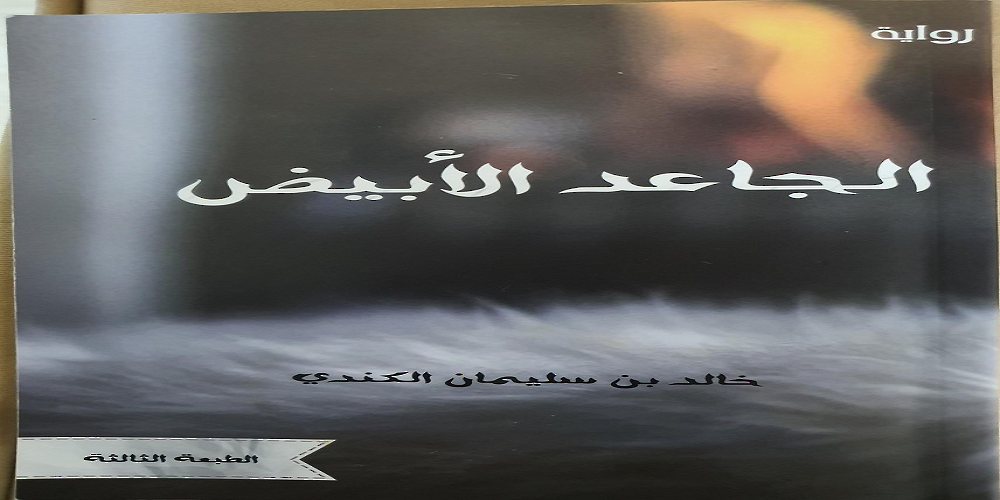
Muscat, June 22 (ONA) The novel “Al-Ja’id Al-Abiadh” (The White Sheepskin), , which is one of six narrative works by the writer Dr. Khalid bin Sulaiman Al-Kindi, published by the Bait Al Ghasham Foundation for Press, Publication and Advertising, has achieved great popularity through its three prints, starting with its first edition in February 2016 to the second edition in October of the same year to continue its success with the release of the third edition in January last year. It ranked first in two consecutive years in the list of bestsellers in Beit Al Ghasham.
The novel came in (408) pages, in which the author recounted its events through (26) chapters. Each chapter deals with different events that embody the idea the writer wants to communicate to the reader. The novel “The White Sheepskin”, as the writer sees it, with the dropping oil prices and the collapse of the economic crisis in developing countries, brings up the figure of Abi Zaid Al-Riyami, who assumed jurisdiction in Bahla in the First and Second World Wars. During that time, Bahla was suffering from droughts, scarcity of resources, and the spread of famine, like all other places in Oman. People did not know oil at the time. What Abu Zayd might do under these circumstances to get Bahla in particular and the state in general out of the crisis?
In the novel’s introduction, the writer pointed out that Omani history presented us with great figures, some of which are closer to the angelic, but the Omani documentation was failing to celebrate them in the moments of their life, as the former did not leave anything to the other to seek help in identifying the detailed biographies of these great people, but rather it kept a small bit of their news. One of the figures that Omani history has known scientifically, politically, economically, and religiously, was Abu Zaid Abdullah bin Humaid Al-Riyami (1884 - 1945 AD). This figure was more fortunate than others in documentation.
The reader will go on to read the contents of the novel, including scenes and events that amounted to 130 included in the twenty-six chapters of the novel. The author excelled in dividing those stories and tales between the chapters of the novel. The writer is distinguished in his novel by taking care of the cultural, social, educational and economic details that aim to educate the reader about the country of that time and depicting the aspects of daily life so that he can live with it as if it were in a movie. The writer moves from a scene to another in an interesting way based on cutting up and distilling exciting events and distributing them in different chapters so that the reader will gasp in requesting to know its conclusion and its justifications that are not complete at once. The novel roamed many places including events and scenes in Bahla, Izki, Al-Qabil, Muscat, Zanzibar, Makkah, Tanuf, Al-Ain, Barakat Al-Mouz, Nizwa and Jibreen. Bahla obtained the lion's share in the scenes of this novel. We find that nearly a hundred scenes in this narration took place in Bahla and the rest of the scenes elsewhere.
This novel is considered one of the historical narratives. It recounts the life of Sheikh Abu Zayd Abdullah bin Muhammad Al-Riyami (1884-1945) from his childhood, and the cultural, political and social events that accompanied his struggle in life. The author chose the biography of Abu Zayd as a model for the successful Omani leadership in managing the affairs of Bahla in particular and managing the resources of Imam Salem bin Abdullah Al Kharusi and Imam Muhammad bin Abdullah Al Khalili in general. The Wali and Judge Sheikh Abu Zaid succeeded in reviving the arid agricultural lands in Bahla and revitalizing industry and trade, during the era in which Oman and the world plunged into economic stagnation due to the two world wars, from his appointment as a wali (governor) and a judge of Bahla 1916 until his death.
In his novel, the author relied on reading the juristic production of Abi Zaid, the researches that were written about his biography in a symposium of his own, testimonies from his contemporaries or those who heard of his contemporaries, and historical books that include political events in his time, in addition to the field inspection of Bahla Fort in which Abi Zaid and his family resided.
The novel tends to fill the gaps in the details of events by creating fictional scenes commensurate with the biography of Abi Zaid, the features of his behaviour and personality, the circumstances of his time and his relations with the state and the people, as the novel is primarily a literary work and not a historical document. The novel received the attention of a professor at Al Al-Bayt University in the Kingdom of Jordan, making it a model for historical narrations in one of its courses. It garnered the audience’s attention in multimedia and it was the subject of a graduation project for a bachelor’s student at Sultan Qaboos University.