
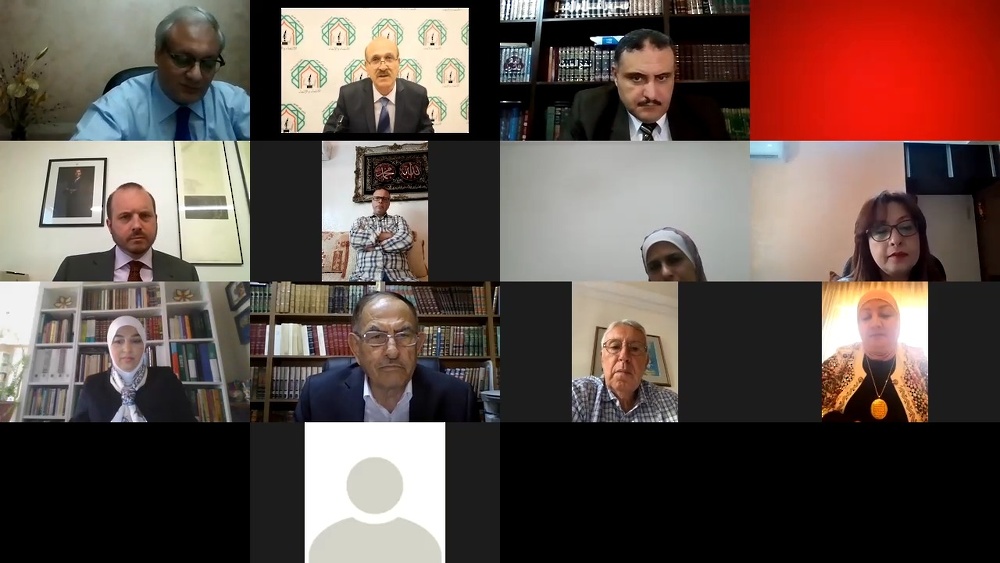
Amman, June 22 (ONA) A number of Arab and Spanish intellectuals and academics discussed, via video conferencing, the dimensions of the Andalusian civilization experience and its echoes in human knowledge, in the light of a lecture by the Professor of Arabic, Moroccan and Andalusian literature Dr. Salah Jarrar on the contents of his new book, “Forgotten Aspects of Andalusian Civilization”.
Jarrar explained in the lecture held at the Arab Forum, that the scholars of Andalusian heritage took care of what the Arabs left of a great civilization whose effects are still present today in the treasures of science rich in Andalusian literature of various fields, and exquisite architectural monuments such as the Alhambra Palace in Granada and the Grand Mosque in Cordoba and the Giralda in Seville. However, in the midst of their preoccupation with the high level of civilization attained by the Andalusians in urbanism, engineering, medicine, music, agriculture, industry and other sciences, some aspects of Andalusian civilization were absent from their eyes, or their attention to them was transient, due to the lack of information reported in Andalusian sources.
Jarrar added that he stood in his book on remarkable aspects represented in its entirety as a Andalusian civilizational achievement that integrates with the famous civilized achievement, in the framework that every human achievement, individual or collective, material or moral, practical or theoretical, carries an addition to the previous human achievement or its development, and it is in the service of the individual, society and the human being, and it has spread throughout space, time, or both.
Jarrar clarified that he relied in his book on what was sporadically mentioned in historical sources and on the echo of these aspects and their shadows in the literary texts, such as poetry, prose and muwashahat (stanzas). They are important sources that help to illustrate the images of Andalusian civilization and reinforce an important function of literature, which depict the life of societies and peoples, on purpose sometimes and unintentionally in many cases.
Among the civilized aspects covered in this book: amazing images from the knowledge society, a model of advanced economic and political systems and practices, the use of vehicles by Andalusians, bullfighting in Andalusia, laws for the preservation of the environment revealed by the books of al-Hesbah, the primacy of Andalusians in the use of shadow imagination, and the Astronomical dome of Abbas Ibn Firnas, training birds to speak, dancing on ropes, the use of gunpowder and cannons, the scientific movement in Cordoba in the era of the caliphate and its role in the dialogue of cultures. The researcher also examined women's issues through two studies: the first on the personality of Andalusian women through their poetry, and the second on Karima Al-Marwaziyya, Sheikh of Andalusia scholars in the fifth century AH.
For his part, the Secretary General of the Forum, Dr. Muhammad Abu Hammour that the Andalusian civilization experience is one of the most important experiences of Arab, Islamic and international history; As an advanced civilizational and intellectual model, it was manifested in the fields of investing variety and cultural diversity in society, upgrading science and scholars, and building cultural, scientific and civilizational edifices. It also includes models of civilized participation and multiculturalism among Arabs, Berbers, and Spaniards.
The Secretary General of the Asilah Forum, Muhammad bin Issa, stressed the importance of some definitions in describing the Andalusian civilization experience as not only Arab and Islamic, but expanded and deepened into a great human content. He added that the talk about Andalusia is not complete without the Moroccan dimension of what was previously called the civilization extension between the land of Andalusia and the land of Morocco. Moreover, this experience was rich and innovative. There is a lot of relief in Andalusia, and it gained its privacy, and it was not what was known as the Levant.
Bin Issa stopped at some bright aspects of the Andalusian civilization, including, for example, the advanced philosophical jurisprudence carried out by the Andalusian philosophers such as Ibn Rushd and Ibn Tufail and others. He also dealt with the music, as Abbas bin Firnas is said to be the first to write the recognized Solvian music, in addition to the Andalusian maqams on which the classical Western music maqams are based. He also addressed agriculture, which was flourishing in Iberia and Morocco, whose terminology is still used in Latin languages for irrigation, plants, ploughing, cultivation, and social life that we do not know much about in addition to what the immigrants to Tetouan, Chefchaouen, and Fez had kept, and then the Moors, coming to Rabat and Salé in Morocco.
Jose Maria Dabo Capra, who participated in this meeting, stressed that this shared heritage deserves the restoration of all of us, considering Jarrar's research efforts in this field, as part of a series of efforts that have contributed to generations of Spanish Arabists and Orientalists such as Miguel Asin Palacios (1871-1944) and Emilio García Ghomet (1905-1995), alongside Moroccan and Oriental researchers and in the world. This confirms the development of interest in Andalusian heritage among these and among intellectuals and writers in modern and contemporary Spanish culture, which has witnessed accelerating steps in increasing interest in Andalusian studies at the university and academic research level since the eighties and nineties of the last century.
Dr. Muhammad Saeed Hasab al-Nabi, a professor of Arabic language and literature at October University in Egypt, said that there is a need for more aspects to be revealed about the role of women in the Andalusian era, especially in answering the question about what happened in later ages and led to the decline of this role.
He suggested that there be a recommendation from the forum to the ministers of education and higher education in the Arab countries to add a reference book within the curricula to enhance heritage values and cherish heritage, including Andalusian heritage.
Known Iraqi academic and investigator Dr. Bashar Awad in his intervention, called to take into account what came about the Andalusian civilization achievement in Jarrar’s book and think about the glory that the Arab civilization was in, which drives away the populists and mazes of globalization entered into it in our time. He notes that the book's research was characterized by the beauty of presentation through a literary style based on sober scientific research.
Professor of Critics, Arabic Literature and Islamic Civilization at the University of Sidi Mohamed bin Abdullah, Dr. Abdullah Al-Ghawasili Al-Marrakchi, referred to the issue of crying over the ruins and self-glorification when studying the literature of civilizations, a technique used by nations that have suffered from a civilization crisis, including the Europeans themselves, motivated by the prospect of hope in the youth for a new civilization breakthrough.
Researcher and academic investigator Dr. Ibtisam Al-Saffar praised Jarrar's approach to research, and the civilizational manifestations he demonstrated in Al-Andalus’s various creations in science, arts and literature.
Huda Al-Shammari, a researcher in Andalusian literature, examined the primacy of Andalusians in the fields of science, technology and innovations, supporting her words with what was mentioned in some Arab sources emphasizing the activity of the people of Andalusia and their interest in learning science and acquiring knowledge.
For her part, Dr. Rasha Al-Khatib, researcher in Andalusian studies and the history of Orientalism, said that the Orient is witnessing academic and university interest in the study of the civilization of Andalusia. She added that there are many noticeable researchers, academics, conferences and seminars in this field, and the previous image of the lack of interest in the study of Andalusia no longer exists. She also referred to the investigative scientific method of Jarrar's book and its efforts in exploration and research supported by sources and texts, which were not affected by the usual emotional inclination towards Andalusia.
The head of the Spanish language department at the University of Jordan, Dr. Renad Al-Momani, mentioned that there are works of contemporary Spanish Arabists concerned with the feminist presence in Andalusian literature, which confirms the role of Andalusian women in science and creativity and their participation in cultural life.
Dr. Omar Al-Fajawi, professor of Arabic literature at the Hashemite University, addressed the controversial issue of what has settled in the minds about the influence of the Orient in Andalusian literature, pointing out that Jarrar's book does not confirm this idea with the examples of Andalusian literature and its specificity in its environment.
Professor of Arabic Literature Dr. Sherine Jad Allah concluded the discussions by saying: “Today we need to realize that the forgotten aspects of Andalusian civilization confirm that civilization is inherent in man more than ornament and architecture, and the Arab world today desperately needs to achieve, like the Andalusians, a great civilization to prove his worth and excellence.
(ONA)