
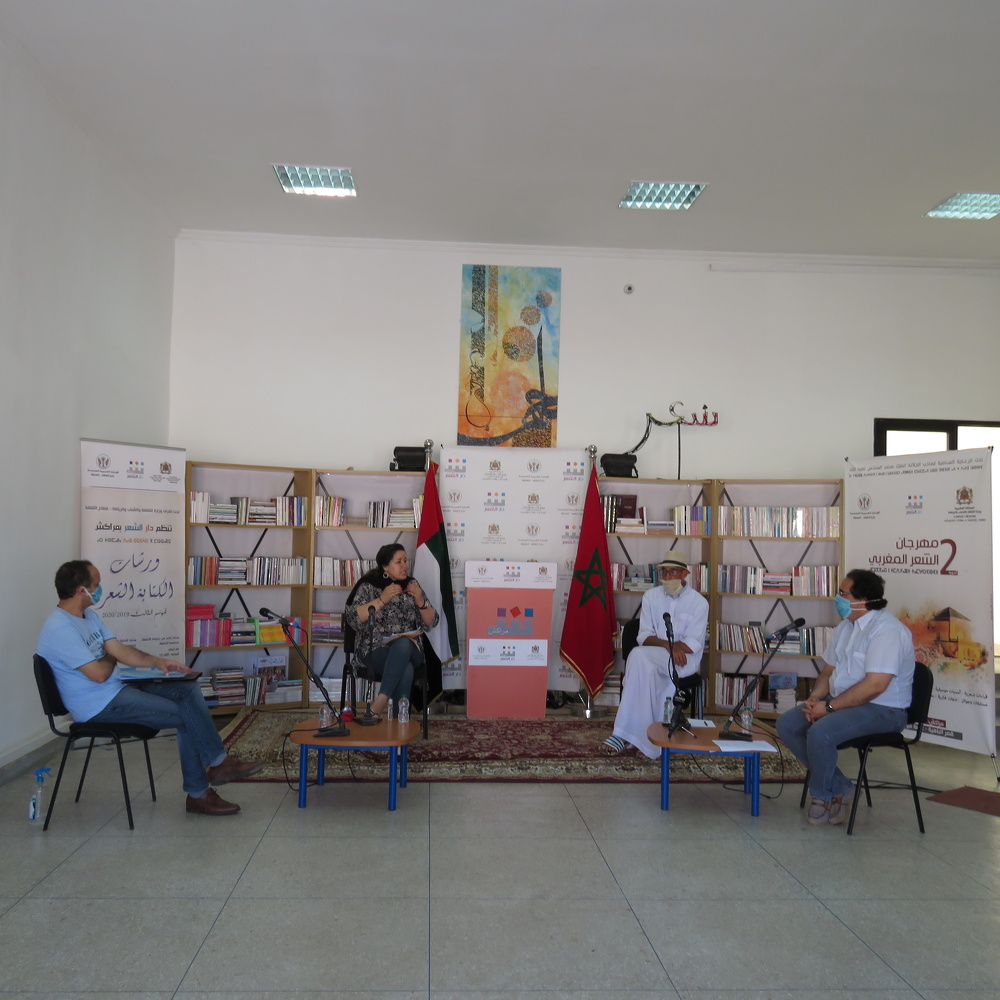
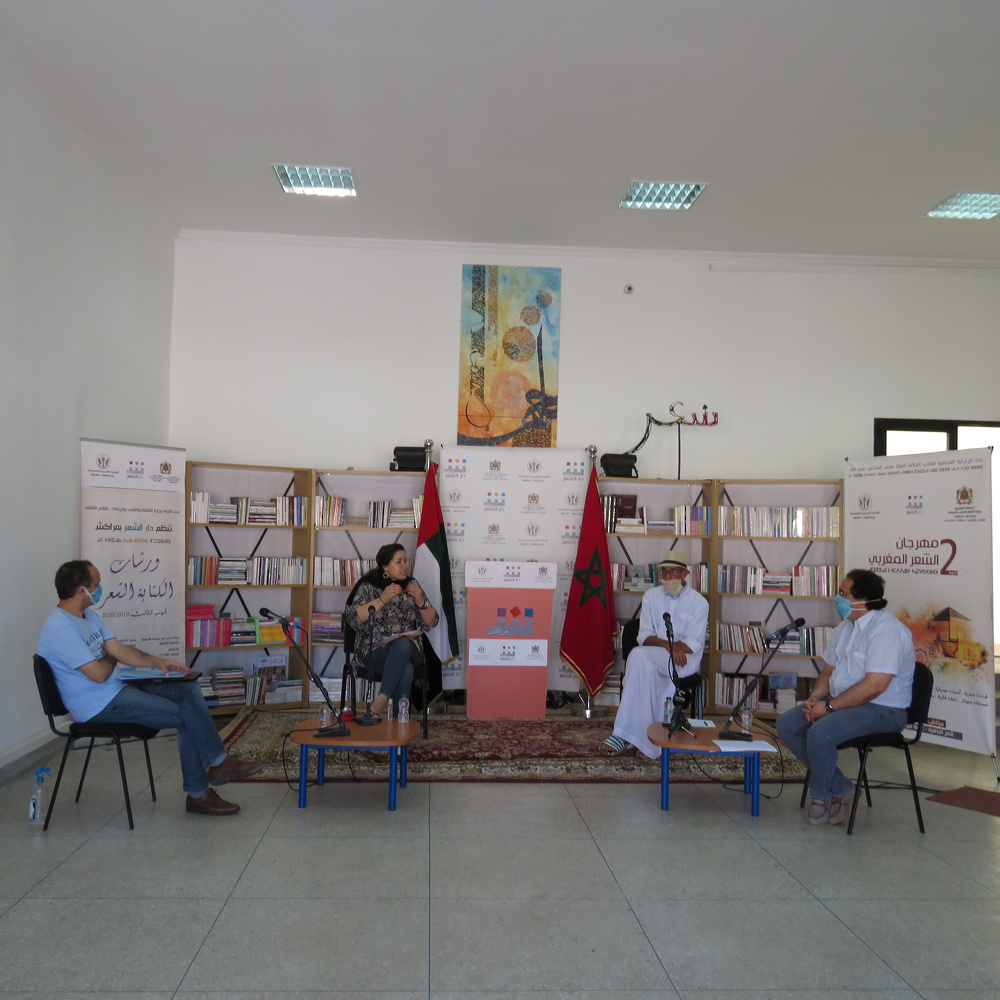
Casablanca, June 15 (ONA) Participants in a symposium organized by the House of Poetry in Marrakech concluded that it is necessary to establish a new critical awareness of the poetic phenomenon in Morocco, in light of the accumulated experiences, sensitivities, visions and patterns of writing.
The critics participating in the symposium, which came under the title “Questions of poetic criticism in Morocco: the achievement and the stakes of interpretation, called in to represent the poetic phenomenon in Morocco, in order to establish a poetic critical project that accompanies it and opens up to poetry experiences with the diversity of its schools.
The seminar, moderated by the director of the House of Poetry Abd Al-Haq Mifrani, included three themes. The first dealt with the general features of poetic criticism in Morocco, its paths and trends, starting in the 1920s. The second theme sought to investigate the phenomenon of poetry through the patterns and manifestations of poetic writing with its various sensitivities, experiences, visions and generations. The third theme addressed the methodological references that control the approaches of the poetic text, while identifying the features of contemporary Moroccan criticism.
The poet, Rachida Shank, within the first theme, pointed out that poetic criticism in Morocco witnessed an important accumulation, with a remarkable presence of critics who mixed the critical and creative writings and solidified the horizon of criticism and its questions. She also addressed the preoccupation of some studies with certain experiments, and with the experiences of prose poem in particular, without awareness of the various styles of poetic writing in Morocco.
Shank also tackled the critical experience of Mohamed Moftah, who developed an important critical project, by possessing a wide variety of knowledge and intellectual and philosophical references that enabled him to enter the folds of poetic texts. She said that the creative text, poetic in particular, is a set of formats that need many knowledges. She added that for this, Moftah’s reading starting from its revision of the diwan of Lisan al-Din al-Khatib and ending with his work on many concepts and founding theoretical references, starts from philosophical and intellectual references, to serve the creative poetic text and poetic criticism project in Morocco.
As for the critic and translator Abdul Jalil Al-Azdi, he saw that there is a difference between the quantitative and qualitative poetic accumulation and the discourse of criticism that has failed to keep pace with this accumulation, in terms of its multiplicity. He outlined some of the general and essential features of this discourse that has formed around Moroccan poetry, including that most Moroccan poetry critics are poets.
Al-Azdi reviewed the most important historical stations established for poetic criticism in Morocco, and the names that contributed to the establishment of the features of the cultural phenomenon in the beginning of the sixties and in the writings of Abdel Karim Ghallab and in academic fields, as well as academic criticism built in theory and doctrine, such as the two theses of Muhammad Bennis, and the two theses of Abdullah Rajaa and Ahmed Al-Majati. Meanwhile, the experience of critic Muhammad Moftah remained a notable exception, as it opened to the semi-poetry and founding concepts (such as contextualization).
Al-Azdi pointed to the individual efforts of intellectuals concerned with Moroccan poetry, noting that the critical practice in this case is based on mitigation without discipline in the rules of scientific research as is the case with the thesis.
Al-Azdi addressed “appropriate criticism,” explaining that it was a form of “critical practice” that accompanies the poetic scene, as it is a superior prose speech, which is closer to the press coverage. He stressed the absence of a critical school in the criticism of poetry, as the critical accumulation achieved in this context is tantamount to individual attempts. Each critic sees himself “an absolute beginning”, while all forms of knowledge are areas that do not recognize the individual or “the first”, because it is a scientific practice linked to historical conditions, which is inspired by the entire cultural heritage.
For his part, the critic Adel Abdel Latif examined the map of poetic criticism in Morocco, and the historical stages that led to the formation of critical discourse. He talked about the interaction of theories, experiences and schools, which led to the emergence of a critical awareness of the poetic phenomenon in Morocco.
Abdel Latif stopped at the founding beginnings of modern poetic criticism in Morocco from the 1920s, attending the Levantine experience, the Fez festival experience, and then opening up to critical experiences and humanities.
He believed that the critical experience in its openness to cultural critical awareness, and the assimilation of the rhetorical perspective in poetry and other references, made poetic phenomena have a special status in the critical scene, warning that poetry is neither discourse, nor formulation, but rather has knowledge backgrounds. He stressed that there are critics who have accumulated important experiences in the field of poetic criticism in Morocco, most notably those who belong to the phenomenon of critical poets.
On investigating the phenomenon of poetry in Morocco, through what it suggests of experiences, sensitivities, patterns of writing and visions, Shank pointed out in this topic that the map of Moroccan poetry is varied, with its Hassani, Amazigh, Zajal (strophic) and el-Fasih (classical Arabic) dimensions, however, the momentum of the Moroccan poetic achievement exceeds the critical writings on it.
Shank saw that there are readings for specific names and experiences, without opening to other sensitivities, calling on critics to pay attention to recent experiences that have been able to achieve a qualitative accumulation. She explained that today the need is for textual friendships not for names, in a time in which the critical debate is absent.
Al-Azdi went in the same direction, emphasizing the need for universities to open up to poetry experiences, for the organic link between the poet, critic, and reader. He cautioned that writing poetry is no longer associated with researchers in the cultural field and university professors, as there are new actors in the field of poetry writing belonging to other fields (lawyers, doctors, judges and engineers) which requires critics to discover these geographies of texts and experiences, and then the need to open up to them.
The critic Adel Abdel Latif saw that the poetic scene in Morocco has increased in number and in its sensitivities and poetic experiences, and its mechanisms and patterns of writing have developed. In this regard, he gradually progressed starting with what the two poets Mohamed Bennis and Ahmed Bal Badawi introduced into the space of the poem, with voices loaded with questions of modernity and postmodernity.
On the theme of references and outlook, the poet Rachida El Shank said that Morocco witnessed a remarkable poetic accumulation, but there is an easement in writing the poem. Hence, the critic's role in standing up to the spread of mediocrity.
She added, “If the critics are building a brick in the poetic scene, then they should contribute to the consolidation of this horizon and remove darkness from some of the texts and submerged experiences, and universities and students should open to them.”
Al-Azadi re-read poetic discourse in Morocco, in an attempt to explore its theoretical and scientific frameworks, noting its dependence on methodological tools, and references drawn from the field of literature and sociology, and cultural, structural and anthropological criticism.
He stressed the need to read poetic texts from within their relationships, dismantle internal structures, and pay attention to the fact that not everything that is published is considered a diwan (a collection of poetry). He called on critics to sift through the published collections, adding, “Criticism must square off with many names, living on the illusion of poetry, unlike poetic experiences possessing beautiful language and enriched with knowledge, myths and historical references.”
The critic Adel Abdul Latif concluded the last topic, by emphasizing the need for a poetic critical speech, fuelling the worlds of the poem with its various sensibilities. He said, “If poetic criticism in Morocco is governed by many references, and with the accumulated Arab heritage when poetry had its legal and symbolic status in Arab culture, in addition to Western theoretical references, it should not stop at the point of diagnosis, but rather the horizon should be foreseen, so that this criticism can restore its central role and function.”
(ONA)