
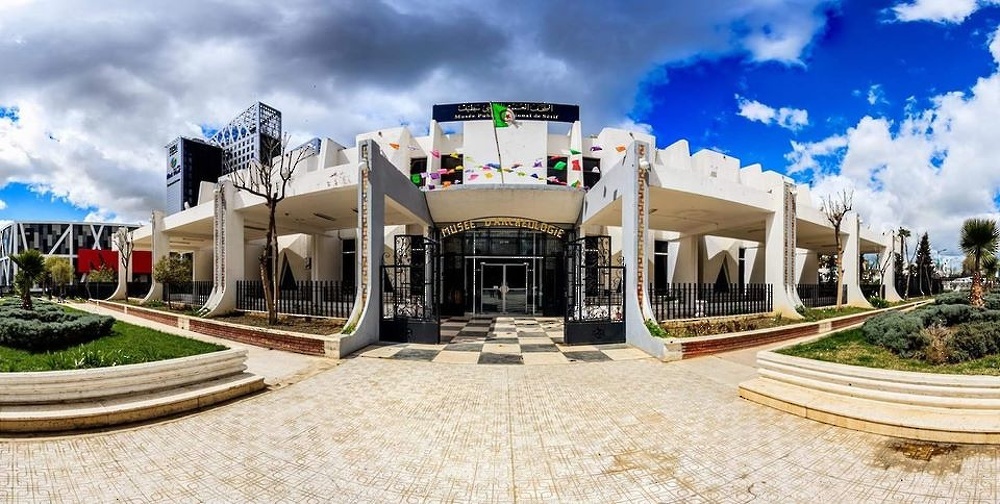
Algeria,(ONA) - The National Public Museum, located in Setif, eastern Algeria, which is located on the street of the National Liberation Army, is one of the most important landmarks trying to advance the burdens of preserving the historical memory of Algeria.
As indicated by many studies that have been conducted on the history of the museum, the idea of collecting archaeological artifacts in the city of Setif dates back to the colonial period, that is around the year 1896 AD, in the park of Prince Abdel Qader, which formed the nucleus of the first open-air museum. Among its flanks, the garden included various archaeological tools dating back to the Roman period, the most important of which are a group of funerary inscriptions, many columns made of limestone, as well as a number of Corinthian, Periodic and Ionian crowns.
These studies indicate that most of the materials presented were found through spontaneous discoveries. In 1932, a small hall was inaugurated inside the Mohammad Kairwani High School, which was called the Albertine High School, and it displayed small-sized archaeological tools dating back to the prehistoric period, such as granite, animal bones, fossils, and others.
In 1968, the authorities decided to convert the old Palace of Justice into a regional museum, after the various archaeological discoveries that were reached, between the years 1959 and 1966, in various sites of the old city (Setifis), such as the Eastern Cemetery, al-Hammamet, the Al-Abd neighbourhood, and the Churches neighbourhood.
The discoveries continued, in a second stage, between the years 1977 and 1984, in the Byzantine castle. It resulted in the finding of various archaeological tools such as bronze, pottery, glass, iron, and bones, dating back to the Roman and Islamic periods.
At a later stage, all these discoveries were added to a huge collection of archaeological discoveries, which was discovered in 1968 in the castle of Bani Hammad in the state of M'sila, dating back to the Almohad period.
Faced with all this great archaeological heritage, and the poor situation in which the old Palace of Justice (the Regional Museum) was, the Algerian authorities decided, in 1985, to establish a new museum to accommodate all the archaeological finds, and it was classified as a national museum in 1992, in view of its unique archaeological holdings.
The National Public Museum in Setif currently includes six halls, the Prehistoric Hall, the Romanian Art Hall, the Islamic Art Hall, the Numismatics Hall, the Mosaic Hall, the Exhibition Hall, as well as the facades of traditional tools, the restoration laboratory, the archaeological store, the library, administration, meeting room, and clubhouse.
The Prehistoric Hall contains a rare collection of archaeological artifacts that reflect the human presence and the first prehistoric cultures, the most prominent of which is a group of pebbles dating back to before the Acholi, discovered in Ain Hanech in 1947, and the white limestone axe which dates back to the Assyrian period and was discovered in Ain Boucherit.
The hall also includes flint and bone tools of various shapes, such as scrapers, cutters and blades, most of which were discovered in Mazlouk site, between 1929 and1931. The hall also contains a group of fossils of invertebrate aquatic animals and molluscs, dating back to the first geological era.
The Romanian Art Hall includes a large collection of archaeological tools, most of which were discovered during the excavations that took place between 1959 and 1966 in the ancient city (Setifis). The most important of them are memorials made of limestone, great needles, bronze artifacts, and pottery (dishes, mugs, oil lamps, jars of various shapes and sizes).
The Islamic Art Hall is distinguished by archaeological groups represented in Fatimid pottery with its beautiful engineering and floral motifs (discovered between 1977 and 1984), at the site of the Byzantine hall in the Islamic Neighbourhood, in addition to those artifacts that were discovered in the Castle of Bani Hammad in 1968. They are painted pottery decorated with geometric and floral motifs, and stucco inscribed with Kufic writings, as well as ceramic tiles that decorate the walls of the mihrab of the Qasr al-Manar mosque, plaster columns and limestone and alabaster crowns.
As for the Numismatics and Mosaic halls, they include collections of bronze and silver coins dating back to the Numid and Roman periods, and bronze and gold coins dating back to the Roman and Islamic periods, in addition to a large group of mosaics, of different shapes, sizes, and motifs.
Moreover, the museum's upper floor houses an exhibition of traditional pottery and copper tools, a collection of silver ornaments and weapons (guns and swords) dating back to the 19th century.
The museum's basement contains an exhibition hall, a laboratory for the restoration of antiques, equipped with tools and chemical solutions used for the repair and preservation of antiques, and two stores that contain a large collection of Islamic pottery, some skeletons, pieces of mosaic, iron, and bronze. The museum's library also contains a significant number of books, magazines, and periodicals in Arabic and French, and it is related to history sciences and archaeology.
(ONA)