
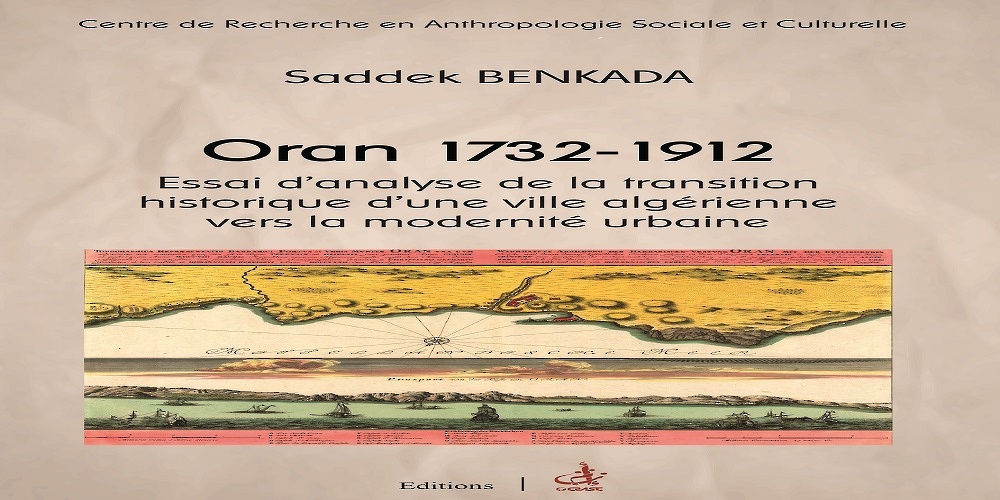
Algeria, (ONA) - The book “Oran. 1732-1912”, by researcher Sadiq Bin Qada, published by the Center for Research in Social and Cultural Anthropology, identifies the various transformations that the city of Oran, the capital of the West of Algeria, has learned from trying to analyze the historical transformations that this city witnessed in the direction of urban modernity.
This study aims, according to the author, to try to understand the historical conditions that qualified the city of Oran to be the first Algerian city to take steady steps towards urban modernity.
The author adds that the book relies on the problematic approach presented from the political sociology perspective of urban reality. It is clear that this approach involves questioning the methods of formulating urban policies and defining actors, collective and individual, institutional or informal, in the field of political action, in its historical dimension.
Within the framework of this thesis, the author also seeks to proceed with the analysis of spatial reformation and transformations in the urban landscape, through the three experiments of urban planning and resettlement policies, which extend for a period of time, in the bordellian sense of the term, over a period of more than two centuries in the history of the city of Oran. It started from the first quarter of the eighteenth century, and was characterized by a series of historical stages, the most important of which were the second Spanish occupation (1732-1792), the second Ottoman Algerian recovery (1792-1831), and finally, the French colonial period from 1831 to 1912, which the author considers the decisive stage, which allowed the city to enter the global transformation of cities.
Each of these historical sequences was distinguished by an urban experience that significantly changed the urban space, both in its organization and in the landscape, and was not without consequences for the ethnic and socio-demographic structure of the urban population.
The author believes that understanding the logic of urban policies that have reshaped the Algerian city in the past indicates, inevitably, that there is a very limited vision for the formation of urban planning policies and the resulting European population in large urban centers, through the process of the emergence of the modern city in Algeria in the context of colonial domination.
This study has been divided into four parts, each of which in turn contains a number of chapters. The first relates to the location and its historical development in terms of the importance of choosing to create the first urban site according to its material aspects, and the impact of the formation of the land on the development of urban space.
The second part focused on the reconstruction and restructuring of the city, beginning in 1792, while studying the origins and formation of the new settlement, and the natural result of owning land, thanks to the dual policy of resettlement in the Bay Muhammed al-Kabeer area. The third part dealt with the problem of the reorganization and symbolic representation of the space born in the aftermath of 1792. In the fourth part, the author attempts to analyze the equipment and locations of the urban economy, and rebuild its distribution in the redesigned urban space, according to the new logic of space production.
(ONA)