
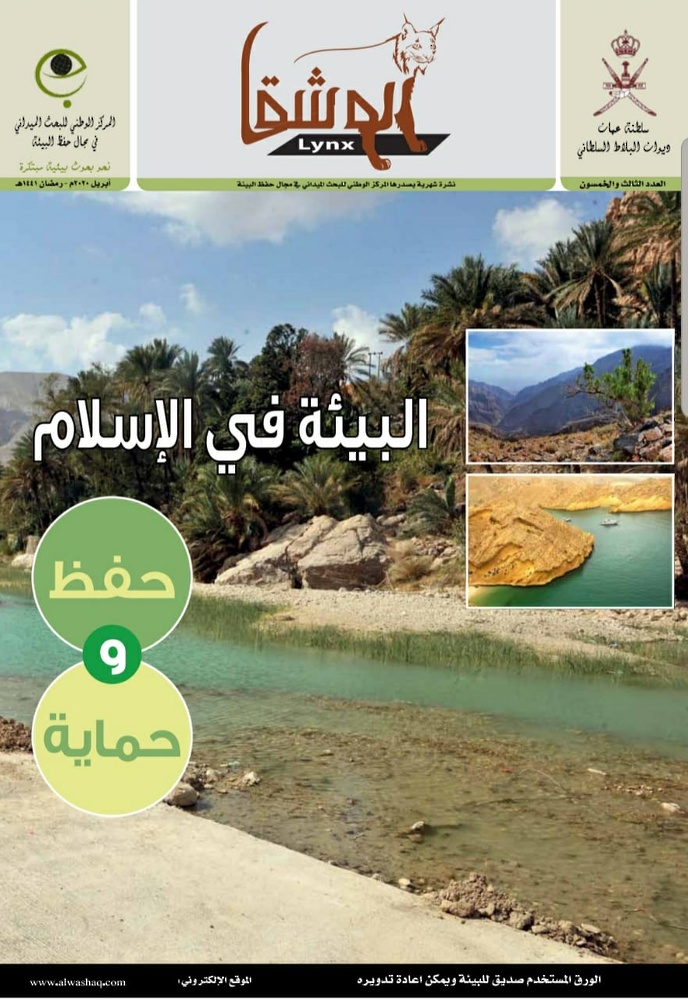
New Issue of Al-Washaq bulletin
The National Center for Field Research in the Office for Conversation of Environmental at the Diwan of Royal Court has issued the new issue of the Al-Washaq (Lynx) Bulletin, bearing the number 53. The new issue published in both Arabic and English included many topics related to environmental conservation.
In the view column by Dr. Dawood bin Sulaiman Al Balushi, the editor-in-chief, under the title “Earth Hour without Hour”, he mentioned that the celebration of Earth Hour passed this year without an hour, minutes, or seconds while all countries of the world were going through a frantic race with Corona virus (Covid 19) and its human, economic and social repercussions. That hour was the result of hundreds of deaths from infection with this virus, which killed thousands of people across the globe. It was not an ordinary hour like all the annual hours that are celebrated on this global environmental occasion.
He said that the celebration of Earth Hour annually on the last Saturday of March of each year is a reminder to all countries of the world, institutions and individuals of the importance of reducing the waste of energy sources. It is a global event organized by the Global Fund for Environmental Protection for the first time in 2007 in the Australian city of Sydney as an awareness campaign on global climate change, and to clarify the importance of the role of the government and private sectors and individuals in reducing global warming. In this hour, in a specific time from 8.30 to 9:30 pm, lighting, electrical and electronic appliances in homes and institutions are turned off, in a clear indication of the need to reduce the waste of non-renewable energy sources.
He added that one of the environmental activists on one of the social networking platforms suggested that, in light of this crisis, the topic of celebrating the Earth Hour should be converted from “turning off lighting and electrical and electronic devices” to “caring for public cleanliness”, as rapid environmental and health shifts in this time require us to pay more attention public hygiene. Assigning an occasion to celebrate that would be extremely important to remind people of its importance and pivotal role in preserving human health and survival. This is up to the global environmental organizations to seriously consider allocating a global environmental event to take care of public cleanliness, in order to avoid repeating the Earth Hour without an hour or value.
On the subject of natural reserves, one of the aspects of environmental treasures the late Sultan Qaboos was interested in, Al-Washaq said that the late His Majesty Sultan Qaboos bin Said, may Allah have mercy on his soul, paid great attention to the environment since the beginning of the blessed renaissance. The nature reserves are one of the areas of concern to the late Sultan. In fact, it contributes to achieving an environmental balance and protecting many living creatures threatened with extinction. During the era of the late Sultan, natural parks were established, and laws and legislations concerned with them were announced. In addition, the Sultanate has declared a number of nature reserves in several different regions, with the aim of preserving and protecting the ecosystems and biological resources.
The bulletin pointed to what the late Sultan said in his speech in the Year of the Environment. He said, “With all the important steps we have achieved in this field in which Oman has gained a respectable place among the countries interested in protecting the environment, efforts must be made, and environmental protection must be considered when planning and implementing development projects. It is also necessary to move forward in developing the existing links with the relevant regional and international organizations, and every citizen must fulfil his duty as this is of great importance to protect our natural resources and public health from the harmful effects and preserve the beautiful and distinct nature that Allah has endowed for our beloved Oman.”
Al-Washaq spoke extensively about many of the reserves and their components that have received the supreme attention of Sultan Qaboos, may Allah rest his soul, including the Qurm Nature Reserve, the Sireen Nature Reserve, the Ras Al-Shajar Nature Reserve and the Wildlife Reserve in Al-Wusta Governorate (formerly the Arabian Oryx Reserve), The Damaniyat Islands Nature Reserve, Ras Al-Jinz Turtle Reserve, Jabal Samhan Reserve, Al-Akhwar (Lagoons) Reserve in Dhofar Governorate, Al-Sulayyil Natural Park, located in Wilayat Al-Kamil and Al-Wafi in South Sharqiyah Governorate and Al-Khiran Area in Muscat Governorate that granted the status of the public eco-tourism area, in which dolphins, coral reefs and various species of marine organisms can be seen. Other reserves include the Jabal Al Akhdar Nature Reserve, Jabal Qahwan Nature Reserve, the Wetlands Reserve in the Al-Wusta Governorate, the Khor Salalah Nature Reserve, the Khuwair Nature Reserve, the Star lights Reserve in Al Hajar Al Gharbi, and the Rustaq Wildlife Reserve.
In the feature of Al-Washaq, the bulletin discussed the topic of the environment in Islam ... conservation and protection. Al-Washaq indicated that the Holy Quran and the Sunnah of the Prophet urged to preserve and protect the environment, as this is a religious duty. Islam also urges not to harm the environment in any way, including soil, water, air, and the universe with everything it contains. In addition, it urges people to care for planting and afforestation in developing the land. There are many things that Islam urges in order to preserve and preserve the environment, such as the prohibition of extravagance and waste, the prohibition of pollution, and the urge to develop the environment.
Al-Washaq said that defining the environment in its general sense came in the book “Islamic Values and its Role in Providing Solutions to Global Environmental Problems” for His Eminence Sheikh Ahmed bin Hamad Al-Khalili, the Grand Mufti of the Sultanate. His Eminence said that “the environment is diverse and multi-conceptualized. It may be natural as the earth and what it contains in its inside or on top of its back, as well as seasons, air and rain. It may be social in respect to the way people in that location, from social systems that support the relations between them and connect with each other. It may be religious in respect to the prevailing societies of the unseen beliefs, and the resulting behaviour of individuals, who believed in them, and their practices of the forms of worship that result from them. It may be cultural in respect to the knowledge spread in nations, and its perceptions. It may also be economic in respect to what it depends on in building its renaissance, moving its life, and expanding its projects of natural or productive wealth. It may be industrial, in respect to what other industries invent or imitate.”
The Islamic religion emphasized protecting the human soul from various dangers and damages, and protecting the environment is at the same time protecting the human soul. The corruption of the environment, its pollution and the depletion of its resources disturbs its balance, which threatens the life of the human being, exposes him to diseases and leads to the death of man. The environmental resources are considered among the blessings that Allah Almighty has bestowed upon the human being, so preserving them and not harming them and not polluting them is one of the thanksgivings that a person must work with. These resources include climate, water and natural vegetation in its various forms. The extension of natural resources also reaches livestock, marine and mineral resources.
The risk of environmental imbalance leads to several damages, including fundamental changes in the general climate such as high temperatures, sea surface level, acid rain and erosion of the ozone layer, and also leads to the occurrence of desertification, which causes great risks to the environment and people. From this standpoint, Islam's concern for the environment came in order to preserve human and natural resources from various pollutants.
On the importance of preserving water from pollutants and methods of protecting it, His Eminence Sheikh Ahmed bin Hamad Al-Khalili explained in the book “Islamic Values and their Role in Providing Solutions to Global Environmental Problems” that “water is the element of purification and the origin of life. Keeping it clean from impurities away from pollutants is a reason for safety of life, continuation of health and prevention of diseases and epidemics. I have seen how the hadith of the Messenger of Allah (may Allah’s prayers and peace be upon him) came to protect the water from pollutants that change its purity. He forbade urinating in stagnant or permanent water and then washed off using it. He also forbade defecating as its effect is transmitted to places where people gather. He also forbade disposal of human waste in the path of people and in their shades, and warned him of excrement in resources, the roadside and shadow. There is no doubt that in this forbidding extreme wisdom, the diseases transmitted due to water pollution are numerous. Many diseases are caused by germs and parasites in the faeces of the sick person or his urine, in the forefront of which is typhoid fever, schistosomiasis, hookworm disease (Ancylostomatidae) and other worms.”
There are several aspects of water pollutants, including industrial wastes that are discharged to water bodies, as well as sewage water when they are discharged into water bodies such as rivers, seas, etc., in addition to marine pollutants that are caused by oil tankers from which oil leaks and affects marine creatures. There is also an effect of pesticides on water by spraying agricultural crops, as well as the impact of nuclear reactors, plastics, lead, mercury, and others on water.
Islam urged to beautify and decorate the plant environment in order to extend its benefit to humans and animals. The Messenger, may Allah’s prayers and peace be upon him, called for the revival of the dead by planting and farming, and he promised a great reward for that. He, peace and blessings be upon him, said: “If a Muslim plants a tree, or sows a field and men and beasts and birds eat from it, all of it is charity from him.” He, peace and blessings be upon him, also urged to plant trees until the Final Hour (the Day of Resurrection) came, for he said, may Allah’s prayers and peace be upon him: “If the Final Hour comes while you have a palm-cutting in your hands and it is possible to plant it before the Hour comes, you should plant it.”
Islam maintains the vegetation and forbids and warns against cutting down trees, especially wild ones, without need. It also prevents harm to the environment by making fires and sabotaging the vegetation. The Islamic religion urges interest in planting trees to create an environmental balance, as this reflects positively on the various organisms by benefiting from the shade of the trees and their fruits, reducing temperature and contributing to the oxygen production.
His Eminence added in his book: "A person is faithful to himself, as he is faithful to everything around him, as he is required to spare himself and others everything that harms them. Therefore, the Messenger of Allah (peace and blessings be upon him) ordered to flee from the leper, like fleeing from the lion. In the guidance of the Prophet, peace and blessings be upon him, to the use of quarantine, in the Musnad al-Rabi` Ibn Habib on the authority of Saad bin Abi Waqqas, he said to Osama bin Zaid: What did you hear from the Messenger of Allah (may Allah bless him and grant him peace) saying on the plague? He said: I heard him say: “The plague is a punishment that was sent down on a party of the Banu Israil or whoever was before them. When you hear of it in a land, do not enter it. If it comes upon a land and you are in it, do not depart in flight from it.” The prohibition from going to a country where the plague occurred is in order to spare the person the harm, so that the infection does not spread to him, and the prohibition from leaving the country in which it occurred is in order to beware of transmitting the infection to others.”
His Eminence added: “This is not limited to human infection alone. In this prohibition, the safety of animals and livestock is respected from the effects of infection. This applies to all species of organisms, such as crops, fruits and forests, as they must be avoided for anything that affects them in any way.”
His Eminence explained: “True Islam came with the method of saving and moderation in the use of the facilities of life and the enjoyment of its goods. It calls for moderation in everything and warns of wastefulness and extravagance. We find, however, that Allah Almighty forbids exceeding the limit in them. The Almighty said: “O children of Adam, take your adornment at every masjid, and eat and drink, but be not excessive. Indeed, He likes not those who commit excess.” (Al-Aaraf: 31).
His Eminence added: “And I learned that the principle of justice in Islam was imposed on his followers when they were forced to war to confine it to a narrow circle, so that those who fight them would not be encroached upon, while warning them against the absolute assault. It means preventing them from anything that assaults a person, an animal, a bird, a planting, a planting, a forest or land. Allah Almighty said: (Fight in the way of Allah those who fight you but do not transgress. Indeed. Allah does not like transgressors.) (Al-Baqarah: 190). In not restricting the prohibition of aggression with anything indicates its freedom so that it includes all kinds of assault on the silent, the talking, the living or the dead. Therefore, everything mentioned above is included in this.
The teachings of true Islam emphasized the importance of preserving the living species from annihilation and extinction. Allah Almighty created all beings for wisdom and role in this universe. Islam also forbade excessive killing of animals and gave them rights that must be observed and fulfilled. The Islamic religion also urged to take care of animals and provide food and drink for them, as those who do so receive a reward from Allah.
The Islamic religion took care of the air and urged to protect it from pollutants, as it is one of the blessings that a person’s life will only continue with. It also has many benefits that Allah Almighty harnessed for man, such as winds that help the movement of ships in the seas, contribute to the formation of rain clouds, help birds and insects to move in the air, and contribute to the process of pollinating plants and trees.
Al-Washaq in its last issue touched on the Ramsar Convention on Wetlands, as the Lakes of Al Ansab were declared the second Ramsar site in the Sultanate. On the other pages, Al-Washaq also addressed news of environmental activity in the Sultanate, the Gulf Cooperation Council states, and other countries of the world. Eng. Khalifa bin Badawi Al-Hajji also discussed in the environmental components’ column one of the unique animals. On the environmental education page, Al-Washaq raised the topic of acid rain, its definition and components.
Omani / 104