
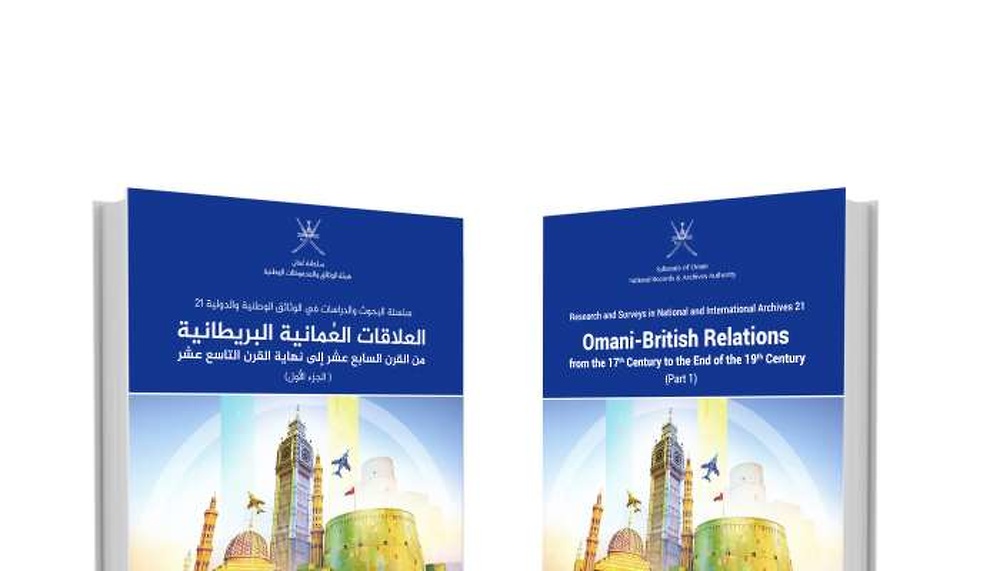
Muscat, (ONA) - The National Records and Archives Authority (NRAA) has issued the first part of the book “Omani-British Relations from the Seventeenth Century to the End of the Nineteenth Century,” within the twenty-first volume of the Series of Research and Studies in National and International Documents. The book consists of 488 pages and includes 14 research papers, including 11 research papers in Arabic and three others in English, by researchers and scholars with different and divergent views due to their affiliation to various schools of thought, in addition to an extensive documentary supplement that supports research topics from the archives of the National Records and Archives Authority. This comes in an effort to provide a balanced view for researchers and those interested in Omani history and Omani-British relations from the political, economic and military aspects from the seventeenth century to the end of the nineteenth century, highlighting these aspects from an impartial and neutral point of view, excluding preconceived ideas and theories to understand the conditions and circumstances of the different events in their context; an understanding based on research and study without resorting to common interpretations that sometimes lack objectivity and impartiality.
From this standpoint, the National Records and Archives Authority, which is rich in Omani-British agreements and correspondence, as well as others between imams and sultans with British and European rulers, ambassadors, and officials, and other related correspondence centred on Omani-British relations and interactions, was used.
His Excellency Dr. Hamad bin Muhammad Al-Dhowiani, Chairman of the National Records and Archives Authority, said that dealing with the issue of Omani-British relations aims to analyse and discuss the history of Omani-British relations and their civilizational, political, historical, economic and cultural role in various fields during the historical period from the seventeenth century to the end of the nineteenth century, which then leads us to search and delve into all aspects that started the relations between the two countries in their various stages.
Al-Dhowiani added, research and studies reveal the difference in the course of these relations, which were characterized at their inception by balance and parity in the commercial and economic aspects, up to the twentieth century, which witnessed the period of restricting the movement of commercial and economic activity.
His Excellency also said that history is a repository of experiences and a revealing of facts, and it must be used. This comes through referring to the original sources, documents, agreements and correspondence in an effort to write a comprehensive history based on an accurate and rooted scientific approach, in addition to the lack of Arab and foreign libraries and their lack of clear and comprehensive knowledge of this Omani depth in these areas. For fear of missing this Omani cultural and historical achievement, this work sheds light by reviewing various researches and themes to reveal an aspect of Oman's civilization and its role and contribution to the human civilization in these areas. It will also be an important documented asset highlighting the facts of this bright history of Oman, by different researchers from many countries.
This part included several topics in both Arabic and English, including: an introduction to studies on Omani-British relations from the seventeenth century to the end of the nineteenth century, the position of the Ottoman Empire on the British moves in the coast of Oman, the British role and its impact on the Omani merchant fleet, and the first British-Omani agreement signed in Suhar in 1646: Its Causes and Consequences. It also addressed the growing maritime power of Oman and its role in pushing the British to establish a political and commercial alliance with the rulers of the early Ya'ariba (1650-1700), the judicial aspect in Omani-British relations during the nineteenth century, and the Omani role in supporting British expedition campaigns in East Africa during the second half of the nineteenth century, Omani-British relations through the agreements of 1798 and 1800, the role of Oman in limiting the slave trade based on the reality of agreements with Britain (1822, 1839 & 1845), and British positions and their impact on the internal situation in Oman during the reign of Sultan Said bin Sultan. This part also included the political role of British residents and consuls and its impact on British-Omani relations during the reign of Sultan Said bin Sultan (1804 -1856), Omani-British relations: political, economic, military, strategic and cultural aspects, and an Omani made the world in the British lake, Sultan Said and the world of the Indian Ocean, Oman and Britain and ending the slave trade in East Africa.
These studies and research mentioned above - in addition to a special appendix of documents, agreements and correspondence available in the National Records and Archives Authority - have highlighted the research topics branching out and the extent to which the British positions were affected by the positions of internal, regional and international conflicts and wars during the reign of the rulers of Oman, Muscat and Zanzibar, whether their objectives were economic, commercial, political or military, and how the Omani sultans and rulers dealt with wisdom in light of local, regional and international conflicts and ambitions in a way that serves the interests of the Sultanate of Oman and Zanzibar.
Undoubtedly, this scientific production supports the efforts to move forward in holding scientific and cultural conferences and forums to introduce Oman and its historical position, as well as providing local and international libraries with studies and research to reach all researchers, specialists and scholars to help them in carrying out their research in addition to the importance of planting and communicating contents to the people of the dear homeland, in order to gain knowledge and read the achievements of the Omani man over the ages and ages, and to sharpen their enthusiasm towards a deep understanding of Oman and its ancient history.
(ONA)