
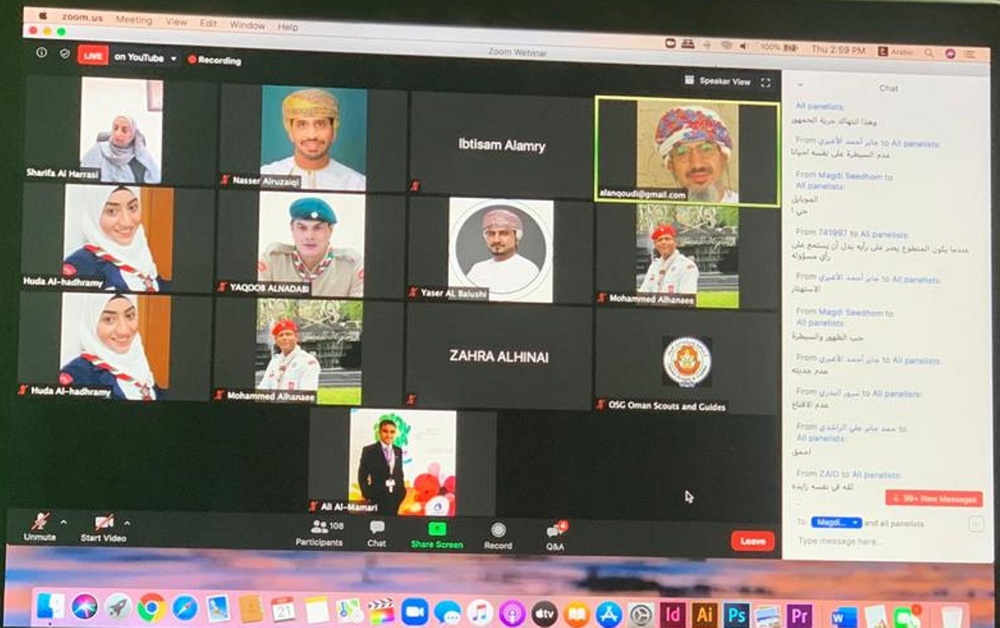
The conclusion of the first virtual training forum under the slogan “Effective Leadership and its Role in Crisis Management”
MUSCAT May 21 (ONA) The first video-conferencing training forum organized by the General Directorate of Scouts and Girl Guides concluded its activities today under the slogan “Effective Leadership and its Role in Crisis Management” during the period from 16 to 21 of the current month through the Zoom program.
Ibtisam bin Abdullah Al-Amiriya, Assistant Director General for Girl Guides Affairs, delivered a speech in which she emphasized the success of the forum, as the number of participants in the forum reached 800 from inside and outside the Sultanate. The forum succeeded in providing the participants with the necessary skills that help them to face the conditions and develop their capabilities in the field of preparing strategies to face crises and mechanisms for dealing with the disaster economy, in addition to investing the times of the scout and guide movement members in order to contribute to raising their training capabilities efficiently and competently. The forum was attended by experts, academics, educators and health members from inside the Sultanate and from the Arab Scout Organization.
She added that five workshops were held during the forum, which dealt with a number of important topics that recorded remarkable presence, interactions and discussions that enriched these sessions, which contributed to enhancing skills and consolidating many important concepts that help young people to creative thinking, effective leadership and proper behaviour in times of crises.
Then Dr. Zahir bin Ahmed bin Matar Al-Anqoudi, Senior Consultant of Family Medicine at the Ministry of Health, delivered a session entitled “Protection of volunteers in health crises”. He said that planning increases the effectiveness and timing of disaster and emergency response, helps to ensure the consistency of relief provision, avoids duplication and easily solves problems, along with its importance as an effective way to build strong relationships with operational partners, and helps to strengthen and secure an effective response and relief process.
The lecturer emphasized that disaster management needs an integrated and coordinated system between environmental, technical and human systems, explaining the importance of harmonizing these systems effectively. He added that the protection of the volunteer should cover the procedures for road safety, security, physical and psychological health, as well as legal protection. He explained that the protection of volunteers in terms of health includes assessing the medical needs of the volunteers including immunizations and aids, taking vaccinations and medicines appropriate for emergencies, coordination with the institutions related to protection in addition to administrative and legal coordination and providing communication plans and the transfer of information and knowledge.
The closing session recommended the importance of making a contingency and crisis plan for community institutions and linking it with other national plans, in addition to providing legislation and regulations to protect volunteers.
(ONA)