
Provinz Dakhiliyah
Ad-Dakhiliyah gehört mit seiner reichen Geschichte, kulturellen Bedeutung und zentralen Lage zu den bedeutendsten Gouvernements Omans. Es dient als strategisches Rückgrat des Landes und ist ein zentraler Verbindungspunkt zu den umliegenden Gouvernements.
Das Gouvernement ist nicht nur ein landwirtschaftliches Zentrum, sondern auch historisch und kulturell prägend für den Oman. Es besteht aus neun Wilayats: Nizwa, Bahla, Manah, Al-Hamra, Adam, Izki, Samail, Bidbid und Jabal Akhdar. Das Verwaltungszentrum ist Nizwa. Die Bevölkerung beträgt 558.419.
Zu den wichtigsten Sehenswürdigkeiten zählen Jabal Akhdar und Jabal Shams, die für ihre spektakulären Landschaften und das angenehme Klima bekannt sind. Weitere Attraktionen sind das Fort von Nizwa, das Fort von Bahla, das Schloss Jibrin, das Dorf Al-Abriyeen in Al-Hamra sowie alte Dörfer wie Al-Busaid in Adam, Al-Bilad in Manah, die Jurnan-Höhle in Izki und die Moschee Al-Mudhmar in Samail. Der Gouvernorat beherbergt traditionelle Märkte in Nizwa, Bahla und Bidbid. Zu den bedeutendsten traditionellen Bewässerungssystemen gehören Falaj Daris in Nizwa, Al-Khatmeen in Barkat Al-Mawz und Al-Malki in Izki. Das Museum „Oman Across Ages“ in Manah bietet einen tiefgreifenden Einblick in die Geschichte des Landes.
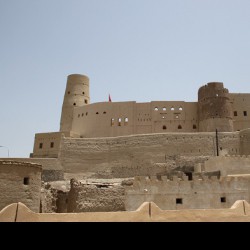
The Wilayat of Bahla
The Wilayat of Bahla is one of the most important archaeological sites in the Sultanate of Oman, as it contains many castles and forts, in the forefront of which is Bahla Fort, whose construction dates back to the pre-Islamic era. Because of its international historical significance, UNESCO has included Bahla Fort in the World Heritage List. Bahla is distinguished by its surrounding wall, which is about seven miles long, to protect it from external aggressions in ancient times. This wall has seven gates. There are other forts in Bahla, one of which is in the village of Bisiya, which is the multi-tower fort while the second in the village of Al-Uqair, which contains a fortress and two towers. In addition, it has an old market beside the fort in the town of Bahla.
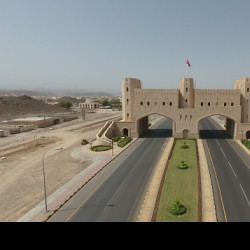
The Wilayat of Samail
It is one of the wilayats of the Governorate of Al Dakhiliyah. It is about 85 km away from the capital, Muscat. about 85 km. The Wilayat of Samail is bordered to the north by the Wilayat of Bidbid, to the south by the Wilayat of Izki, to the east by the Wilayat of Al-Mudhaibi, and to the west by the Wilayat of Nakhal. The Wilayat of Samail includes about 115 castles, forts and towers, but the most important of them is the Samail Fort, which is located in one of the mountainous highlands in the city centre and its castle, Al-Shahba, with a tower called “Burj Al Dawa”. The wilayat also includes about 300 ancient monuments, the most important of which is the Great Companion Mosque Mazin bin Ghadhouba and the “Qiblatain” Mosque. The falajs, in addition to springs and green oases, are among the prominent tourist attractions in the wilayat, whose number reaches about 194 falajs. The most famous of which is the “Samdi” falaj. The Wilayat of Samail is known as “Al-Fayhaa” for its abundance of green oases, orchards, and adjacent trees. Palm trees abound, especially the fardh palm, which is the emblem of the Wilayat of Samail. There are about 15 springs in Samail.
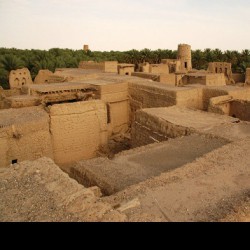
The Wilayat of Adam
It is one of the wilayats of the Governorate of Al-Dakhiliyah. It is located in the southern side of Al Dakhiliya Governorate, bordered to the north by the Wilayats of Manah and Bahla, to the south by the Wilayats of Mahout and Haima of the Governorate of Al Wusta, to the east by the Wilayat of Al Mudhaibi of Al Sharqiyah North Governorate, and to the West by the Wilayat of Ibri of Al Dhahirah Governorate. It is about 223 km away from the Governorate of Muscat. It takes Adam Grand Mosque and the Fardh palm tree as its symbol. There are a number of archaeological monuments in the Wilayat of Adam, the most important of which are mosques, such as Al-Muhallab bin Abi Sufra, Al-Rahba, Al-Hawashim, Al-Shayabnah and Al-Rogha. As for castles and forts, the most prominent of which are the two forts of Falaj Al-Ain, the two forts of Falaj Al-Maleh and Adam's Castle. The number of towers in the wilayat is estimated at about thirty. In addition to the ancient monuments of castles, forts, towers, and ancient mosques, there are also several sites in the Wilayat of Adam that can be placed among the monuments. The Wilayat of Adam has also several old neighbourhoods which gave birth to men who had fame and reputation and contributed actively to shaping and making Omani history. Most notably is the neighbourhood of Al-Busaid Mosque, which takes an oval shape, where the founder of the royal family, Imam Ahmed bin Saeed was born. His house is still standing today. It also has Al-Shayabnah neighbourhood, which the historical sources to the region indicate that it was a meeting place for commercial caravans at the time of pre-Islamic times and Al-Ayn neighbourhood, which witnessed the birth of the great scholar Darwish bin Jumaa Al-Mahrouqi, the author of Kitab al-Dala’il fi al-Lawazim wal-Wasa’il. The list of the prominent scholars who were born in the Wilayat of Adam also includes Al-Muhallab bin Abi Sufra, Muhammad bin Saif Al Shaibani, and Hassan bin Harmal Al Mahrouqi. In addition to those historical neighbourhood and political and scholarly figures born in the Wilayat of Adam, three tourist springs are joining the convoy of tourist attractions: Ayn Al-Rakhim and Ayn Al-Jandali, which are located at the foot of Mount Sallakh and Ayn Namah, which is located on the banks of Wadi Halfin. As for the falajs, there were 24 falajs, but twenty of them were subject to drought and extinction throughout the years, leaving only four falajs.
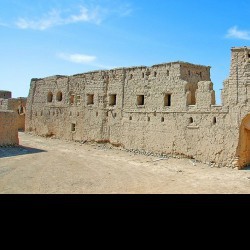
The Wilayat of Izki
It is one of the wilayats of the Governorate of Al Dakhiliyah. It is bordered by Al-Jabal Al-Akhdar from the west, by Manah and Nizwa from the west and south, and by Samail from the north, and by Al-Mudhaibi in Al Sharqiyah North Governorate from the east. Its area is about 2500 km2 and it is about 138 km away from the capital, Muscat. It takes Falaj Al-Malki as its symbol. Monuments are still a testament to the ancient legacy of the wilayat. There are approximately 142 towers, three castles, one of which is Al-Aawamir Fort and two forts in the wall of the village of Al-Qaryatayn. In addition, it has a number of archaeological houses, the most important of which are Al-Nizar and Al-Yameen. There is also a large fort, some of whose parts have been damaged throughout the years, which was built during the reign of Sayyid bin Sultan. Among the most prominent tourist attractions in the wilayat is Falaj Al-Maliki, which is named after Malik bin Fahim Al-Azdi, as well as Ghar and Jarran Falaj, about which many fiction and real stories are narrated.
The Wilayat of Manah
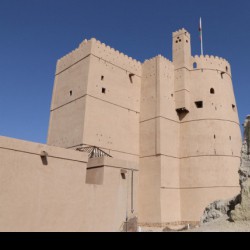
It is one of the Wilayats of the Governorate of Al Dakhiliyah. It is bordered by the Wilayat of Adam to the south, the Wilayat of Izki to the east and north, and the Wilayat of Nizwa to the west. It is about 160 km from the capital, Muscat. Some of the important archaeological sites in the Wilayat include Al-Faiqain castle, Al-Bilad castle, another castle in the village of Ma’mad, and an old fort in Al-Maadi in addition to the old mosque that was built during the time of Imam Omar bin Al-Khattab Al-Kharousi, as well as the Al-Sharah mosque. All of them were restored during the years of the Omani modern renaissance led by His Majesty Sultan Qaboos bin Said. There are many tourist attractions in the Wilayat of Manah. There is a spacious cave in the old village of Harat Al Bilad surrounded by the ancient wall. It is said to be hiding places during the war for women and children. There is also a subterranean vault located in one of the ancient houses in Al Faiqain. There are ancient ruins on the mountain Bou Sarrouj, including houses for commercial stone-built halls. Close to it to the south, there is a rock with writings, which reads: ‘From Ibrahim, Khalil Allah, we met in this place seventy horsemen, neither they were from Manah nor were from Nizwa.’ Legend surrounds the Az al Qadim mosque regarding a rock with a footprint of a person. It is said that a 100 kg rock was moved by a visitor to the mosque, which he took with him on his travels south. The next day, upon waking, the man noticed the rock had gone, only to be found back in the mosque. Furthermore, the Wilayat of Manah has two water springs: Ayn Al-Bilad and Ayn Al-Ma’iyah. It is also estimated that there are more than 13 falajs.
The Wilayat of Bidbid
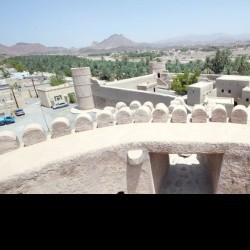
It is one of the wilayats of the Governorate of Al Dakhiliyah. It is bordered to the north by the Wilayat of Seeb, to the south by the Wilayat of Samail, and to the east by the Wilayat of Dima W'attayeen. It is approximately 71 km from the city of Muscat. The emblem of the wilayat is the bridge of Fanjaa. Bidbid nature combines mountains and plains crossed by valleys. It has mountain ranges such as Jabal Al-Hamar and Jabal Hameem. It has also many valleys, including wadi So’al which has water springs. The number of towers in various parts of the wilayat is estimated at about 40, the most famous of which are the Fanjaa tower, the Al-Mansheira towers, and the Naqsi castle. Among its tourist attractions are Ayn Qu’aid and other tourist areas in Naqsi and Handroot. There are also a number of falajs, the most important of which are the “Al-Raha” falaj, and the Al-Hamamiyat falaj in Fanjaa.
The Wilayat of Al Hamra
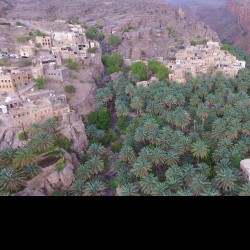
It is one of the Wilayats of the Governorate of Al Dakhiliyah. It is located in the northwestern side of Al-Jabal Al-Akhdar. It is bordered to the north by the Wilayat of Rustaq, to the south by the Wilayat of Bahla, to the east by the Wilayat of Nizwa, and to the west by the Wilayat of Ibri. It is located at an altitude of 580 meters above sea level. The Wilayat of Al-Hamra was established During the rule of the Yarubi dynasty, and its location was known as Qadam. This wilayat took the fortress of Sharia as its symbol. Since the introduction of Islam to Oman, this area, like others, has established a number of mosques. The most prominent was Al-Arid Mosque, which has a capacity of about 1,000 worshipers, and consists of 26 pillars, which indicates the size of human density in that spot at the time. As it dates back to the fourth century AH, it is considered an important heritage. As for Al-Qaria mosque, it is located to the east of the Wilayat of Al-Hamra and can accommodate about 200 worshipers. It is also an Islamic archaeological site. In addition to the historical sites striking in the depths of time in this wilayat, which is an important tourist aspect, there are other tourist attractions, the most important of which are: Beit Al-Nu’ma, which is an architectural masterpiece by the standards of its time, and the village of Al-Nakhr, which is famous for its mild weather throughout the summer months, as well as many of hollows and caves. In view of the natural composition of the Wilayat, mostly from rocks and mountains, valleys descended from the tops of those mountains, which led to the creation of wonderful landscapes. Among the most important valleys of the Wilayat are Al-Nakhr, Shahma, Al-Maleh, and Wadi Ghoul, which is located along the course of the dam known by the same name. Wadi Ghoul Dam is located about 3.8 km northwest of the Wilayat of Al-Hamra, and its length is 415 meters. It was implemented in November (1989 AD), at a cost of one million and 200 thousand riyals. It aims to improve the status of groundwater that feeds the “Falaj Al Hamra” as well as existing agricultural wells, to secure the water needs of existing farms. It also aims to benefit the falajs and wells near the Wilayat of Bahla to achieve new agricultural development. Falajs are one of the most important water sources on which agriculture depends in the Wilayat of Al-Hamra, but a large area of agricultural land depends on wells, especially in the area of Wadi Al-Khor.
The Wilayat of Nizwa
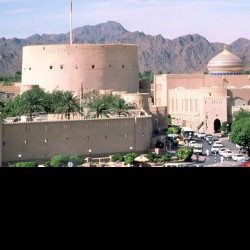
It is one of the Wilayats of the Governorate of Al-Dakhiliyah, located on the southern foot of the Jabal Al-Akhdhar, which borders it from the north side. It is bordered by the Wilayat of Manah from the south side, by the Wilayat of Izki from the east and by the Wilayat of Bahla from the west. It is located at an altitude of 450 meters above sea level and about 174 km away from the capital Muscat. It is the regional centre for the Al-Dakhiliya Governorate, and it takes its famous fort as its symbol. One of its most famous features is Nizwa Fort, which was built during the era of Imam Salt bin Malik and was the seat of the governor. It is also famous for its jama (grand mosque), which was a beacon of knowledge where Friday prayers are held at the time of the imams. Nizwa has a number of renowned mosques, such as So'al Mosque which was built during the reign of Imam Salt bin Malik in the 2nd century AH, Ash-Shawathinah Mosque, which belongs to its founder Issa bin Abdullah bin Shathan and Ash-Sharjah Mosque built in 727 AH in So’al. There are also Al-Ain Mosque, built by Imam Al-Muhanna bin Jaifar and Ash-Sheikh Mosque which was built by the scholar Bashir bin Al-Mundhir during the reign of Imam Al-Julanda bin Masoud and Shuraij Mosque in Tanuf built in the reign Omar bin Nabhan in 377 AH. There are also three forts, one of which is "Tanuf" in the village with the same name, and the other is “Beit Saleet” which is located in Nizwa. Falajs and springs, which represent wonderful tourist attractions, are spread all over the Wilayat. There are more than 89 springs and falajs, the most important and most famous of which is the “Daris” falaj, which is characterized by its vastness, wide expanse and fresh running water. In addition to these falajs and springs that represent wonderful tourist attractions, Al Jabal Al-Akhdar with its agricultural surfaces with exquisite geometric gradients, and its cold climate are among the most famous tourist attractions in the governorate. In addition, Nizwa is known for its traditional market, which has been recently renovated while retaining its distinctive historical character.


Traditional Crafts
In spite of the development and progress achieved by Omani society in all aspects of life, the preservation of the Omani heritage is a fundamental pillar of the modern state and a distinctive feature of the Omani society. Heritage is an essential element in the formation of national identity. Despite the tremendous development of tools and means of production. Omani crafts include: Ship (Dhow) Building Oman's connection with the sea stretches back many centuries when Omani sailors using mast and sail, pioneered sea routes to the cities of the ancient world. Favorable factors were Oman's position at the crossroads of shipping routes which linked the Arabian Gulf to India, the Red Sea and East Africa and her knowledge of shipbuilding. Oman became the first non-European country to extend its influence to Africa where it remained for hundreds of years, due mainly to her ships/dhows. Oman was an important maritime and political power who established relations with China, Great Britain, France, the Netherlands and the United States of America. Throughout its long history, Oman's navy has played a key role in the country's economic success, both in providing the instrument for internal and external trade and in underpinning fishing and pearling activities. The Omani warship "The Sultana" which anchored in New York harbour in 1840, bearing gifts from Sultan Said bin Sultan to the American President, was a symbol of the greatness of the Omani fleet at that time. In Oman two techniques are used in shipbuilding. In the first, timbers are laid side-by-side and pierced at intervals with a fine hand drill. The timbers are then bound together through these holes by means of rope made of coconut fibre and the holes covered with a mixture of fibre or raw cotton soaked in fish, coconut or sesame oil. Arab geographers such as Al Idrissi and Ibn Jubair believed that boats bound with fibres and with flat hulls were safer than those fitted together with rigid iron nails because if they ran onto rocks or came into contact with another hull, they were more flexible. In the second method, nails are used and in essence this is the same technique as used in other countries of the Arabian Gulf and Red Sea. The main type of wood used for the hull and keel is teak which is imported from India. The ribs are made from locally available woods such as qart, sidr and sarar. The tools used in a ship's construction are simple and basic such as the hammer, saw, awl, bow drill, chisel, plane and calking iron. The principal shipbuilding yards in Oman were Sur, Mutrah and Shinas. Omani ships, which can last for 60-100 years, are distinguished by their variety of types although some are no longer made. The largest type was the ocean-going cargo vessel, the baghlah with a length of 135 feet and a load capacity of 150-400 tonnes which could be distinguished by its high poop deck and quarter galleries, its transom stern being pierced by five window apertures and often elaborately carved. The ghanjail was very similar to the baghlah, and is considered by many Omanis to be the most beautiful of the large dhows.The sambuuq used to be one of the most commonly seen Arab vessels: its distinguishing features are the low, curved, scimitar-shaped stem piece and high square stern which lacks a quarter gallery. The word sambuaq used to denote the sewn boats of the Dhofari coast, and may therefore be a term of great antiquity. The government is keen to encourage the maritime tourist industry, in restoring old ships, increasing the use of large vessels/dhows for sea fishing, and also the building of small models of Omani ships for decorative purposes and for i participating in exhibitions. HALWA Omani halwa (sweet) is famous at home and abroad as a symbol of traditional Omani hospitality. It is usually served in Omani homes before drinking Arabic coffee. The main ingredients which go into the making of halwa are: starch, eggs, sugar, water, ghee, saffron, cardamom, nuts and rose water from the Jebel al Akdhar. The ingredients are mixed, in proportions and quantities known only to the skilled halwamaker, and cooked in a mirjnl (large cooking pot used especially for halwa) for a time of not less than 2 hours. The cooking can be done over a gas or electric stove, but the preferred method is over a wood fire made up of snmr wood, known for its durability, smoke and odourfree properties. After cooking, the halwa can be preserved for more than four months without losing its quality, and without the need for refrigeration or preserving agents. Halwa is usually served in a dist, a large earthenware bowl, which can vary in size and composition according to demand or type of occasion. The list can also be made of metal or plastic. Halwa is invariably served at times of joy or sorrow and, on religious occasions and festivals. It graces the tables of every Omani home. Palm leave products The Palm leave products depends on palm trees. There are Al Khaws (palm leaves), the Zawr (palm branches stripped of their leaves), the palm trunk and the fibre. For example, mats(rugs) are made of the two plants called Al Ghadf and Al Rusul which grow on the valley banks where there is an abundance of water. Governorate of Musandamis renowned for its palm leaf industries, such as utensils (Al Surood and Al Makba) which are made from palm leaves. Al Surood is a mat-shaped tray known as Sama, used with food to protect it from insects, while Al Makba fulfils the same purpose. Daggers and Swords A normal or hooked dagger is the most important component of the Omani dress. Omanis are keen to acquire daggers and appear wearing them at official events, national celebrations and weddings. Due to the succession of this social custom from one generation to another, the dagger-making industry has survived the passage of time, albeit with modern improvements. The Omani dagger is an authentic heritage the present generation is keen to pass on to their children. The dagger is also a symbol of manhood and pride among Omani men, who wear it on their leather belts over the dishdashah (long outer garment). Its front section is made of small connected silver pieces, or it may be elegantly embroidered with silver or gold threads. A dagger’s price is determined by the raw material it is made of, usually iron, silver or gold. Although silver daggers are the most common, especially for making the dagger handle, the blade case too determines a dagger’s price. There is the giraffe case, which is the most expensive because it has been banned, and cases made of buffalo skin, sandalwood, and the bitter orange tree. Silver wares The silver industry occupies a key place in the history of Oman. Omani silver jewellery is characterised by a rich sense of the aesthetic and reflects the unique taste of the country’s authentic art, deeply rooted in its history. Silver in Omani society is reflective of its rich social and religious symbols. The Omani dress, whether that of women or men, is never complete without silver jewellery that adds to its beauty, especially apparent in the Omani khanjar (dagger). The Pottery The art of pottery-making is an inherent and distinct testimony to the world’s civilisations as it reflects the extent of their development and advancement. Though pottery-making is one of the simplest forms of art because of its primitive nature, it is in fact, one of the most difficult trades because it involves a form of art. Pottery-making in Oman is considered an ancient industry. The reason it has attracted much interest can be attributed to the multitude of its uses in Omanis’ daily lives. Bahla in A'Dhahirah Governorate is the most famous town for pottery-making in Oman. Pottery is of many kinds and shapes, and its uses and manufacturing materials vary. The pots known as jihal are used for keeping water, the red pots with a thick layer known as khuroos are used for keeping water and dates, the small ones are for keeping honey and grease and the pots known as brams are used as cooking utensils. Pottery is also made as coffee pots and thermoses. Clay is the main component of Pottery and is widely available in Bahla in A'Dhahirah Governorate, where the soil is rich in clay.


